ISO 14001 is the world’s environmental management system standard — the requirements document, published by the International Organization for Standardization, against which an organization can build, and be certified for, a system that manages its environmental responsibilities on purpose rather than by accident. The current certifiable edition is ISO 14001:2015. A revision has been working through the ISO process and is widely expected to publish in 2026 — which is why searches for “ISO 14001:2026” exist before the document does; until it lands, 2015 is the text auditors certify against, and transition periods follow publication, not anticipation. This page covers what the standard requires, how certification works, and what the revision is expected to change.
What an EMS actually is
A management system is the difference between effort and machinery. Plenty of companies do environmental things — recycle, report, respond to spills. ISO 14001 asks whether those things are a system: a policy signed by leadership, a register of the organization’s environmental aspects and impacts (what it uses, emits, discharges, and risks), a register of the legal obligations that attach to those aspects, objectives with owners, operational controls where the impacts live, and a review cycle that checks whether any of it worked. The standard is built on Plan-Do-Check-Act, the improvement loop it shares with ISO 9001 and ISO 45001 through the common Annex SL structure — which is why organizations routinely run the three as one integrated system with three certificates on the wall.
The requirements, in working order
Context and leadership (Clauses 4–5): understand the organization, its interested parties, and its obligations; leadership owns the environmental policy and the system’s results — delegation of the paperwork is allowed, delegation of the accountability is not. Planning (Clause 6): the aspects-and-impacts register, scored for significance; the compliance obligations register; risks and opportunities; and objectives that descend from both. Support and operation (Clauses 7–8): competence, awareness, communication, documented information, operational control of the significant aspects (including over outsourced processes and contractors), and emergency preparedness for the incidents the aspects register predicted. Evaluation and improvement (Clauses 9–10): monitoring and measurement, evaluation of compliance against the obligations register, internal audit, management review, and corrective action when the system or the environment says something failed. Read as a story, it is one sentence long: know your impacts, know your obligations, control both, check, and fix — with receipts.
Certification: how it works
Certification is a third-party audit on a three-year cycle. An accredited certification body runs a Stage 1 documentation review and a Stage 2 implementation audit; major nonconformities must close before the certificate issues; surveillance audits follow in years one and two, recertification in year three. Certificates are scoped — to sites, activities, and operations — and the scope statement is the first thing a competent customer reads, because an EMS certified for the head office does not describe the factory. Within this site’s territory, ISO 14001 shows up most often inside compliance frameworks conversations and customer questionnaires: manufacturers, construction firms, and facilities operators are asked for it by buyers who need environmental diligence they can file, and it answers alongside the reporting regimes mapped in the regulatory frameworks guide.
The 2026 revision: what is expected
An amendment, not a reinvention. The revision in process is expected to refresh the 2015 text rather than replace its architecture: clearer requirements wording, strengthened emphasis on climate — already forced into the standard’s context clauses by a 2024 amendment that requires organizations to determine whether climate change is a relevant issue — and closer alignment with the current Annex SL. Organizations certified to 2015 should plan on a transition window after publication (recent ISO transitions have run about three years) during which surveillance audits migrate them to the new text. The practical advice is unglamorous: keep the current system genuinely running, because a living 2015 system transitions in paperwork; a paper one transitions in pain. And note the honest caveat that belongs on every “2026” page until the document exists: specifics of the revision are known when ISO publishes it, not before.
Frequently asked questions
What is ISO 14001?
The international standard for environmental management systems: requirements for how an organization identifies its environmental aspects and legal obligations, sets objectives, controls operations, checks compliance, and improves — auditable by third parties and certifiable. The current edition is ISO 14001:2015.
Is there an ISO 14001:2026?
Not yet published. A revision of the 2015 edition is in the ISO process and widely expected in 2026. Until it publishes, ISO 14001:2015 remains the certifiable text; a transition window (typically around three years for recent revisions) follows publication.
What is the difference between ISO 14001 and ISO 14064?
ISO 14001 certifies a management system — how the organization runs its environmental affairs. The ISO 14064 family concerns greenhouse gas quantification and verification — how emissions are counted and checked. Companies often use both: 14064 discipline for the numbers, 14001 machinery for the management.
Who needs ISO 14001 certification?
Nobody by statute, in most jurisdictions — it becomes necessary through markets: customer contracts and questionnaires, tenders, and supply-chain codes that ask for a certified EMS. Manufacturers, construction and facilities firms, and any business whose environmental aspects are significant relative to its size feel the demand first.
Net zero means cutting greenhouse gas emissions as close to zero as possible, and neutralizing what remains. The balance is the whole concept: emissions still going into the atmosphere are matched by emissions removed from it, so the net addition is zero. It is the state the IPCC’s pathways require for the global economy — net-zero CO2 around mid-century for the 1.5°C limit — translated into a target that governments and companies have adopted by the thousand. It is also a phrase stretched over very different levels of seriousness. This page is the definition, the distinctions that keep it honest, and the tests that separate a net zero plan from a net zero slogan.
The definition, precisely
Net zero is a balance across all greenhouse gases, achieved primarily by reduction. The gases are counted in CO2-equivalent across the emitter’s full footprint — Scope 1, 2, and 3, the framework this site teaches in its carbon accounting guide. The sequence is not optional in any credible version: deep reductions first — the Science Based Targets initiative’s Corporate Net-Zero Standard, the most widely used corporate benchmark, expects reductions on the order of 90 percent against the baseline — and only the residual, genuinely hard-to-abate remainder is neutralized with removals. A “net zero” claim that begins with buying instruments against an unchanged footprint is not an early version of this. It is a different thing wearing the name.
Net zero versus carbon neutral: the distinction that matters
Carbon neutral is the older, weaker claim. It typically covers CO2 only (not all greenhouse gases), often covers only part of the footprint, and historically allowed the balance to be struck with avoidance credits — paying for emissions not to happen elsewhere — with no requirement that the claimant’s own emissions fall. Net zero, in its standardized forms, is broader in gases, fuller in scope, and insists on the claimant’s own deep reductions plus durable removals for the residual. In practice the labels on real claims vary wildly, so the working rule is to ignore the banner and read the boundary: which gases, which scopes, what reduction before any neutralization, and what kind of removal. Four answers that turn a slogan into an auditable claim — or reveal that it is not one.
Removals: what may balance the residual
Only removals count, and durability is the argument. Neutralization means taking CO2 out of the atmosphere and storing it — reforestation and ecosystem restoration at the biological end, direct air capture with geological storage at the engineered end. The debate inside net zero is about permanence and timing: a tonne stored in a forest that burns in thirty years does not balance a tonne emitted today in the way a tonne in basalt might, and credible standards are tightening around that difference. This is also where carbon credits — treated in depth in this site’s guide to carbon credits and the GHG Protocol — must be read carefully: credits representing avoided emissions are a finance contribution to someone else’s reduction; they are not removals of your own.
Why companies adopt it — including the hard reason
The public reasons are climate alignment and stakeholder expectation; the hard reason is transition risk. A company whose footprint stays high is short a position against carbon pricing, disclosure law, customer procurement rules, and the physical exposure of its own assets — the complex this site examines in transition risk and stranded assets. A net zero target with a real reduction pathway is the management answer to that position: it converts an unbounded future liability into a sequenced capital plan. That is also the honest way to judge any company’s target from outside — not by the date in the headline, but by whether the interim milestones, the capital allocation, and the scope boundary look like a plan an operator could actually execute.
The five tests of a credible net zero claim
Boundary: all three scopes, or an explained and immaterial exclusion. Baseline: a stated year with a published footprint, so progress can be checked. Sequence: reduction commitments on the order of 90 percent before neutralization, with dated interim targets — a 2050 promise with no 2030 number is a wish. Removals: neutralization reserved for the residual, with durability addressed rather than assumed. Disclosure: progress reported on the same boundary as the pledge, including the years it went backwards. A claim that passes all five is rare and worth crediting. A claim that fails the first is not yet a claim at all.
Frequently asked questions
What does net zero mean?
A balance: greenhouse gas emissions cut as close to zero as possible, with the small residual neutralized by removals from the atmosphere, so the net addition is zero. Credible versions require deep reductions first — around 90 percent in the Science Based Targets initiative’s corporate standard — before any neutralization.
What is the difference between net zero and carbon neutral?
Carbon neutral is older and weaker: usually CO2 only, often a partial footprint, and historically balanceable with avoidance credits without reducing the claimant’s own emissions. Net zero spans all greenhouse gases and the full footprint, requires deep own-reductions, and reserves durable removals for the residual.
By when must the world reach net zero?
IPCC pathways limiting warming to 1.5°C reach net-zero CO2 around 2050, with net-zero greenhouse gases later in the century. Company and country targets cluster around 2050 for that reason — the date comes from the carbon budget, not from fashion.
Can a company reach net zero by buying carbon credits?
Not credibly, if the credits substitute for reducing its own emissions. Credits that finance reductions elsewhere are a contribution, not neutralization. The standardized sequence is: measure the full footprint, reduce it by roughly 90 percent, and neutralize only the residual — with removals, whose durability has to be addressed.
The triple bottom line is the idea that a business should be measured on three results, not one: profit, people, and planet. Coined by John Elkington in 1994 and developed in his 1997 book “Cannibals with Forks,” it proposed that a company’s real performance shows in its financial return, its effect on the humans it touches, and its effect on the environment it draws from — and that managing only the first of the three is how businesses become profitable and fragile at the same time. It is one of the ancestor concepts of ESG, older than the acronym by a decade, and its history contains a twist worth knowing: its own creator later tried to recall it.
The three Ps
Profit in the triple bottom line is not the quarterly number alone; it is economic value created sustainably — the business as a going concern that pays its way, including the taxes, wages, and supplier income it generates in the places it operates. People covers everyone the business touches: employees (safety, pay, development, dignity), customers (product safety and honest dealing), suppliers (fair terms, no exported exploitation), and communities (the jobs and the burdens landing in the same postal code). Planet covers the physical ledger: energy, emissions, water, waste, land — the resources drawn down and the damage left behind, measured in the units this site’s carbon accounting guide exists to teach.
What the idea actually asks of a company
It asks for management, not bookkeeping. Elkington’s original provocation was that the three results interact: a company that profits by degrading its workforce and its watershed is borrowing from its own future, and the loan comes due — in turnover, in regulation, in the loss of the social license that lets it operate at all. The discipline the triple bottom line demands is noticing the trade-offs while they are still cheap: the supplier squeeze that becomes next year’s scandal, the deferred maintenance that becomes the spill, the workforce practice that becomes the lawsuit. Read generously, it is an early-warning philosophy, not an accounting method — and it sits upstream of the structured risk view in this site’s ESG risk explainer.
The recall: what Elkington said in 2018
In 2018, Elkington publicly proposed a “recall” of his own concept — writing that the triple bottom line had been reduced, in practice, to an accounting framework: three columns that let companies report a good year for people or planet against a bad one and call the sum responsibility, without changing the underlying business model. His complaint was not that the three measures were wrong but that they had become a trade-off machine — profit permitted to buy absolution — when he had intended a transformation agenda. It is a rare and useful moment in management ideas: the inventor grading the implementation. Anyone using the triple bottom line today should know the recall happened, and what it was actually about.
Triple bottom line versus ESG
They are relatives, not synonyms. The triple bottom line is a philosophy of what a company is for, voiced from inside the company. ESG — coined a decade later — is a measurement and disclosure system aimed largely at investors judging companies from outside. TBL asks “what did we do to people and planet, alongside profit?” ESG asks “how do environmental, social, and governance factors affect this company’s risk and value, and can it prove its answers?” A company can practice the triple bottom line with no ESG reporting at all, and can produce immaculate ESG disclosures with no philosophy behind them. The mature position uses the first as the compass and the second as the instruments — and knows which is which, especially when regulators come asking for the instrument readings, as this site’s compliance frameworks map lays out.
Frequently asked questions
What is the triple bottom line?
A framework, coined by John Elkington in 1994, holding that a business should be judged on three results — profit, people, and planet — rather than profit alone. It argues the three interact, and that profit built by degrading the other two is borrowed from the company’s own future.
Who created the triple bottom line?
John Elkington, founder of the consultancy SustainAbility. He coined the term in 1994 and developed it in his 1997 book “Cannibals with Forks.” In 2018 he proposed a “recall” of the concept, arguing it had been diluted into an accounting trade-off exercise.
What are the three Ps of the triple bottom line?
Profit (durable economic value), People (effects on employees, customers, suppliers, and communities), and Planet (effects on emissions, resources, and ecosystems). Some later versions rename them People, Planet, Prosperity — the substance is the same.
Is the triple bottom line the same as ESG?
No. The triple bottom line is an internal philosophy of what a company is for; ESG is an external measurement and disclosure system developed for investors. They share ancestry and concerns, and are often used together — compass and instruments — but they answer different questions.
ESG stands for Environmental, Social, and Governance — three categories of non-financial factors used to judge how a company actually behaves, as distinct from what it earns. The term was coined in 2004, in “Who Cares Wins,” a report produced under the UN Global Compact with major financial institutions, which argued that these factors belonged inside investment analysis rather than beside it. Two decades on, ESG is simultaneously a risk discipline, a reporting industry, a regulatory subject, and a political argument. Most confusion about the term comes from using one of those meanings when you needed another. This page separates them.
The three pillars, in plain terms
Environmental covers a company’s physical footprint and physical exposure: the emissions it produces (measured through the Scope 1, 2, and 3 framework this site details in its carbon accounting guide), the energy, water, and materials it consumes, the waste and pollution it generates, and the climate and nature risks its assets sit inside. Social covers its treatment of people: workforce safety and labor practices, human rights in its supply chain, product safety, data privacy, and its standing with the communities it operates in. Governance covers how it is run: board independence and oversight, executive pay, audit quality, shareholder rights, business ethics, and — the piece every other pillar quietly depends on — whether the disclosures themselves can be trusted.
What ESG is used for: the three jobs
As a risk lens, ESG is how investors and lenders surface exposures that financial statements report late or never: the factory in the flood zone, the supplier whose labor practices are a headline waiting to happen, the board that cannot say no to its founder. This is the original 2004 meaning, and this site’s treatment of ESG risk works in that register. As a reporting discipline, ESG is the machinery of measurement and disclosure — the frameworks, standards, and regulations (mapped in the regulatory frameworks guide) that increasingly require companies to publish their footprint and face questions about it. As a values screen, ESG is how some investors exclude or favor whole categories of companies — the meaning that draws the political fire. A reader who knows which job is on the table in any given document understands more about ESG than most of its debaters.
ESG is not the same as its neighbors
ESG is not sustainability, though the words are used interchangeably in casual speech. Sustainability names the goal — operating so the future remains possible. ESG names a measurement and disclosure approach aimed mostly at how environmental and social forces affect the company. ESG is not CSR. Corporate social responsibility is the older, voluntary practice of companies doing visible good; ESG grew out of the investment world’s demand for comparable, decision-grade data instead. And ESG is not impact investing, which sets out to produce measurable social or environmental outcomes as a primary goal. ESG analysis can inform all of these; collapsing them into one word is how the arguments start.
Why the ratings disagree — and why that is not the scandal it sounds like
Two agencies can rate the same company at opposite ends of the scale, and both can be doing their jobs. Academic research on the divergence — most citedly a 2022 study by Berg, Koelbel, and Rigobon — attributes most of it to measurement: agencies choose different indicators, estimate missing data differently, and weight the pillars differently, because there is no single agreed definition of what is being measured. A credit rating answers one question (will they repay?) with one unit. An ESG rating answers dozens of questions with dozens of units and then compresses them. The practical lesson for anyone consuming ESG data: read what a score actually measures before arguing with where it lands, and treat any single letter grade as the beginning of diligence, not its conclusion.
Where the argument stands
ESG the acronym has become politically contested in the United States — state-level rules restricting its use in public investing, federal disclosure rules adopted, challenged, and withdrawn or defended depending on the administration — while reporting obligations in Europe (the CSRD and its standards, followed on this site in the CSRD roadmap) continue to make the underlying measurement compulsory for thousands of companies regardless of the label attached. The durable observation: the political argument is about the word and the values screen. The plumbing — emissions accounting, supply-chain diligence, governance disclosure — keeps being built by people who never use the acronym at all. Companies that understand which layer they are actually being asked about respond to both more calmly.
Frequently asked questions
What does ESG stand for?
Environmental, Social, and Governance — the three categories of non-financial factors used to assess how a company behaves and what risks it carries beyond its financial statements. The term was coined in the 2004 UN Global Compact report “Who Cares Wins.”
What is the difference between ESG and sustainability?
Sustainability is the goal — operating in a way that can continue. ESG is a measurement and disclosure approach, developed for investors, for judging how environmental, social, and governance factors affect a company and how the company manages them. They overlap heavily but are not synonyms.
Why do ESG ratings differ so much between agencies?
Because agencies measure different things. Research attributes most divergence to measurement differences — different indicators, different estimates for missing data, different weighting of the pillars — rather than to error. There is no single agreed unit being measured, the way there is with credit risk.
Is ESG a law?
ESG itself is a framework, not a statute. But specific disclosure laws increasingly mandate the underlying reporting — the EU’s CSRD, California’s climate disclosure laws, and various listing rules — so for many companies the measurement ESG describes is compulsory even where the label is not used.
Whole-life carbon assessment (WLCA) measures the carbon a building produces across its entire life — materials, construction, operation, maintenance, and demolition. In the UK right now, how that assessment gets done depends on where the project sits and which authority is asking, and new research from the Centre for Construction Best Practice (CCBP) puts numbers on the inconsistency: 70% of the practitioners it interviewed said current policy and regulation has weak or no influence on how WLCA is actually implemented.
That is the finding that matters. WLCA is supposed to turn carbon data into spending decisions — which design gets funded, which bid wins, which materials get specified. Data that cannot be compared from one project to the next cannot do that job, no matter how carefully it is collected.
What the CCBP research found
The Centre for Construction Best Practice opened its research in December 2025, and its initial phase ran 35 interviews and five focus groups with local authorities, contractors, and consultants. Three numbers from that work describe the current state of WLCA in UK public construction:
70% of respondents agreed that current policy and regulation had weak or no influence on the implementation of WLCA.
59% described the use of WLCA as selective — required on some projects, ignored on others.
58% described current policy as fragmented and inconsistent between authorities.
CCBP is now calling on the sector — contractors, consultants, engineers, planners, project managers, clients, and the wider supply chain — to submit evidence on how WLCA is used in public sector construction and infrastructure projects. Its full findings are due in 2027.
Why the inconsistency happens
There is no single national requirement, so individual local authorities have introduced their own guidance — and each local version asks for the assessment in a different way. The result is that the same building, assessed under two authorities' rules, can produce two different carbon numbers.
Conor Neild Crabb, CCBP's head of centre, described a clear common thread in the feedback: the way WLCA is approached varies significantly, and the inconsistencies have knock-on effects for the supply chain and for capital and operational spending. Michèle Young, principal development coordinator at the London Borough of Tower Hamlets, made the mechanism plain: requiring a WLCA lets authorities and industry engage in design discussions around carbon, but without a consistent national framework its potential to support net zero ambitions is limited — and the absence of a national requirement, such as the long-proposed Part Z of the Building Regulations, risks a fragmented approach that reduces the ability to compare outcomes.
Tom Roxburgh, senior sustainability consultant at Pick Everard, added the cost side: differing WLCA standards produce differing results, varying planning requirements and reporting demands have created a bloated assessment process, and one standard may cost more than another without providing better insight for reduction decisions.
What one consistent framework would have to fix
A single WLCA framework is not mainly a paperwork exercise — it has to fix five specific things before carbon data can drive spending and procurement decisions.
1. One methodology. The framework has to fix the boundary of the assessment: which life-cycle stages count, which materials and processes are in scope, and which calculation rules apply. Until two assessors measuring the same building are required to count the same things, their results are not measurements of the same quantity.
2. One trigger. WLCA is currently selective — required by some authorities on some projects. A consistent framework sets a national threshold for when an assessment is required, so the obligation does not change at a borough boundary. This is the role the proposed Part Z is meant to fill for embodied carbon in England.
3. Comparable outputs. Assessments have to report in the same format, against the same reference values, so a client can place two projects' results side by side and have the comparison mean something. Comparability is the property that turns an assessment into evidence.
4. Proportionate cost. When each authority's variant demands a new approach, project teams pay for the assessment process repeatedly — Roxburgh's "bloated" process. One framework means one approach learned once, priced once, and reused, which is what makes it reasonable to ask teams to spend money on carbon reduction rather than on compliance variation.
5. A link into decisions. The end point of the CCBP evidence call is whether consistency could help WLCA "have a greater influence on spending decisions." An assessment that is filed to satisfy a planning condition changes nothing. A framework earns its keep when the number it produces is wired into procurement scoring, design funding, and capital approval — the places where money actually moves.
Why this travels beyond the UK
The UK's WLCA problem is a specific case of a general pattern: carbon rules written at the local level, one jurisdiction at a time, produce data that cannot be compared across the line where the rule changes. Any market where building carbon obligations are set city by city or state by state should expect the same three symptoms the CCBP respondents named — selective use, fragmented policy, and weak influence on real decisions — until the methodology and the reporting format are standardized above the local level.
The sequence matters for practitioners everywhere: consistency first, then comparability, then influence. Carbon data starts driving spending only after the first two are in place.
Frequently asked questions
What is whole-life carbon assessment? Whole-life carbon assessment is the practice of quantifying a built asset's carbon emissions over its full life — extracting and manufacturing materials, transport and construction, operation and maintenance, and end of life — so design and procurement choices can be compared on carbon as well as cost.
What did the CCBP research find? In initial research involving 35 interviews and five focus groups, 70% of respondents agreed current policy and regulation had weak or no influence on how WLCA is implemented, 59% described its use as selective, and 58% described policy as fragmented and inconsistent between authorities. CCBP has opened an evidence call to the whole sector, with full findings due in 2027.
What is Part Z? Part Z is a proposed addition to the Building Regulations in England that would require the assessment — and potentially the limiting — of embodied carbon in new buildings. It is an industry-backed proposal, not current law. In the WLCA debate it stands for the missing piece: a national requirement that applies the same way everywhere.
When will the full CCBP findings be published? CCBP is continuing to gather evidence through its open call, and its full findings are expected in 2027.
Source: Construction Management, "The way we do whole-life carbon assessment is a mess, says Centre for Construction Best Practice" (October 2026), reporting CCBP's initial research and evidence call. Figures quoted are from CCBP's initial findings as reported; the research is ongoing.
On October 12, 2026, California’s Office of Administrative Law approved the Air Resources Board’s initial regulation for SB 253, and it took effect the same day. The first Scope 1 and Scope 2 emissions reports are due November 10, 2026.
The sentence most likely to get a board in trouble this month is “we don’t operate in California.” SB 253 coverage does not turn on where a company sits. It turns on global revenue and California sales — and a company with no California office, no California employees, and no California property can still owe CARB a report in 18 days.
This is the coverage test, the exemptions, and the part of the filing almost nobody plans for: whatever you submit becomes public.
The three-part coverage test
SB 253 — the Climate Corporate Data Accountability Act, Health and Safety Code section 38532 — applies to a “reporting entity” that meets all three tests:
Formed under U.S. law. Organized in California, another state, D.C., or by an act of Congress. A U.S.-formed subsidiary of a foreign-headquartered group can be covered in its own right.
More than $1 billion in total annual revenue. Revenue is measured globally, not by California sales, using the lesser of the entity’s two most recent fiscal years — one exceptional year does not pull you in, and one soft year does not let you out.
Doing business in California. CARB borrows the tax code’s definition (Revenue and Taxation Code section 23101) but adopted the sales-based test: an entity organized or commercially domiciled in California, or with California sales above the threshold — $735,019 for 2024 and $757,070 for 2025, adjusted over time. CARB did not adopt the property and payroll thresholds that also appear in the tax statute.
Read that third test again. Roughly three-quarters of a million dollars of California sales — a rounding error for a billion-dollar company — is enough. Physical presence is not required, and CARB has been explicit that the applicability determination is the entity’s own job: you run the test, and you keep the records behind your answer.
Who is out
The regulation excludes several categories outright:
Tax-exempt nonprofit organizations.
Entities regulated by the California Department of Insurance, or engaged in the insurance business in another state.
Government entities, and companies more than 50% government-owned.
Entities whose only California activity is wholesale electricity transactions.
Entities whose only California business is employee compensation or payroll — including paying people who telework from California.
If none of those describe you and the three tests are met, the question is no longer whether you file. It is what you file — and that is where the three doors into the first filing come in: report the data you had, or file the statement explaining why you are not reporting.
Whatever you file becomes public
Reports go to CARB through its Report Intake Platform (CARB’s preferred route) or by email to [email protected]. Companies that were not collecting emissions data as of CARB’s December 5, 2024 enforcement notice may instead submit a statement of non-reporting on company letterhead.
Both kinds of submission become public. That makes the November 10 filing a different exercise from most compliance paperwork: it is a document your competitors, your customers, ESG raters, and plaintiffs’ counsel will be able to read.
Two practical consequences follow. First, the non-reporting statement deserves the same care as the report itself — short, factual, and confined to the reason CARB’s rule allows: the data was not being collected as of December 5, 2024. It is not the place for commentary about the law. Second, the numbers in a full report should be numbers the company is prepared to defend in public, because public is where they will live.
CARB has said it will exercise enforcement discretion in the first year and expects entities to submit the information available to them. That posture is real, but it is not the law: the statute’s penalty ceiling — up to $500,000 per reporting year — stands behind the deadline either way.
The fee arrives either way
Covered entities owe CARB an annual program fee whether they submit emissions data or a non-reporting statement. CARB has not published a final per-entity figure; law-firm estimates put it in the $2,000 to $7,000 range per entity.
Fee notices are scheduled for December 10, 2026, with payment due within 60 days of the invoice. A parent company may consolidate fee payments for subsidiaries that report on a consolidated basis. Budget holders should treat the fee as a cost of the determination itself: deciding you are covered creates the obligation, filing or not.
If you are covered, the filing mechanics are already mapped
Scope 3 is not required in 2026. Assurance is not required this year — CARB accepts 2026 submissions with or without limited assurance. The report covers the prior fiscal year’s Scope 1 and Scope 2 emissions, built from information the company possessed or was already collecting as of December 5, 2024.
This year’s filing is the narrow one. CARB expects Scope 3 reporting to begin in 2027, covering 2026 emissions — which means the supplier data requests start now, not next year. Limited assurance applies to Scope 1 and 2 first, transitioning to reasonable assurance by 2030.
And one litigation note, because boards ask: the Ninth Circuit has enjoined enforcement of SB 261, the companion climate-risk law. SB 253 has not been enjoined. The November 10 deadline is in force.
This article is general information about a public regulation, not legal advice. Applicability determinations under SB 253 are fact-specific; companies should confirm their position with counsel. Sources: Greenberg Traurig, “California SB 253: CARB Sets Nov. 10, 2026, Deadline for Scope 1 and Scope 2 Emissions Reports” (October 2026); CARB SB 253 Initial Regulation, 17 CCR sections 96070–96077 (effective October 12, 2026).
The short answer: when three things are already in place before the bond is sold. A creditworthy buyer has signed a long-term offtake for the credits the equipment will produce. The credits themselves are durable and registry-verifiable, so “delivered” is a fact a third party can check. And the bond’s structure lets investors keep their principal while staking only their return on delivery. Citi’s $72 million Carbon Removal-Linked Note for Applied Carbon, closed this month, is the worked example — the first outcome bond Citi has tied to verified carbon removals.
The deal, in one pass
Citi issued a $72 million, 3.5-year, principal-protected note whose proceeds finance Applied Carbon’s mobile biochar deployment across Texas farmland. There are no conventional coupons. Investors receive payments linked to the generation, verification, and delivery of carbon removal credits the project produces — if the credits are not issued and delivered, the payments tied to them do not flow.
Applied Carbon’s equipment is the reason the financing has to arrive first. Its mobile pyrolysis units process crop residue directly in the field, converting agricultural waste into biochar in a single pass and applying it to the soil, where the carbon stays stored for hundreds of years. The machines have to be built and deployed before a single credit exists. That ordering — equipment, then credits, then revenue — is the whole problem the note is designed to solve.
Nuveen participated as a primary buyer, citing the note’s relative value, its impact reporting, and the credit backing of the project’s off-taker. Microsoft holds a long-term carbon credit purchase agreement with Applied Carbon, signed in 2022, covering a portion of the project’s credits. Sonia Battikh, Citi’s Global Head of Carbon Offsets Trading, framed the gap the structure fills: “The voluntary carbon market requires new financial structures to bridge the gap between investor capital and the long-term funding needs of carbon removal projects.”
The timing mismatch is the market’s core problem
Carbon removal projects spend money in the opposite order from the one lenders prefer. Conventional debt wants a revenue history; a removal project has a purchase contract and a field. Venture capital will fund the early stage, but it prices for equity upside and exits, not for fleets of field equipment that pay back over years of credit deliveries.
The World Bank named this exact mismatch when it issued its own credit-linked outcome bond for a Vietnam water-purifier project: projects need up-front financing for capital and operating costs, and the carbon credits arrive a year or more later, after verification. Its answer was the same shape as Citi’s — channel capital-market money in at the start, and link what investors earn to credits actually issued. The Citi note applies that development-finance pattern to a commercial removal developer, at commercial scale, with a corporate offtake standing behind the revenue instead of a donor.
How the structure re-slices the risk
Principal protection removes the risk institutional fixed income cannot hold. A pension-grade buyer cannot put client principal on whether a Texas biochar fleet hits its production plan. Protecting the principal takes that question off the table. What remains at risk is the return — and the return is allowed to depend on delivery, because that is the part the buyer is being paid to underwrite.
Delivery-linked payments keep the outcome incentive inside the security. In a conventional bond, the issuer owes the coupon whether or not anything is removed from the atmosphere. Here the payments exist only when verified credits are generated and delivered. The investor’s upside and the project’s environmental output are the same event, which is what “outcome bond” means when the label is earned.
The anchor offtake turns a delivered credit into a receivable. A verified credit with no buyer is inventory. A verified credit under a long-term purchase agreement with Microsoft is contracted revenue. The offtake is what lets a structurer model the cash flows, what lets Nuveen describe the note as credit-backed, and what separates this financing from a bet on future spot prices in the voluntary market.
What the offtake does — and what it does not do
The Microsoft agreement was signed in 2022, four years before this note. The bond did not create that demand; it borrowed against its credibility. That sequence matters for anyone hoping to copy the structure: the financing was possible because the revenue anchor predated it, not the other way around.
The limits deserve equal weight. The offtake covers a portion of the project’s credits, not all of them. The full credit volume, the delivery schedule, the price per credit, and the note’s exact return formula have not been disclosed publicly. An anchor offtake makes a project financeable; it does not, by itself, underwrite every tonne the equipment could produce, and no reader of this deal’s public record can verify the coverage ratio.
There is a second question the headline number cannot answer. In the World Bank’s $100 million plastic waste outcome bond — a deal Citi itself lead-managed — about $14 million of the headline was the up-front financing the projects actually received. Outcome-bond headlines describe the note, not the project capital. How much of this note’s $72 million reaches Applied Carbon as deployment capital, and on what schedule, is not in the public record either. It is the first question a diligence process should ask of any deal built this way.
When this shape works
The credits are durable and verifiable. The structure prices delivery, so delivery has to be measurable by an independent registry on a schedule the note’s term can contain. Biochar’s multi-century storage and established verification pathways fit; a credit class with contested permanence would not.
A creditworthy anchor buyer signed before the financing. The offtake is the revenue story the structurer sells to the bond buyer. Without it, there is nothing to link payments to except hope and spot prices.
Equipment is the bottleneck, not demand. This shape funds machines that produce contracted output. It does not fix a project whose problem is finding buyers.
The developer can survive the verification lag. Payments follow issued credits, and issuance trails production. A developer without the balance sheet — or the structurer’s up-front allocation — to bridge that gap will stall between making biochar and getting paid for it.
Applied Carbon’s founder and CEO, Jason Aramburu, described the ambition plainly: projects like his “can be structured and financed like any other asset.” This note is evidence for a narrower and more useful claim. A removal project can be financed like an asset when a named buyer has already agreed to purchase its output, the output can be verified by someone other than the seller, and the financing is honest about which risks sit with the principal and which sit with the return. Where any one of those three is missing, the outcome bond is not a shortcut. It is a label.
Deal coverage: ESG News, ESG Post, Carbon Herald, and CarbonCredits.com, October 2026 — terms consistent across all four. Outcome-bond precedent: World Bank outcome bond program materials, including its Emission Reduction-Linked Bond and Plastic Waste Reduction-Linked Bond documentation. Undisclosed items are noted in the text where they occur.
On October 20, carbon removal registry Isometric introduced an insurance framework, developed with broker Marsh, that lets developers of Isometric-certified reforestation projects replace part of their buffer pool contributions with insurance. Five providers — Artio, CarbonPool, CFC, Kita and Oka — are approved to offer the coverage, and other insurers can apply to join. The promise is straightforward: fewer certificates locked in reserve, more revenue in a project’s early years.
The question that decides whether this is progress or dilution is narrower: under what conditions can an insurance policy stand in for part of a buffer pool without weakening the reversal protection the pool exists to provide?
What the buffer pool is doing in the first place
A buffer pool is the carbon market’s self-insurance. A share of every project’s issued certificates is withheld into a shared reserve instead of being sold. If a project later loses stored carbon — a wildfire, a disease outbreak, a failed plantation — certificates from the pool are cancelled against the loss, so a credit a buyer already retired still represents a tonne of carbon removed. It is the same integrity machinery we walked through in how carbon credits are accounted for under the GHG Protocol.
The cost of that protection is real, and it is timed badly. Withheld certificates cannot be sold, and the withholding bites hardest in a project’s early years, when planting and operating costs are at their peak and revenue is thinnest. Every certificate in the pool is integrity you can point to — and cash the project does not have.
What the framework actually changes
Two features of the design matter more than the headline. First, the substitution is partial: insurance replaces part of a project’s buffer contribution, not the buffer itself. Marsh’s Hema Mistry, CEO of FINPRO UK at Marsh Risk, describes the framework as establishing requirements for using insurance alongside existing buffer mechanisms. Second, it is gated: the policy must meet Isometric’s requirements and come from a provider the registry has approved. The registry, not the developer, decides what counts as an adequate substitute.
Isometric’s chief commercial officer, Lukas May, states the design intent plainly: the framework gives developers “more flexibility when the economics matter most, without compromising on the safeguards that ensure every certificate buyers retire represents a tonne of carbon removed from the atmosphere.” Bruno Figueiredo, VP of Finance at reforestation developer Mombak, calls it “an important step toward a more mature carbon market,” arguing insurance can give buyers greater certainty while developers manage reversal risk more efficiently.
When substitution holds up — and when it weakens protection
Whether an insured buffer is as strong as a stocked one depends on terms that are not yet public. Isometric has not disclosed pricing, coverage limits, eligibility thresholds or an implementation date — so the honest answer today is conditional. The conditions that decide it:
The insured perils must match the pool’s perils. The pool absorbs reversals from fire, disease and project failure alike. A policy that covers fire but excludes disease or insolvency substitutes for only part of the risk while releasing the whole contribution.
The payout must restore certificates, not just compensate the developer. Buffer protection runs to the buyer and the registry: reversed tonnes get cancelled and replaced. A cash payment to a developer who may no longer be operating does not, by itself, retire a replacement tonne.
The term must face the horizon. Reversal obligations run for decades; insurance is typically written in years. Substitution holds only if renewal, replacement or registry step-in rights are enforced for as long as the certificates are outstanding.
The residual buffer must cover what the policy excludes. Partial substitution is the framework’s own safeguard — the remaining pool has to be sized against the uninsured remainder of the risk, not just reduced by a fixed percentage.
The gate must be real. Approved-provider status is the mechanism that keeps substitution from becoming a race to the cheapest paper. Who approves, on what capital and claims standards, and what happens when a provider exits, decides whether the gate holds.
Why this matters beyond reforestation
Isometric says it is exploring whether the framework can extend to other removal pathways beyond reforestation. If it does, the pattern generalizes: reversal risk starts being priced by underwriters instead of being absorbed silently by a pooled reserve. That is what Figueiredo’s “more mature market” line actually points at — a market where integrity has a priced, inspectable instrument behind it rather than only a withheld percentage.
It also changes the buyer’s diligence question. “How large is the buffer?” was always a proxy. The better question, once insurance enters the structure, is “what stands behind the buffer — certificates in a pool, a policy from an approved carrier, on what perils, for how long, and paying whom?” A framework that forces that question into the open strengthens the market even before a single policy is bound. One that leaves the terms undisclosed will be judged, fairly, on the first reversal that tests it.
Updated: November 14, 2026 — Refreshed to reflect current statutory cycles, verification rules, and post-election regulatory posture.
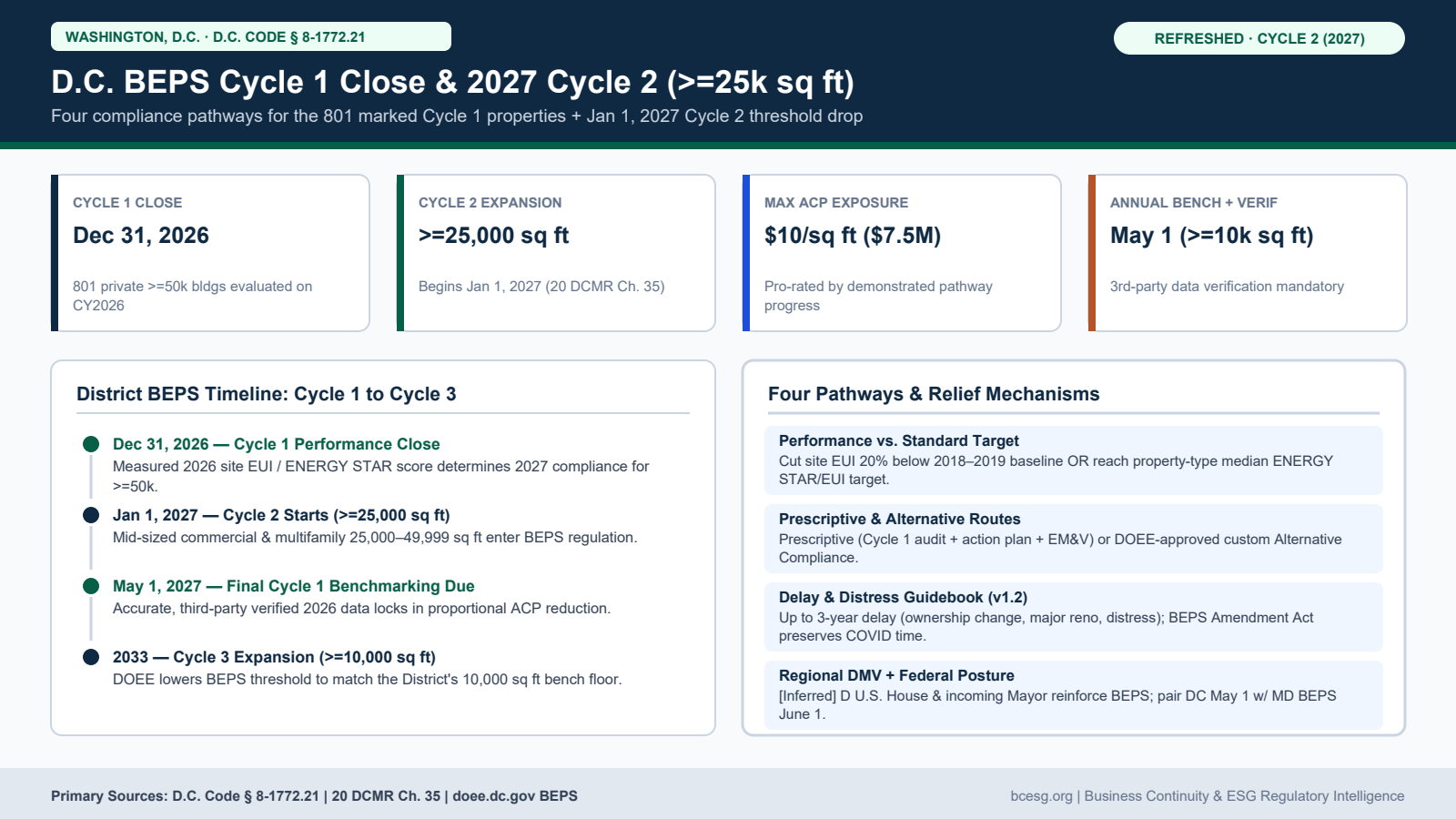
Short answer: The District’s own Building Energy Performance layer, updated in October 2026, marks 801 properties as not meeting the Building Energy Performance Standard against 1,038 marked as meeting it—and Cycle 1 closes on December 31, 2026. Immediately on its heels, Cycle 2 opens January 1, 2027, dropping the private-building BEPS threshold down to 25,000 gross sq ft under D.C. Code § 8-1772.21 and 20 DCMR Chapter 35.
Missing the original Cycle 1 median standard was never the end of compliance: a marked building entered an approved DOEE pathway. Today, the urgent questions are confirming which Cycle 1 pathway closes out your CY2026 measurement year cleanly—and preparing 25,000–49,999 sq ft properties for Cycle 2 enforcement in 2027.
Statutory Status at a Glance
Governing Authority:D.C. Code § 8-1772.21 (CleanEnergy DC Omnibus Amendment Act) & 20 DCMR Ch. 35.
Cycle 1 Close (≥50k Private):December 31, 2026 (CY2026 benchmarking evaluated in 2027; final Cycle 1 benchmarking due May 1, 2027).
Cycle 2 Expansion (≥25k Private): Begins January 1, 2027 (with Cycle 3 dropping to ≥10,000 sq ft in 2033); benchmarking + 3rd-party verification runs annually May 1 (≥10k sq ft).
Post-2026 Political Trajectory (Inferred): Incoming Mayor Janeese Lewis George and a Democratic U.S. House lower Congressional Home Rule preemption risk over DC BEPS enforcement entering Cycle 2.
Print-First Compliance Brief
Close D.C. BEPS Cycle 1 Cleanly & Prep >=25,000 sq ft Assets for Cycle 2 (2027)
2-page quick card summarizing all 4 DOEE pathways, Cycle 1 close (Dec 31, 2026), Jan 1, 2027 >=25k expansion, v1.2 financial distress relief, and ACP math.
What 'Missed' Means—and the Four Cycle 1 Pathways Explained
For Cycle 1, DOEE set each property type’s standard at no lower than the local District median from 2019 benchmarking data (for example, an ENERGY STAR score of 71 for offices, 66 for multifamily housing, 54 for hotels, 50 for hospitals, or 36 for K-12 schools, or source EUI where scores do not apply). Putting the bar at the median placed roughly half of large buildings into Cycle 1 compliance pathways based on each building’s own 2019 record.
Even though compliant buildings cut median weather-normalized EUI by 11.2% between 2019 and 2024, individual buildings that missed entered one of four DOEE Cycle 1 compliance pathways:
1. Performance Pathway (20% Cut): Demonstrate a 20% reduction in site EUI in 2026 versus the building’s 2018–2019 baseline average.
2. Standard Target Pathway (Hit Median in 2026): Reach the District’s property-type standard on measured 2026 data (available where the standard meets or beats national median).
4. Alternative Compliance Pathway (Custom Plan): Execute a DOEE-approved deep energy retrofit or custom trajectory yielding comparable energy savings.
Cycle / Requirement
Covered Building Floor
Key Dates & Statutory Caps
Cycle 1 (Active Close)
Private >=50,000 sq ft (DC >=10k)
Measured through Dec 31, 2026; final CY2026 bench May 1, 2027
Cycle 2 Expansion
Private >=25,000 sq ft (adds 25k–49k)
Starts Jan 1, 2027 under D.C. Code § 8-1772.21 / 20 DCMR Ch. 35
Cycle 3 Expansion
Private >=10,000 sq ft
Scheduled 2033 alignment with District bench threshold
Annual Bench & Verif
All buildings >=10,000 sq ft
Annual May 1 Portfolio Manager report + 3rd-party data verification
Maximum ACP Penalty
Non-compliant GFA
Up to $10/sq ft capped at $7.5M (prorated by verified progress)
Washington, D.C. BEPS Cycle 1 (2021–2026) through Cycle 2 (>=25,000 sq ft starting Jan 1, 2027) pathways and penalty rules under D.C. Code § 8-1772.21.
As Cycle 1 closes December 31, 2026, DOEE shifts immediately into BEPS Cycle 2 on January 1, 2027, extending mandatory performance standards to private commercial and multifamily buildings between 25,000 and 49,999 sq ft (with Cycle 3 hitting ≥10,000 sq ft in 2033). Remember that annual D.C. benchmarking and third-party verification already apply down to 10,000 sq ft every May 1.
Delays, Financial Distress Relief (v1.2), and Maximum $10/sq ft Penalties
Under DOEE’s August 2026 BEPS Compliance and Enforcement Guidebook (v1.2) and the BEPS Amendment Act of 2024, owners with genuine grounds—change of ownership, major renovation, pending demolition, or verified financial distress—can secure up to a three-year compliance delay without losing credit for the prior COVID extension. Delays are paused financing, not erasers: buildings re-enter the next cycle without resetting future targets.
Otherwise, non-compliant buildings face an Alternative Compliance Payment capped at $10 per gross sq ft (up to $7,500,000 per building), prorated downward strictly according to verified energy savings achieved—a financial calculation identical to our business continuity and insurance analysis for LL97.
Compliance Execution Checklist
Step
Owner / Team
Auditable Deliverable
1. Open Data Status
Asset Mgmt
Check building standing in DOEE Building Energy Performance disclosure (Meets / Pathway / Missing).
2. Close Cycle 1 Docs
Energy / PE
Finalize Prescriptive Phase 3–4 EM&V reports or CY2026 meter tracking before Dec 31, 2026.
3. Prep 25k Cycle 2
Portfolio Lead
Flag all DC properties 25,000–49,999 sq ft entering Cycle 2 standards on Jan 1, 2027.
4. May 1 Verified File
Compliance Lead
Submit third-party verified CY2026 benchmarking by May 1, 2027 to preserve proportional ACP relief.
Field & Print Package
Keep This Washington, D.C. Compliance Checklist Handy
Download the formatted 2-page PDF reference brief or pull the structured Markdown edition for internal compliance documentation.
When does D.C. BEPS Cycle 2 begin and what building sizes does it cover?
Cycle 2 begins January 1, 2027 and expands mandatory BEPS compliance to privately owned buildings of 25,000 gross sq ft or larger (down from Cycle 1's 50,000 sq ft threshold).
How is the D.C. BEPS Alternative Compliance Payment calculated if my building only falls slightly short?
The maximum penalty is $10 per sq ft of gross floor area (capped at $7,500,000 per building), but DOEE scales the actual payment down in proportion to verified progress achieved toward the building's pathway target—provided final CY2026 benchmarking data is accurate, complete, and timely.
What threshold triggers annual benchmarking and third-party verification in Washington, D.C.?
Annual May 1 benchmarking and periodic third-party data verification apply to covered private and District-owned buildings of 10,000 gross sq ft or larger.
Can my D.C. building still get a delay for financial distress or renovation?
Yes. Under DOEE's Compliance and Enforcement Guidebook v1.2 and the BEPS Amendment Act of 2024, qualifying owners can apply for up to a 3-year compliance delay for ownership changes, major renovations, pending demolition, or verified financial distress without losing prior COVID timeline relief.
Informational notice: This guide summarizes enacted statutes, regulations, or pending legislative records from the primary authorities linked above as of November 14, 2026. It is not legal, accounting, or licensed engineering advice.
For most contractors, an embodied-carbon figure is built backwards. The materials arrive, the job proceeds, and weeks later someone assembles what was bought from delivery tickets and invoices, then hunts down an emissions factor for each line. Travis Perkins, the UK builders’ merchant group, is now attacking that sequence from the other end: its Connect platform attaches a carbon dioxide equivalent (CO2e) value to products on orders and delivery records, so the number arrives with the goods instead of being reconstructed after them.
The group says it has mapped product weights in tonnes and kilograms and applied a CO2e figure to more than 120,000 products, and it is expanding Connect across five of its distribution businesses — Travis Perkins, CCF, Keyline, BSS, and Travis Perkins Managed Services. Connect began at CCF, the group’s interiors business; the October announcement is the group-wide rollout and the newly reported mapping scale. This is a British merchant’s platform in a British rollout. Nothing about it is on sale in the United States — what travels is the pattern.
The human stake is in the number the group’s announcement keeps returning to. Phil Monkman, who led the CCF team that built Connect, describes the old way in the announcement: “Up to now, the only way to get really accurate carbon data has been for the subcontractor to download delivery tickets and invoices and manually input the information, line-by-line. For some this could mean inputting up to 3,000 data points a month, just for carbon reporting.” That figure is one supplier’s description of some subcontractors’ burden, not a measured saving — but anyone who has assembled a Scope 3 inventory from a subcontractor’s spreadsheet knows the workload it names.
Three thousand hand-keyed data points a month is not just slow. It is where carbon reporting quietly goes wrong: a transposed digit, a quantity entered in the wrong unit, a factor grabbed from the wrong table at 11 p.m., a gap filled with a plausible number because the filing was due. Attaching the factor at the merchant’s end does not exhort that weakest link to try harder; it removes the link. The transcription step disappears, and with it an error surface that came free with every line.
What it proves — and what it doesn’t
What the delivery-attached number genuinely proves is provenance. Each line carries the product, quantity, weight, and the factor applied, on a transaction record that already exists for commercial reasons. An auditor, a client’s sustainability team, or your own assurance provider can walk that chain line by line. A month-end estimate cannot offer the same walk; it can only be believed or doubted as a whole. For data heading toward assurance — which California’s SB 253 builds in as its Scope 3 requirements phase in from 2027 — provenance is most of the game.
What it does not prove is precision, and the distinction lives in the factor library. Travis Perkins says its factors come from manufacturers’ environmental product declarations — EPDs — where those exist, and from recognized industry datasets everywhere else. Those are two different grades of evidence. An EPD is a manufacturer-specific, independently verified declaration with defined life-cycle boundaries. A generic dataset value is an average for a product class: a reasonable estimate wearing a uniform. A delivery total that blends the two is only as strong as its mix, and the group does not publish what share of its 120,000 mapped products is declaration-backed.
The boundary matters
The boundary matters as much as the grade. A product-level figure describes the material — typically manufacture up to the merchant’s gate. It is not a life-cycle assessment of the building: transport to site, installation, replacements across decades of use, and end of life sit outside the frame unless someone adds them. Nor does one merchant’s platform cover a project. Materials bought from any other supplier arrive the old way, numberless, and a contractor reporting on the whole job still has to reconcile covered and uncovered piles without double-counting.
The group’s own customer accounts hint at why the trade is still worth making. In one account the company tells, a contractor’s earlier estimate came in roughly 60 percent below the figure the delivery data later produced — a supplier-told story, not a validated error rate. But the direction is familiar to anyone who has compared a first-pass estimate with a counted inventory: hand-built numbers drift, usually downward, because the person building them is tired, rushed, and missing half the tickets.
The questions to ask your own merchants
So the useful response for a US or Canadian contractor is not envy of a UK platform; it is a set of questions for your own merchants and distributors, because the pattern is now demonstrably buildable. Which of my regular lines can you attach carbon data to, and which of those factors are declaration-backed rather than generic? What share of my tonnage does each grade cover? How often is your factor library updated, and are past deliveries restated when a factor changes? And can I have the data line by line, in a file my reporting system can ingest — or only as a printed total I have to re-key — rebuilding the weakest link this pattern exists to remove?
The delivery record was always the most trustworthy document on a construction job. It is signed, priced, and argued over; nobody invents one for fun. What is changing — in this UK rollout first, and in the questions it teaches buyers to ask everywhere else — is that the record now carries the carbon alongside quantity and price. When it does, the argument about your Scope 3 number moves from whether you counted at all to what grade of evidence you counted with. That is a better argument, and it is the one assurance providers, clients, and California’s filing calendar are about to have with you.
Updated Nov 2, 2026 — added the free SB 253 first-filing quick card, Nov 10 first-filing print pack, and SB 253 first-filing bot book downloads to this checklist.
On October 12, 2026, the California Office of Administrative Law approved the California Air Resources Board’s Initial Regulation for SB 253, and the regulation took effect the same day. That approval locked the date every covered company now has to work to: the first Scope 1 and Scope 2 emissions reports under the Climate Corporate Data Accountability Act are due to CARB on or before November 10, 2026.
This is not a proposed rule and it is not a distant phase-in. It is a live filing, roughly three weeks out, for U.S. companies with more than $1 billion in annual revenue that do business in California. What follows is the practitioner version: exactly who is covered, which fiscal year goes into the first report, the ways CARB will accept the filing, what assurance does and does not require this year, and the preparation steps that still fit in the time left.
Instant First-Filing Downloads
Equip Your Compliance Team or Feed Your AI Assistant
Grounded in California’s approved Initial Regulation (17 CCR §96075–§96078) and HSC §38532. Zero legal advice—practical working tools for the November 10, 2026 deadline.
Field ReferenceFREE
SB 253 First-Filing Quick Card
2-page field card: filing-in-one-table, coverage rules, data year February 1 test, submission routes, fee & penalty schedule, and 5-year records.
U.S.-organized business entities with revenue over $1 billion that do business in California
First deadline
November 10, 2026
Scopes in the 2026 report
Scope 1 and Scope 2 only — Scope 3 is not required this cycle
Data year
Prior fiscal year, selected under the February 1 rule below
How to file
CARB’s voluntary 2026 Report Intake Platform, or email to [email protected]
Assurance
Limited assurance is the statutory standard from 2026, but CARB accepts 2026 filings with or without it
Fee
Annual, formula-based; CARB issues fee determination notices by December 10, payment due within 60 days
Penalty ceiling
Up to $500,000 per reporting year for nonfiling, late filing, or other failure to comply
Records
Keep the California tax records behind your applicability determination for five years
Who must file — and who is out
The regulation defines a “reporting entity” as a partnership, corporation, limited liability company, or other business entity formed under the laws of California, another U.S. state, the District of Columbia, or an act of Congress, with total annual revenues in excess of $1 billion, that does business in California.
Three details of that definition decide most borderline cases. First, revenue means gross receipts, as defined in California Revenue and Taxation Code section 25120(f)(2). Second, the revenue test uses the lesser of the entity’s two previous fiscal years — one exceptional year does not pull an entity in, and one soft year does not let it out. Third, the test is applied entity by entity, at the individual business entity level; revenue from intercompany transactions inside the same combined reporting group does not count toward the threshold.
“Doing business in California” is also a defined term, not a vibe. It means doing business under Revenue and Taxation Code section 23101(a) and meeting either the section 23101(b)(1) or the section 23101(b)(2) test. Wholesale electricity sales in interstate commerce do not count toward the (b)(2) sales test. CARB’s guidance is explicit that entities are responsible for determining their own applicability — there is no approval step where CARB confirms your status for you.
Five categories are outside the article entirely:
Tax-exempt nonprofit or charitable organizations
Business entities regulated by the California Department of Insurance, or in the business of insurance in any other state
Federal, state, and local government entities, and companies majority-owned (over 50 percent) by government entities
Entities whose only California activity is wholesale electricity transactions in interstate commerce
Entities whose only California business is employee compensation or payroll expenses, including teleworking employees
One structural relief valve matters for groups: reports may be consolidated at the parent-company level. A covered subsidiary does not have to file separately if its parent files a consolidated report that includes it.
Which fiscal year goes in the first filing
The first report covers a prior fiscal year, and section 96076(c) of the regulation picks which one by a February 1 line:
Fiscal year ends on or before February 1 in a calendar year → report the fiscal year ending in the current calendar year.
Fiscal year ends after February 1 → report the fiscal year ending in the previous calendar year. The entity may instead choose its most recent preceding fiscal year, if that data is available.
Worked through the common cases: a calendar-year filer reports its 2025 fiscal year. A company whose fiscal year ends June 30 reports the year that ended June 30, 2025 — but may elect the year ended June 30, 2026 if the data is ready. A company whose fiscal year ends January 31 reports the year ended January 31, 2026, because that year ends in the current calendar year under the first branch of the rule.
Scope for this cycle is deliberately narrow. Scope 1 is direct greenhouse gas emissions from sources the entity owns or directly controls, regardless of location, including fuel combustion. Scope 2 is indirect emissions from purchased or acquired electricity, steam, heating, or cooling, regardless of location. Scope 3 — the value-chain inventory — is not part of the 2026 report; under the statute it begins in 2027. Emissions are measured and reported in conformance with the Greenhouse Gas Protocol’s standards and guidance.
The no-data door, stated precisely
For the November 10, 2026 report only, the regulation carries forward CARB’s December 5, 2024 Enforcement Notice. A covered entity has two options:
(A) Submit Scope 1 and Scope 2 emissions from its prior fiscal year that can be determined from information it already possessed or was already collecting on or before December 5, 2024; or
(B) Submit a statement of non-reporting on company letterhead stating that it is not submitting a report because it did not possess Scope 1 or Scope 2 information and was not collecting it on or before December 5, 2024.
CARB asks that the statement be submitted through the intake platform or by email before November 10, 2026. Read this door for exactly what it is: a one-cycle enforcement-discretion posture for the first report, not an exemption from SB 253. An entity that uses it is still a reporting entity, still owes the fee, and still needs a real inventory for the next cycle. Our earlier briefing walks through the three doors into the filing in more depth.
How to file in 2026
CARB built a 2026 Report Intake Platform, and its status surprises people: use of the platform is voluntary, not mandatory. Ahead of the deadline it can carry your contact information, your Scope 1 and 2 report through its submission fields, and the billing information CARB needs for fee invoicing. The alternative route is plain email — send the emissions report and contact information to [email protected].
The first-year formats are equally pragmatic. CARB’s September 1, 2026 reporting guidance accepts an existing annual report that includes Scope 1 and 2 emissions, existing Scope 1 and 2 data already reported to other programs or voluntary initiatives, or CARB’s Draft Scope 1 and 2 GHG Reporting Template — which is itself voluntary for 2026. For Scope 2, no single factor dataset is mandated this year: EPA eGRID 2023, the Cornerstone Sustainability Data Initiative’s eGRID 2024, or other credible sources may be used, provided the filing identifies the factors and sources behind the numbers.
CARB also encourages filers to include the context around the numbers — methodologies, data sources, global warming potential values, emission factors, organizational boundaries, disaggregation by category and gas, and assumptions. That context is encouraged rather than mandated in the first-year guidance, but it is the cheapest defensibility a filer can buy: it is the record that shows how each number was produced.
November 10, 2026 Deadline
Operationalize Your First SB 253 Filing
With California’s first filing deadline days away, covered entities cannot afford ambiguous gross receipts calculations, misapplied February 1 fiscal year rules, or unorganized submission records. Build an auditable five-year compliance file and evaluate your data options under CARB’s first-year enforcement rules.
• Applicability Worksheet: RTC §25120 & §23101 tests.
• Fiscal Year Picker: 17 CCR §96076(c) worked form.
• Scope 1 & 2 Checklist: Dec 5, 2024 baseline inventory.
• Submission Checklist: Intake platform vs email route.
• AI Bot Routines: 4 automated workflows ($17).
Secure 1-Click Square Checkout
Assurance: the requirement versus the first-year enforcement
The statute sets a real assurance ladder. Health and Safety Code section 38532 requires independent third-party assurance of the disclosure: limited assurance for Scope 1 and 2 beginning in 2026, rising to reasonable assurance beginning in 2030.
The first-year enforcement posture is different from the requirement, and conflating the two is the most common error in coverage of this filing. CARB’s FAQ and its September 2026 guidance state that CARB will accept 2026 submissions whether or not assurance has been obtained. The obligation did not move; the enforcement did. Assurance requirements for 2027 and beyond are part of CARB’s second rulemaking and are not settled by the Initial Regulation — so the correct 2026 posture is to file on time, and to build the inventory so that it can survive limited assurance when the second rulemaking lands.
Fees, penalties, and the five-year file
The fee is an annual implementation fee assessed per reporting entity, calculated by formula: CARB’s program costs are recovered across the number of covered entities, with contingency and debt components in the calculation. The approved regulation sets the mechanics, not a fixed dollar figure — anyone quoting you an exact per-company fee for 2026 is quoting an estimate, not the rule. CARB issues fee determination notices by December 10, and payment is due within 60 calendar days of the notice. A parent may pay on a consolidated basis, but the fee is still assessed per covered entity.
The penalty exposure sits in the statute. CARB’s penalty regulations may reach nonfiling, late filing, or other failure to meet the law’s requirements, and penalties imposed on a reporting entity shall not exceed $500,000 in a reporting year. In setting a penalty, CARB considers all relevant circumstances, including the entity’s past and present compliance and whether it took good-faith measures to comply, and when. Keep that separate from fee enforcement: under the fee subarticle, each calendar day of a violation is a separate offense, violations may be enjoined, and an unpaid fee is a separate violation for each day it remains unpaid. The $500,000 cap and the daily fee offenses are two different mechanisms, and a compliance calendar should track both.
Finally, the recordkeeping rule that outlives the deadline: entities must keep the California tax records that prove the revenue and doing-business thresholds for five years, and produce them on request. Your applicability memo is not a one-time work product; it is a five-year file.
What changed on the way to November 10
Companies that planned against the original calendar have already been whipsawed once, and the history explains the current date. SB 219 (2024) amended SB 253 and its companion law — among other changes it moved CARB’s deadline to adopt the implementing regulation and formalized parent-level consolidation. The Initial Regulation CARB approved on February 26, 2026 set the first filing deadline at August 10, 2026. CARB withdrew that package from the Office of Administrative Law on June 24, released modified text for a 15-day comment period on July 27 deferring the deadline to November 10, 2026, resubmitted the final package on September 21, and OAL approved it effective October 12, 2026.
The lesson is not that dates move. It is that this date has finished moving: the regulation is approved and in effect, and November 10 is the deadline in the operative text.
Preparation checklist: the next three weeks
Close the applicability question in writing. Entity-by-entity revenue test on the lesser of the last two fiscal years, doing-business analysis, exemption check — signed off and filed for the five-year record.
Pick the fiscal year deliberately. Apply the February 1 rule, and where the election exists, decide whether the most recent preceding fiscal year is genuinely ready or merely newer.
Inventory what existed on December 5, 2024. That date decides whether you file numbers, file numbers built from what you had, or file the letterhead statement. Do not reconstruct this answer from memory in November.
Choose the route and format. Intake platform or email; existing report, other-program data, or CARB’s draft template. Any of them beats a late bespoke build.
Assemble the methodology context now. Boundaries, factors and their sources, GWP values, assumptions — while the people who produced the numbers still remember how.
Set the assurance posture explicitly. Filing without assurance is accepted in 2026; arriving at the second rulemaking with an unassurable inventory is the real risk. Build to the limited-assurance standard even if no provider signs this cycle.
Calendar December 10. The fee determination notice starts a 60-day payment clock, and it lands in the middle of year-end close.
Read the filing the way your insurer will. A CARB submission is a dated, signed representation about your operations. Our sister desk at Risk Coverage Hub reads the same filing as a liability document — what a missed or inconsistent filing does to penalties, D&O applications, and renewals.
One tooling note for teams starting from zero: BC ESG’s Corporate Carbon Footprint Calculator can size a Scope 1, 2, and 3 footprint quickly enough to sanity-check an inventory in progress. Use it for exactly what it is — a planning estimate built on published U.S. EPA factors, in the page’s own words not an audit, not a GHG Protocol inventory, and not a certification. It is a reasonableness check on the filing, never a substitute for it.
Choose Your SB 253 Compliance Toolkit
Grounded directly in California’s approved Initial Regulation (17 CCR §96075–§96078) and HSC §38532.
Quick Reference
SB 253 First-Filing Quick Card
FREE
2-page printable card: filing-in-one-table, coverage rules, February 1 test, submission routes, and 5-year records.
Is the November 10, 2026 deadline real, or is the regulation still proposed?
It is real. The Office of Administrative Law approved CARB’s Initial Regulation on October 12, 2026 and it took effect that day. The operative regulation sets the first Scope 1 and Scope 2 reports due on or before November 10, 2026. Older CARB web pages still carry some “proposed” language; the October approval and CARB’s September 1, 2026 reporting guidance control.
Our revenue crossed $1 billion once, two years ago. Are we covered?
Probably not on that fact alone — and the reverse is also true. Applicability uses the lesser of your two previous fiscal years’ gross receipts, measured entity by entity. One spike year above $1 billion with the other year below it leaves the lesser year under the line. Two years above it puts you in, even if the current year is softer.
We have no emissions data at all. What do we file?
For the 2026 report only, if you did not possess Scope 1 or Scope 2 information and were not collecting it on or before December 5, 2024, you may submit a statement of non-reporting on company letterhead, through the intake platform or by email, before November 10, 2026. That is a first-cycle enforcement posture, not an exemption — and the statement must be true. If you were collecting data for any purpose by that date, the honest route is to report what that data supports.
Do we have to use CARB’s intake platform?
No. The 2026 Report Intake Platform is voluntary. You may file through it — it also collects contact and billing information for fee invoicing — or email your emissions report and contact information to [email protected]. CARB’s own draft reporting template is likewise voluntary for 2026; an existing annual report or data already reported to another program can serve as the filing.
Is third-party assurance required for the 2026 filing?
The statute requires limited assurance of Scope 1 and 2 disclosures beginning in 2026, with reasonable assurance from 2030. For this first cycle, however, CARB has stated it will accept 2026 submissions whether or not assurance has been obtained. Treat that as enforcement discretion for one year, not a repeal: assurance requirements from 2027 sit in CARB’s second rulemaking.
What does the filing cost, and what does a miss cost?
The annual fee is formula-based — CARB’s program costs divided across covered entities — with determination notices issued by December 10 and payment due within 60 days; the regulation does not set a fixed dollar amount. A miss costs more: administrative penalties for nonfiling, late filing, or other failure to comply can reach $500,000 in a reporting year, with good-faith compliance efforts counted in the entity’s favor, and fee violations accrue as separate daily offenses on top of that.
Is SB 261 the same deadline?
No. SB 261 is the companion climate-risk reporting law for companies over $500 million, on a biennial cycle — and its enforcement is currently enjoined by the Ninth Circuit. November 10, 2026 is an SB 253 date, for Scope 1 and Scope 2 emissions, for companies over $1 billion. The two laws share a regulation but not a deadline, a threshold, or a current enforcement posture.
California’s first corporate emissions filing is due November 10, 2026, and the regulation behind it is no longer a proposal. The Office of Administrative Law has approved CARB’s Initial Regulation — Title 17, California Code of Regulations, Article 6, sections 96070 through 96077 — and it took effect October 12. What gets filed by the deadline, though, is narrower and stranger than the headline version. For the first cycle, what you owe California depends less on what your emissions are than on what you were already doing about them on December 5, 2024.
This is the operator’s briefing: who is in the room, the three doors into the filing, the mechanics nobody reads until the week before, and the line between what is now in force and what CARB is still proposing.
First, decide whether you are in the room
SB 253 — the Climate Corporate Data Accountability Act, Health and Safety Code section 38532 — covers U.S. companies with total annual revenues over $1 billion that do business in California. “Revenue” is tested on gross receipts as California’s tax code defines them (Revenue and Taxation Code section 25120(f)(2)), using the lower of the two most recently completed fiscal years. “Doing business” borrows the tax code’s test as well: actively transacting in the state, or crossing its economic-presence thresholds on California sales, property, or payroll.
CARB’s guidance is blunt about whose job the determination is: yours. Entities are responsible for deciding whether they meet the definition of a reporting entity, including assessing their own revenue and California footprint. CARB has published a frequently-asked-questions document and sent reminder letters to organizations that may be subject to the program — if a letter arrived, treat it as a prompt to run the test, not as the test itself.
The statute behind the deadline carries penalties of up to $500,000 per reporting year for late filing, nonfiling, or other violations. The first cycle comes with a safety net, described below — but the net is CARB’s enforcement posture, not an amendment to the law.
Door one: you were already counting
CARB’s December 2024 Enforcement Notice set the line that still governs this cycle. For the 2026 report, CARB exercises enforcement discretion: you report the Scope 1 and Scope 2 emissions for your preceding fiscal year based on the information you already had, or were already collecting, when that notice was issued — whether or not the data received limited assurance.
The acceptable vehicles are deliberately unglamorous. CARB will take an existing annual report that includes your Scope 1 and Scope 2 data. It will take the data as reported to another program or voluntary initiative — the inventory already sitting in a CDP response or another filing does not need to be rebuilt in a California shape. Or you can use CARB’s Draft Scope 1 and 2 Reporting Template, posted in October 2025; its use is voluntary for this cycle.
Two details separate a filing from a number. Emissions are measured under the Greenhouse Gas Protocol, as the statute requires. And CARB encourages filers to include the context that qualifies the figures — methodologies, data sources, global warming potential values, organizational boundaries, disaggregation by category and gas, and the assumptions used. For Scope 2, no single emission-factor dataset is mandated: eGRID 2023 is acceptable, as are other credible sources, provided the report identifies the factors and where they came from.
Door two: you were not counting yet
If your company was not collecting Scope 1 and 2 data — and was not planning to — when the December 2024 notice issued, CARB does not expect an inventory for this first cycle. What it requests instead is a statement of non-reporting on company letterhead, saying exactly that, submitted before November 10 through the intake platform or by email.
Read that door carefully, because it is the one most often misdescribed. It is not an exemption from SB 253 and it is not a filing holiday. It is a one-cycle posture tied to a specific date: the discretion applies to the 2026 report only, and the facts it rests on — what you were collecting on December 5, 2024 — are either true of your company or they are not. Companies that were collecting data do not get to use the letter, and companies that use the letter should expect the posture to end with this cycle.
Assurance follows the same pattern of a hard statute and a soft first year. The law requires limited assurance on Scope 1 and 2 beginning in 2026, phasing to reasonable assurance by 2030. CARB will nonetheless accept 2026 submissions whether or not assurance has been obtained. The requirement did not move; the enforcement did.
The mechanics: platform, email, and a fee
CARB built a voluntary 2026 Report Intake Platform, released with its September 1, 2026 guidance document. Use is not mandatory. The platform collects contact information ahead of the deadline, offers fields to submit the Scope 1 and 2 report itself, and gathers billing information for fee invoicing. Anything the platform accepts can also be emailed to CARB’s climate disclosure inbox instead — the channel is your choice; the deadline is not.
The Initial Regulation also stands up the fee that funds the program: a flat annual charge per covered entity, set to cover CARB’s cost of administering it. Staff estimates during the rulemaking put the SB 253 fee in the low thousands of dollars per entity per year — roughly $3,100 — which is also why the intake platform asks for billing contacts. The fee is a rounding error next to the cost of building the inventory; the reason to register your contact information accurately is that this platform is how the program will reach you from here.
The road to this date is worth knowing, because it explains the compressed calendar. The regulation was proposed with an August 10, 2026 deadline. CARB withdrew the package in June, released modified text in July, and OAL approved the revised version in October — moving the first deadline to November 10 in the process. Companies that built their plan around August got three extra months; companies that waited for certainty got about four weeks.
What is in force, and what is still only proposed
In force today: the November 10, 2026 deadline for first-year Scope 1 and 2 reports; the definitions of revenue and doing business; the fee structure; and the enforcement-discretion posture for 2026 described above. Scope 3 reporting begins in 2027 under the statute — the emissions themselves are owed from next year, not from this filing.
Still to come: a second CARB rulemaking that will set the 2027-and-beyond machinery — accounting methodologies, deadlines, assurance requirements, and reporting formats. Anything you read about how 2027 reporting will work in detail is, at this point, a proposal moving through that process, not a rule you can file against. Build the 2026 filing to the documents that exist; design the underlying data system so it can absorb the machinery when it lands.
Do not conflate the companion law. SB 261, the climate-related financial risk act, covers a wider population (over $500 million in revenue), runs on a biennial cycle, and is currently not being enforced: the Ninth Circuit enjoined its enforcement in November 2025, and CARB has said it will not enforce the statute while the injunction stands. CARB opened a public docket in December 2025 where companies may post risk reports voluntarily. SB 261’s pause changes nothing about the November 10 SB 253 deadline.
If you also report in Europe
Dual reporters face two different instruments built on the same underlying inventory. California asks for an emissions number, measured under the GHG Protocol, from any company over the revenue line that does business in the state — regardless of where it is headquartered or listed. The EU’s CSRD, as narrowed by the Omnibus package, asks a wider question — double materiality across environmental and social topics, in ESRS format — of a differently drawn population. Our CSRD roadmap after the 2026 Omnibus walks the European side, and our regulatory convergence map tracks how the regimes line up.
The operational answer is boring and correct: one inventory, documented once, with the methodology trail kept at a standard that satisfies the strictest reader, then rendered into each regime’s format. Groups can report to California at the parent level, which keeps a multi-subsidiary structure from fragmenting into dozens of inconsistent filings. What does not transfer is the assurance clock and the legal posture — California’s good-faith first year is California’s alone.
For a facilities-level view of what the November 10 numbers set in motion inside buildings and portfolios, see our companion piece, November 10 Is Locked. The filing itself, though, is a three-week problem now: run the applicability test, establish which side of December 5, 2024 your company was on, and put the report — or the letter — through one of the doors before November 10.