
2025 launch (~10/day) and reentry (>3 intact/day) rates cited from ESA 2026 Space Environment Report (data through end of 2025).
ORBITAL SUSTAINABILITY · MEASUREMENT & ESG GAP · ATMOSPHERIC SCIENCE VS. REPORTING GAP
Reentry Ablation & Atmospheric Impact
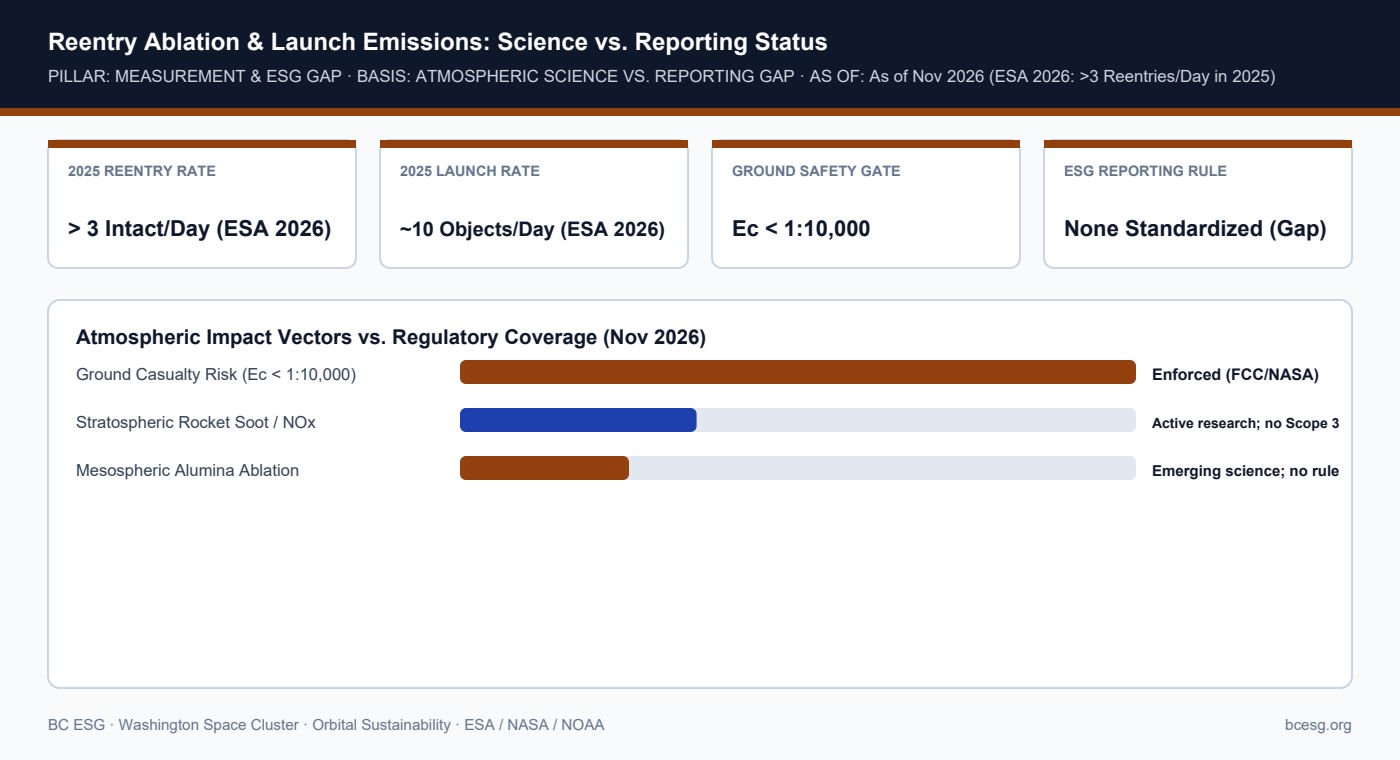
Design-for-demise prevents ground casualties (< 1:10,000) by vaporizing aluminum spacecraft in the upper atmosphere, but ESA's 2026 Report notes >3 intact objects/rocket bodies reentered daily in 2025—injecting alumina and soot where no standardized ESG accounting protocol exists.
Primary Authority / Source: ESA / NASA / NOAA | As-Of / Horizon: As of Nov 2026 (ESA 2026: >3 Reentries/Day in 2025)
Documented Instrument & Engineering Record
- The physical tradeoff: Design-for-demise protects people on the ground by burning up aluminum spacecraft buses in the mesosphere/stratosphere—converting solid metal into aerosolized aluminum oxide (alumina).
- Scale of traffic (ESA 2026 Report, data through end of 2025): Launch rates reached ~10 objects/day and >3 intact objects or rocket bodies reentered the atmosphere daily in 2025.
- Launch plume injections: Rocket launches inject black carbon, water vapor, and nitrogen oxides directly into the stratosphere and mesosphere, with different radiative forcing than ground-level combustion.
- Reporting boundary: While physical atmospheric research is active, neither GHG Protocol, ISSB IFRS S2, EU CSRD, nor FAA/FCC imposes a standardized space-specific radiative-forcing or ablation metric as of November 2026.
Atmospheric Vectors: Physical Reality vs. Compliance Status
| Vector | Physical Mechanism | Compliance / ESG Status (Nov 2026) |
|---|---|---|
| Reentry Ground Impact | Surviving fragments > 15 J | Regulated: Ec < 1:10,000 (FCC / NASA) |
| Mesospheric Alumina | Vaporized Al bus from demisable sats | Unregulated; no ESG reporting standard |
| Stratospheric Launch Plume | Black carbon / NOx / H2O injection | Terrestrial Scope 1 fuel only; no RF multiplier |
Mission Designer, Compliance Lead & Founder Takeaways
- Compliance leads should not invent custom stratospheric radiative-forcing multipliers inside statutory Scope 1/2/3 filings unless a recognized standard adopts one.
- Ground casualty safety (< 1:10,000) remains the legally binding priority over speculative atmospheric ablation offsets.
- Track NOAA, NASA, and ESA atmospheric research separately from statutory ESG disclosures.
Connected Census Profiles, Segments & Rules
- No Space-Specific Scope 3 / ESG Standard Gap
- Reentry Casualty Risk & Demisability
- ESA & NASA Debris Counts (2026)