Verified against 14 CFR Part 450 (eCFR) and Batch 5 #1966 transition dates as of 2026-11-16.
ORBITAL SUSTAINABILITY · DISPOSAL REGIME · FEDERAL REGULATION (14 CFR PART 450)
FAA Part 450 Upper-Stage Disposal
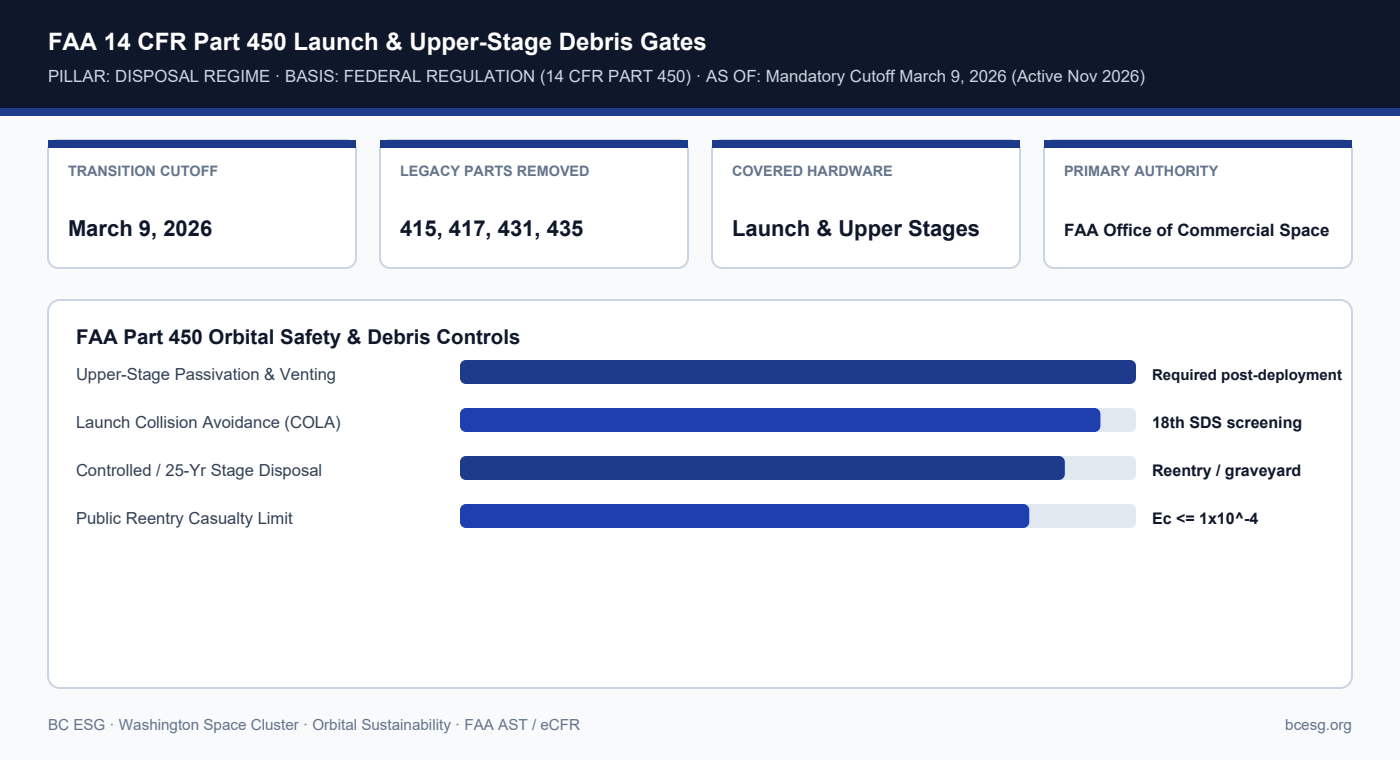
With FAA's 5-year transition to 14 CFR Part 450 completed on March 9, 2026, all U.S. commercial launch and reentry licenses govern upper-stage orbital debris mitigation, collision avoidance at launch, and stage passivation under unified Part 450 safety rules.
Primary Authority / Source: FAA AST / eCFR | As-Of / Horizon: Mandatory Cutoff March 9, 2026 (Active Nov 2026)
Documented Instrument & Engineering Record
- Unified licensing regime: As of March 9–10, 2026, legacy Parts 415, 417, 431, and 435 were sunsetted into 14 CFR Part 450 for all commercial orbital launches.
- Upper-stage focus: While FCC regulates satellite payloads, FAA Part 450 regulates the launch vehicle and orbital upper stage—requiring collision avoidance (COLA) screening during ascent/deployment and post-deployment stage disposal.
- Reusable vs. expendable stages: WA launch developers (Blue Origin New Glenn, Stoke Space Nova) design reusable or rapidly deorbited upper stages that eliminate long-lived spent rocket bodies in LEO.
- Angle split with Batch 5: Batch 5 Post #1966 documents that Part 450 is LIVE; this brief isolates the upper-stage disposal and COLA obligations inside Part 450.
FAA Part 450 vs. FCC Part 25 Jurisdiction Split
| Hardware Element | Governing Agency | Primary Regulation |
|---|---|---|
| Launch Vehicle & Upper Stage | FAA (AST) | 14 CFR Part 450 |
| Payload RF & Satellite Disposal | FCC (Space Bureau) | 47 CFR Part 25 (§ 25.283) |
| Remote-Sensing Payload Data | NOAA (CRSRA) | 15 CFR Part 960 |
| NASA-Contracted Payloads | NASA SMA | NASA-STD-8719.14C (Contract) |
Mission Designer, Compliance Lead & Founder Takeaways
- Spent rocket bodies represent a disproportionate share of total orbital mass (>17,000 tonnes total tracked mass per ESA 2026 Report).
- WA launch teams operating out of Florida/Vandenberg (Blue Origin, Stoke Space) still engineer upper-stage passivation valves and reentry guidance in Kent and Redmond.
- Rideshare payload integrators must verify that the launch provider's Part 450 license covers deployment separation and COLA windows.
Connected Census Profiles, Segments & Rules
- Batch 5 Verdict: FAA Part 450 Licensing (LIVE)
- No Orbital Launch Range in Washington
- Stoke Space (Kent) Census Profile