RF Radiation Hazard (RadHaz) & Backup Generator Air Permitting
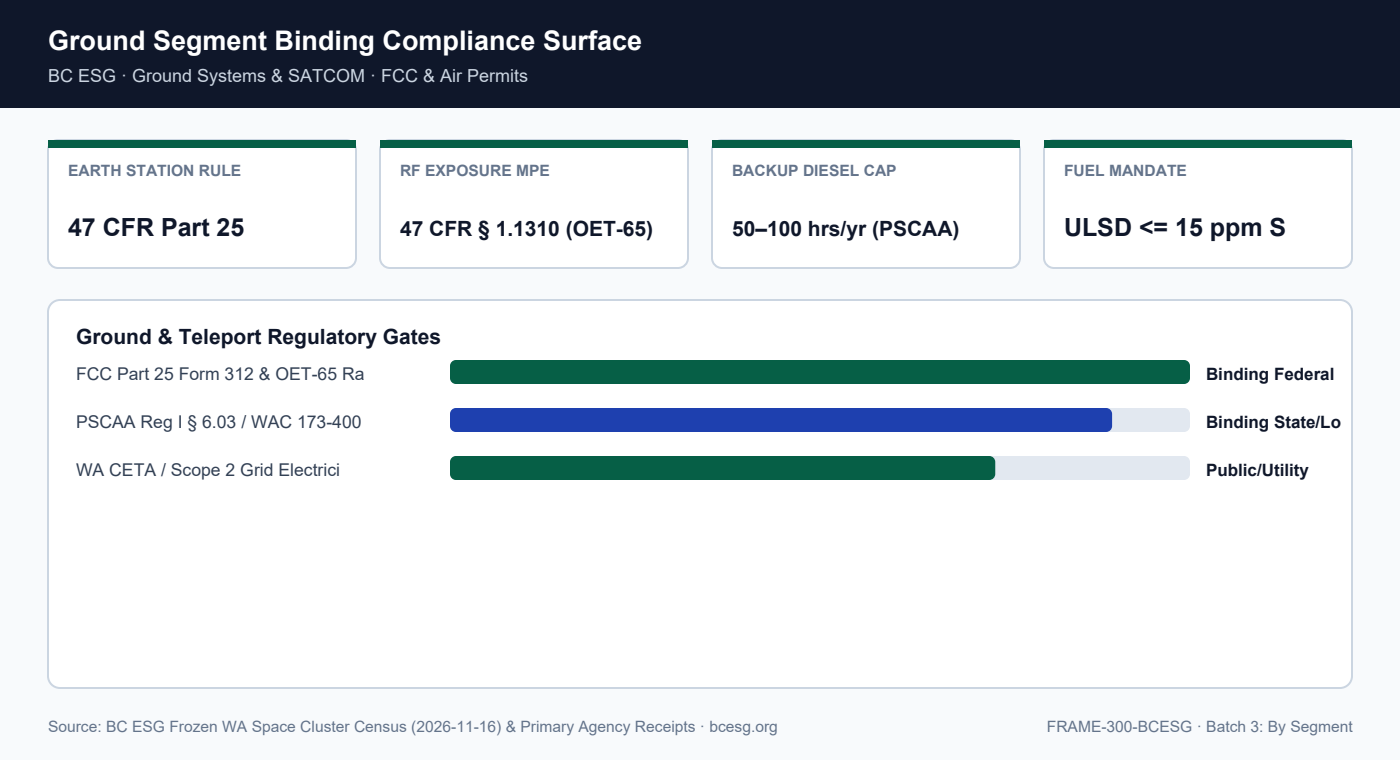
Under 47 CFR Part 25 and 47 CFR § 1.1307(b), Part 25 earth stations are not categorically excluded from environmental review for human RF exposure. Applicants must submit a Radiation Hazard (RadHaz) study under OET Bulletin 65 against 47 CFR § 1.1310 MPE limits; exceeding public limits triggers a formal Environmental Assessment (§ 1.1311) and physical interlocks/fencing.
On the ground-facility side, standby emergency diesel generators (RICE) supporting teleports or operations centers in King, Pierce, Snohomish, and Kitsap counties require a PSCAA Regulation I, Section 6.03 Notice of Construction Order of Approval (WAC 173-400-110 statewide): EPA Tier 2–4 compliance, 50–100 hour/year non-emergency testing caps, non-resettable hour meters, and Ultra-Low Sulfur Diesel (<= 15 ppm sulfur).
| Rule | Citation | Trigger | Requirement |
|---|---|---|---|
| FCC Earth Station & RadHaz | 47 CFR Part 25; § 1.1307(b); § 1.1310 | Parabolic uplink antennas | Form 312, OET-65 RadHaz study, fencing/interlocks |
| PSCAA / WA Standby Diesel | PSCAA Reg I § 6.03; WAC 173-400-110 | Backup RICE generators | NOCOA permit, 50-100 hr/yr cap, ULSD <=15 ppm |
| WA Clean Energy (CETA) | RCW 19.405 | Utility power procurement (MSFT/AMZN) | 2030 GHG-neutral / 2045 100% clean utility grid |
Related BC ESG Guides & Verified Primary Sources
- Washington Space Cluster Census Hub
- Microsoft Azure Space Profile
- AWS Aerospace & Satellite Profile
- RBC Signals Profile
- Viasat Profile
- Ground & Mission Software Group (US Electrodynamics)
- Kymeta (Primary: Components & Suppliers) Profile
- WA CBPS Guide (#1171)
- Seattle BEPS Guide (#1275)