
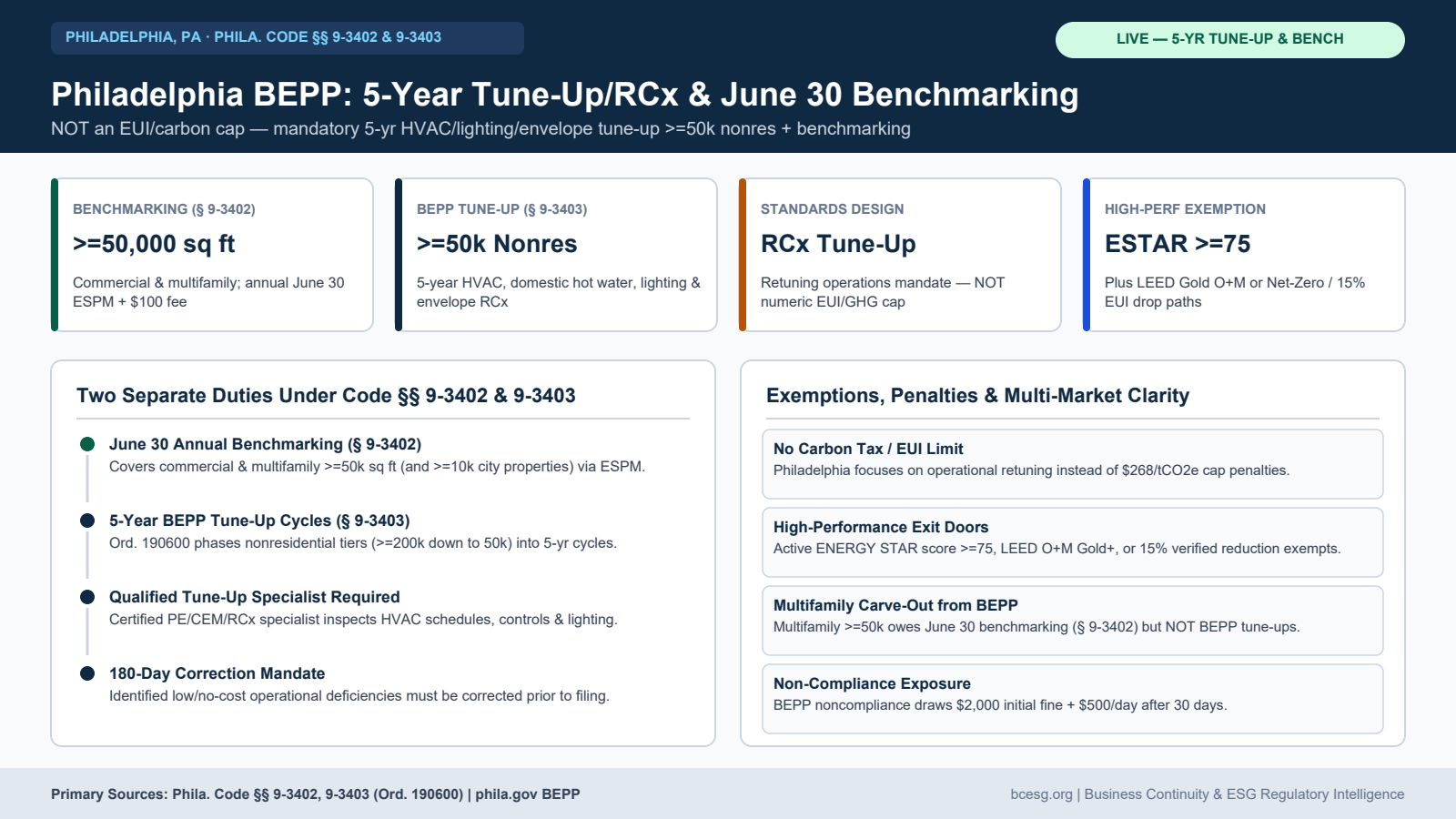
Short answer: Multi-market compliance teams routinely misread Philadelphia as another numeric emissions-cap city like New York or Washington, DC. In reality, Philadelphia’s Building Energy Performance Program (BEPP, Phila. Code § 9-3403 / Ord. 190600) is a mandatory 5-year operational tune-up (retro-commissioning) requirement — not a numeric EUI cap or carbon price — running alongside annual June 30 benchmarking under Phila. Code § 9-3402.
Just as important is coverage separation: commercial and multifamily buildings >=50,000 sq ft must file annual June 30 Portfolio Manager benchmarking, whereas only non-residential buildings >=50,000 sq ft fall under 5-year BEPP tune-up cycles (multifamily is excluded from BEPP). Compare this tune-up architecture against numeric cap statutes like NYC LL97, DC BEPS, or regional peer Pittsburgh Benchmarking.
- Code § 9-3402 (Annual Benchmarking — June 30): Commercial and multifamily properties >=50,000 sq ft (plus municipal properties >=10,000 sq ft) report via ENERGY STAR Portfolio Manager + $100 annual administrative fee.
- Code § 9-3403 (BEPP 5-Year Tune-Ups — Sept 30 / Oct Cycles): Non-residential buildings >=50,000 sq ft (staggered across 200k+, 100k–200k, 70k–100k, and 50k–70k sq ft cohorts entering repeating 5-year cycles) must engage a Qualified Tune-Up Specialist.
- High-Performance Exemptions: Buildings earning ENERGY STAR score >=75, LEED O+M Gold or Platinum, Net-Zero Energy certification, recent major energy code renovation, or 15% site-EUI reduction file a simple exemption instead of a field tune-up.
- Penalties & 180-Day Repairs: Specialists inspect base-building HVAC, lighting controls, domestic hot water, and envelope seals; low/no-cost operational corrections must be completed within 180 days/prior to submission, or owners risk $2,000 initial + $500/day after 30 days.
Download the Philadelphia BEPP & Benchmarking Compliance Guide
Inside a Qualifying BEPP Tune-Up vs. High-Performance Exemption Doors
Under Philadelphia Office of Sustainability rules, a BEPP submission must be signed by a Qualified Tune-Up Specialist holding eligible PE, CEM, CEA, BEAP, or certified commissioning credentials. The scope focuses on practical operational waste — failed economizers, simultaneous heating and cooling, misaligned occupancy schedules, defective steam traps, or malfunctioning lighting sensors — rather than forcing full capital boiler replacement.
Wait too late to review your June 30 Portfolio Manager scores, however, and you miss the easiest compliance exit: properties reaching an ENERGY STAR rating of 75 or higher on their benchmarking submission can file an exemption application, bypassing field RCx expense entirely for that five-year cycle.
- Multifamily Clarification: Purely residential multifamily towers >=50,000 sq ft still pay the $100 annual fee and file June 30 benchmarking under § 9-3402, but do NOT owe § 9-3403 BEPP tune-ups.
- Mixed-Use Space Allocation: Buildings containing >=50,000 sq ft of strictly non-residential floor area fall inside BEPP even when sitting beneath residential floors.
| Provision & Citation | Covered Threshold | Deadline / Cadence | Compliance Standard & Penalty |
|---|---|---|---|
| Benchmarking (§ 9-3402) | Commercial & multifamily >=50k sf (+ city >=10k) | Annual June 30 (+ $100 fee) | ENERGY STAR PM filing; $300 initial + $100/day |
| BEPP Tune-Up (§ 9-3403) | Non-residential >=50k sf ONLY (no multifamily) | 5-year repeating cohort cycles (Sept 30) | RCx tune-up OR ESTAR >=75 exempt; $2,000 + $500/day |
Compliance Execution Checklist
| Step | Owner / Team | Auditable Deliverable |
|---|---|---|
| 1. June 30 Portfolio Mgr | Property Ops | Submit PECO/PGW/PWD energy + water data and $100 fee; check ENERGY STAR score. |
| 2. Cohort & Exemption Check | Sustainability / Asset Mgr | Verify 5-year BEPP cycle date and evaluate ESTAR >=75 / LEED Gold exemption. |
| 3. Specialist Tune-Up | Qualified PE / CEM / RCx | Complete HVAC/lighting audit, execute operational corrections, and file BEPP report. |
Keep This Philadelphia, PA Compliance Checklist Handy
Frequently Asked Questions
Does Philadelphia BEPP impose a fine if a building exceeds an EUI or GHG emissions limit?
No. Unlike NYC LL97 or Boston BERDO, Philadelphia Code § 9-3403 is a 5-year retro-commissioning (tune-up) mandate requiring inspection and correction of HVAC, lighting, water, and envelope operations — fines ($2,000 + $500/day) apply only for failing to complete or file the tune-up/exemption.
Do multifamily apartment buildings have to comply with Philadelphia BEPP?
Multifamily buildings >=50,000 sq ft must complete annual June 30 energy/water benchmarking under Phila. Code § 9-3402, but they are excluded from § 9-3403 5-year BEPP tune-ups unless non-residential space alone meets coverage thresholds.
Primary Authorities & Official Resources
- City of Philadelphia Office of Sustainability — Building Energy Performance Program (BEPP)
- City of Philadelphia — Building Energy Programs Portal
Informational notice: This guide summarizes enacted statutes, regulations, or pending legislative records from the primary authorities linked above as of November 14, 2026. It is not legal, accounting, or licensed engineering advice.