Updated: November 14, 2026 — Refreshed to reflect current statutory cycles, verification rules, and post-election regulatory posture.
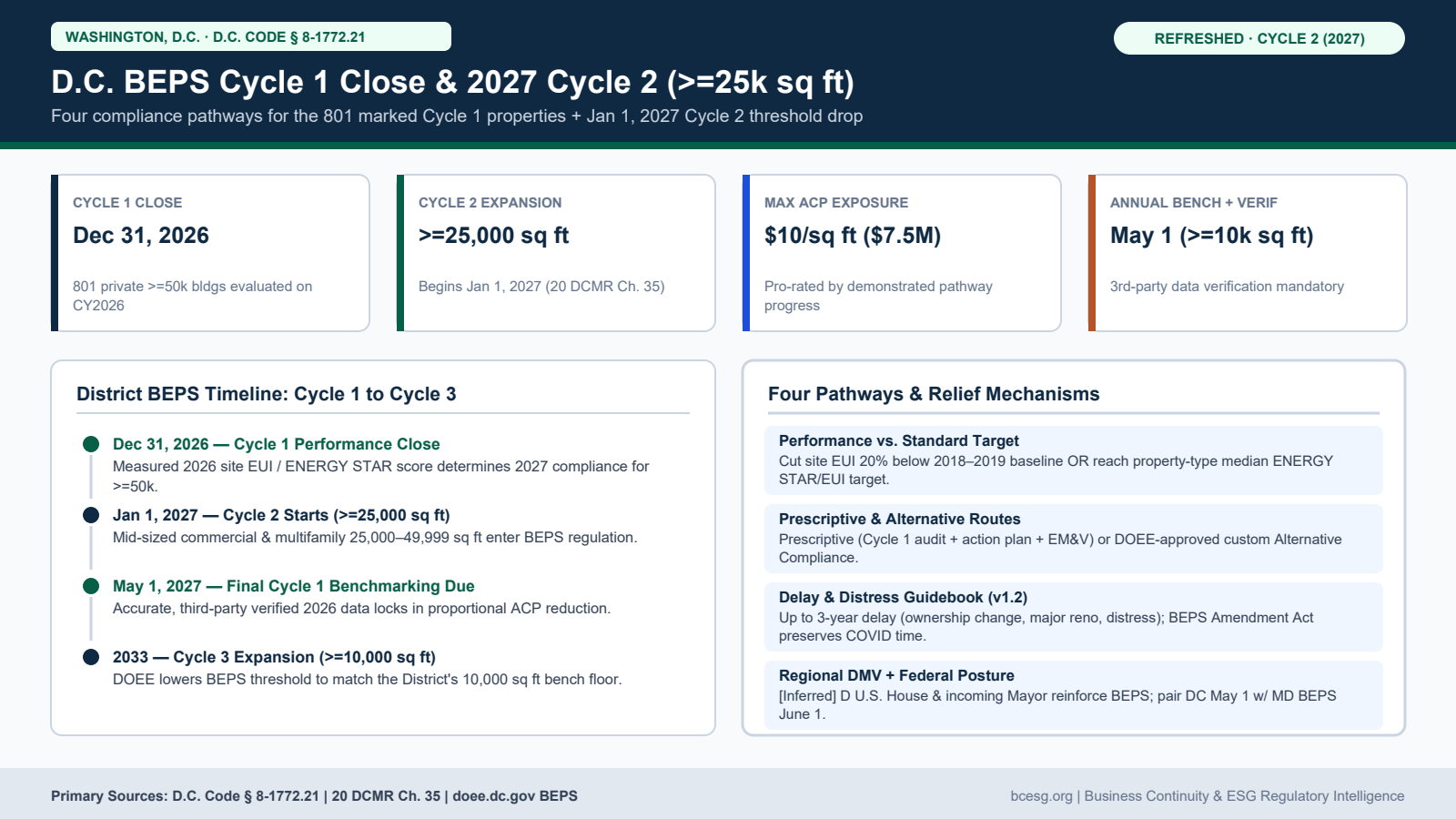
Short answer: The District’s own Building Energy Performance layer, updated in October 2026, marks 801 properties as not meeting the Building Energy Performance Standard against 1,038 marked as meeting it—and Cycle 1 closes on December 31, 2026. Immediately on its heels, Cycle 2 opens January 1, 2027, dropping the private-building BEPS threshold down to 25,000 gross sq ft under D.C. Code § 8-1772.21 and 20 DCMR Chapter 35.
Missing the original Cycle 1 median standard was never the end of compliance: a marked building entered an approved DOEE pathway. Today, the urgent questions are confirming which Cycle 1 pathway closes out your CY2026 measurement year cleanly—and preparing 25,000–49,999 sq ft properties for Cycle 2 enforcement in 2027.
Statutory Status at a Glance
Governing Authority:D.C. Code § 8-1772.21 (CleanEnergy DC Omnibus Amendment Act) & 20 DCMR Ch. 35.
Cycle 1 Close (≥50k Private):December 31, 2026 (CY2026 benchmarking evaluated in 2027; final Cycle 1 benchmarking due May 1, 2027).
Cycle 2 Expansion (≥25k Private): Begins January 1, 2027 (with Cycle 3 dropping to ≥10,000 sq ft in 2033); benchmarking + 3rd-party verification runs annually May 1 (≥10k sq ft).
Post-2026 Political Trajectory (Inferred): Incoming Mayor Janeese Lewis George and a Democratic U.S. House lower Congressional Home Rule preemption risk over DC BEPS enforcement entering Cycle 2.
Print-First Compliance Brief
Close D.C. BEPS Cycle 1 Cleanly & Prep >=25,000 sq ft Assets for Cycle 2 (2027)
2-page quick card summarizing all 4 DOEE pathways, Cycle 1 close (Dec 31, 2026), Jan 1, 2027 >=25k expansion, v1.2 financial distress relief, and ACP math.
What 'Missed' Means—and the Four Cycle 1 Pathways Explained
For Cycle 1, DOEE set each property type’s standard at no lower than the local District median from 2019 benchmarking data (for example, an ENERGY STAR score of 71 for offices, 66 for multifamily housing, 54 for hotels, 50 for hospitals, or 36 for K-12 schools, or source EUI where scores do not apply). Putting the bar at the median placed roughly half of large buildings into Cycle 1 compliance pathways based on each building’s own 2019 record.
Even though compliant buildings cut median weather-normalized EUI by 11.2% between 2019 and 2024, individual buildings that missed entered one of four DOEE Cycle 1 compliance pathways:
1. Performance Pathway (20% Cut): Demonstrate a 20% reduction in site EUI in 2026 versus the building’s 2018–2019 baseline average.
2. Standard Target Pathway (Hit Median in 2026): Reach the District’s property-type standard on measured 2026 data (available where the standard meets or beats national median).
4. Alternative Compliance Pathway (Custom Plan): Execute a DOEE-approved deep energy retrofit or custom trajectory yielding comparable energy savings.
Cycle / Requirement
Covered Building Floor
Key Dates & Statutory Caps
Cycle 1 (Active Close)
Private >=50,000 sq ft (DC >=10k)
Measured through Dec 31, 2026; final CY2026 bench May 1, 2027
Cycle 2 Expansion
Private >=25,000 sq ft (adds 25k–49k)
Starts Jan 1, 2027 under D.C. Code § 8-1772.21 / 20 DCMR Ch. 35
Cycle 3 Expansion
Private >=10,000 sq ft
Scheduled 2033 alignment with District bench threshold
Annual Bench & Verif
All buildings >=10,000 sq ft
Annual May 1 Portfolio Manager report + 3rd-party data verification
Maximum ACP Penalty
Non-compliant GFA
Up to $10/sq ft capped at $7.5M (prorated by verified progress)
Washington, D.C. BEPS Cycle 1 (2021–2026) through Cycle 2 (>=25,000 sq ft starting Jan 1, 2027) pathways and penalty rules under D.C. Code § 8-1772.21.
As Cycle 1 closes December 31, 2026, DOEE shifts immediately into BEPS Cycle 2 on January 1, 2027, extending mandatory performance standards to private commercial and multifamily buildings between 25,000 and 49,999 sq ft (with Cycle 3 hitting ≥10,000 sq ft in 2033). Remember that annual D.C. benchmarking and third-party verification already apply down to 10,000 sq ft every May 1.
Delays, Financial Distress Relief (v1.2), and Maximum $10/sq ft Penalties
Under DOEE’s August 2026 BEPS Compliance and Enforcement Guidebook (v1.2) and the BEPS Amendment Act of 2024, owners with genuine grounds—change of ownership, major renovation, pending demolition, or verified financial distress—can secure up to a three-year compliance delay without losing credit for the prior COVID extension. Delays are paused financing, not erasers: buildings re-enter the next cycle without resetting future targets.
Otherwise, non-compliant buildings face an Alternative Compliance Payment capped at $10 per gross sq ft (up to $7,500,000 per building), prorated downward strictly according to verified energy savings achieved—a financial calculation identical to our business continuity and insurance analysis for LL97.
Compliance Execution Checklist
Step
Owner / Team
Auditable Deliverable
1. Open Data Status
Asset Mgmt
Check building standing in DOEE Building Energy Performance disclosure (Meets / Pathway / Missing).
2. Close Cycle 1 Docs
Energy / PE
Finalize Prescriptive Phase 3–4 EM&V reports or CY2026 meter tracking before Dec 31, 2026.
3. Prep 25k Cycle 2
Portfolio Lead
Flag all DC properties 25,000–49,999 sq ft entering Cycle 2 standards on Jan 1, 2027.
4. May 1 Verified File
Compliance Lead
Submit third-party verified CY2026 benchmarking by May 1, 2027 to preserve proportional ACP relief.
Field & Print Package
Keep This Washington, D.C. Compliance Checklist Handy
Download the formatted 2-page PDF reference brief or pull the structured Markdown edition for internal compliance documentation.
When does D.C. BEPS Cycle 2 begin and what building sizes does it cover?
Cycle 2 begins January 1, 2027 and expands mandatory BEPS compliance to privately owned buildings of 25,000 gross sq ft or larger (down from Cycle 1's 50,000 sq ft threshold).
How is the D.C. BEPS Alternative Compliance Payment calculated if my building only falls slightly short?
The maximum penalty is $10 per sq ft of gross floor area (capped at $7,500,000 per building), but DOEE scales the actual payment down in proportion to verified progress achieved toward the building's pathway target—provided final CY2026 benchmarking data is accurate, complete, and timely.
What threshold triggers annual benchmarking and third-party verification in Washington, D.C.?
Annual May 1 benchmarking and periodic third-party data verification apply to covered private and District-owned buildings of 10,000 gross sq ft or larger.
Can my D.C. building still get a delay for financial distress or renovation?
Yes. Under DOEE's Compliance and Enforcement Guidebook v1.2 and the BEPS Amendment Act of 2024, qualifying owners can apply for up to a 3-year compliance delay for ownership changes, major renovations, pending demolition, or verified financial distress without losing prior COVID timeline relief.
Informational notice: This guide summarizes enacted statutes, regulations, or pending legislative records from the primary authorities linked above as of November 14, 2026. It is not legal, accounting, or licensed engineering advice.
Updated Nov 2, 2026 — added the free SB 253 first-filing quick card, Nov 10 first-filing print pack, and SB 253 first-filing bot book downloads to this checklist.
On October 12, 2026, the California Office of Administrative Law approved the California Air Resources Board’s Initial Regulation for SB 253, and the regulation took effect the same day. That approval locked the date every covered company now has to work to: the first Scope 1 and Scope 2 emissions reports under the Climate Corporate Data Accountability Act are due to CARB on or before November 10, 2026.
This is not a proposed rule and it is not a distant phase-in. It is a live filing, roughly three weeks out, for U.S. companies with more than $1 billion in annual revenue that do business in California. What follows is the practitioner version: exactly who is covered, which fiscal year goes into the first report, the ways CARB will accept the filing, what assurance does and does not require this year, and the preparation steps that still fit in the time left.
Instant First-Filing Downloads
Equip Your Compliance Team or Feed Your AI Assistant
Grounded in California’s approved Initial Regulation (17 CCR §96075–§96078) and HSC §38532. Zero legal advice—practical working tools for the November 10, 2026 deadline.
Field ReferenceFREE
SB 253 First-Filing Quick Card
2-page field card: filing-in-one-table, coverage rules, data year February 1 test, submission routes, fee & penalty schedule, and 5-year records.
U.S.-organized business entities with revenue over $1 billion that do business in California
First deadline
November 10, 2026
Scopes in the 2026 report
Scope 1 and Scope 2 only — Scope 3 is not required this cycle
Data year
Prior fiscal year, selected under the February 1 rule below
How to file
CARB’s voluntary 2026 Report Intake Platform, or email to [email protected]
Assurance
Limited assurance is the statutory standard from 2026, but CARB accepts 2026 filings with or without it
Fee
Annual, formula-based; CARB issues fee determination notices by December 10, payment due within 60 days
Penalty ceiling
Up to $500,000 per reporting year for nonfiling, late filing, or other failure to comply
Records
Keep the California tax records behind your applicability determination for five years
Who must file — and who is out
The regulation defines a “reporting entity” as a partnership, corporation, limited liability company, or other business entity formed under the laws of California, another U.S. state, the District of Columbia, or an act of Congress, with total annual revenues in excess of $1 billion, that does business in California.
Three details of that definition decide most borderline cases. First, revenue means gross receipts, as defined in California Revenue and Taxation Code section 25120(f)(2). Second, the revenue test uses the lesser of the entity’s two previous fiscal years — one exceptional year does not pull an entity in, and one soft year does not let it out. Third, the test is applied entity by entity, at the individual business entity level; revenue from intercompany transactions inside the same combined reporting group does not count toward the threshold.
“Doing business in California” is also a defined term, not a vibe. It means doing business under Revenue and Taxation Code section 23101(a) and meeting either the section 23101(b)(1) or the section 23101(b)(2) test. Wholesale electricity sales in interstate commerce do not count toward the (b)(2) sales test. CARB’s guidance is explicit that entities are responsible for determining their own applicability — there is no approval step where CARB confirms your status for you.
Five categories are outside the article entirely:
Tax-exempt nonprofit or charitable organizations
Business entities regulated by the California Department of Insurance, or in the business of insurance in any other state
Federal, state, and local government entities, and companies majority-owned (over 50 percent) by government entities
Entities whose only California activity is wholesale electricity transactions in interstate commerce
Entities whose only California business is employee compensation or payroll expenses, including teleworking employees
One structural relief valve matters for groups: reports may be consolidated at the parent-company level. A covered subsidiary does not have to file separately if its parent files a consolidated report that includes it.
Which fiscal year goes in the first filing
The first report covers a prior fiscal year, and section 96076(c) of the regulation picks which one by a February 1 line:
Fiscal year ends on or before February 1 in a calendar year → report the fiscal year ending in the current calendar year.
Fiscal year ends after February 1 → report the fiscal year ending in the previous calendar year. The entity may instead choose its most recent preceding fiscal year, if that data is available.
Worked through the common cases: a calendar-year filer reports its 2025 fiscal year. A company whose fiscal year ends June 30 reports the year that ended June 30, 2025 — but may elect the year ended June 30, 2026 if the data is ready. A company whose fiscal year ends January 31 reports the year ended January 31, 2026, because that year ends in the current calendar year under the first branch of the rule.
Scope for this cycle is deliberately narrow. Scope 1 is direct greenhouse gas emissions from sources the entity owns or directly controls, regardless of location, including fuel combustion. Scope 2 is indirect emissions from purchased or acquired electricity, steam, heating, or cooling, regardless of location. Scope 3 — the value-chain inventory — is not part of the 2026 report; under the statute it begins in 2027. Emissions are measured and reported in conformance with the Greenhouse Gas Protocol’s standards and guidance.
The no-data door, stated precisely
For the November 10, 2026 report only, the regulation carries forward CARB’s December 5, 2024 Enforcement Notice. A covered entity has two options:
(A) Submit Scope 1 and Scope 2 emissions from its prior fiscal year that can be determined from information it already possessed or was already collecting on or before December 5, 2024; or
(B) Submit a statement of non-reporting on company letterhead stating that it is not submitting a report because it did not possess Scope 1 or Scope 2 information and was not collecting it on or before December 5, 2024.
CARB asks that the statement be submitted through the intake platform or by email before November 10, 2026. Read this door for exactly what it is: a one-cycle enforcement-discretion posture for the first report, not an exemption from SB 253. An entity that uses it is still a reporting entity, still owes the fee, and still needs a real inventory for the next cycle. Our earlier briefing walks through the three doors into the filing in more depth.
How to file in 2026
CARB built a 2026 Report Intake Platform, and its status surprises people: use of the platform is voluntary, not mandatory. Ahead of the deadline it can carry your contact information, your Scope 1 and 2 report through its submission fields, and the billing information CARB needs for fee invoicing. The alternative route is plain email — send the emissions report and contact information to [email protected].
The first-year formats are equally pragmatic. CARB’s September 1, 2026 reporting guidance accepts an existing annual report that includes Scope 1 and 2 emissions, existing Scope 1 and 2 data already reported to other programs or voluntary initiatives, or CARB’s Draft Scope 1 and 2 GHG Reporting Template — which is itself voluntary for 2026. For Scope 2, no single factor dataset is mandated this year: EPA eGRID 2023, the Cornerstone Sustainability Data Initiative’s eGRID 2024, or other credible sources may be used, provided the filing identifies the factors and sources behind the numbers.
CARB also encourages filers to include the context around the numbers — methodologies, data sources, global warming potential values, emission factors, organizational boundaries, disaggregation by category and gas, and assumptions. That context is encouraged rather than mandated in the first-year guidance, but it is the cheapest defensibility a filer can buy: it is the record that shows how each number was produced.
November 10, 2026 Deadline
Operationalize Your First SB 253 Filing
With California’s first filing deadline days away, covered entities cannot afford ambiguous gross receipts calculations, misapplied February 1 fiscal year rules, or unorganized submission records. Build an auditable five-year compliance file and evaluate your data options under CARB’s first-year enforcement rules.
• Applicability Worksheet: RTC §25120 & §23101 tests.
• Fiscal Year Picker: 17 CCR §96076(c) worked form.
• Scope 1 & 2 Checklist: Dec 5, 2024 baseline inventory.
• Submission Checklist: Intake platform vs email route.
• AI Bot Routines: 4 automated workflows ($17).
Secure 1-Click Square Checkout
Assurance: the requirement versus the first-year enforcement
The statute sets a real assurance ladder. Health and Safety Code section 38532 requires independent third-party assurance of the disclosure: limited assurance for Scope 1 and 2 beginning in 2026, rising to reasonable assurance beginning in 2030.
The first-year enforcement posture is different from the requirement, and conflating the two is the most common error in coverage of this filing. CARB’s FAQ and its September 2026 guidance state that CARB will accept 2026 submissions whether or not assurance has been obtained. The obligation did not move; the enforcement did. Assurance requirements for 2027 and beyond are part of CARB’s second rulemaking and are not settled by the Initial Regulation — so the correct 2026 posture is to file on time, and to build the inventory so that it can survive limited assurance when the second rulemaking lands.
Fees, penalties, and the five-year file
The fee is an annual implementation fee assessed per reporting entity, calculated by formula: CARB’s program costs are recovered across the number of covered entities, with contingency and debt components in the calculation. The approved regulation sets the mechanics, not a fixed dollar figure — anyone quoting you an exact per-company fee for 2026 is quoting an estimate, not the rule. CARB issues fee determination notices by December 10, and payment is due within 60 calendar days of the notice. A parent may pay on a consolidated basis, but the fee is still assessed per covered entity.
The penalty exposure sits in the statute. CARB’s penalty regulations may reach nonfiling, late filing, or other failure to meet the law’s requirements, and penalties imposed on a reporting entity shall not exceed $500,000 in a reporting year. In setting a penalty, CARB considers all relevant circumstances, including the entity’s past and present compliance and whether it took good-faith measures to comply, and when. Keep that separate from fee enforcement: under the fee subarticle, each calendar day of a violation is a separate offense, violations may be enjoined, and an unpaid fee is a separate violation for each day it remains unpaid. The $500,000 cap and the daily fee offenses are two different mechanisms, and a compliance calendar should track both.
Finally, the recordkeeping rule that outlives the deadline: entities must keep the California tax records that prove the revenue and doing-business thresholds for five years, and produce them on request. Your applicability memo is not a one-time work product; it is a five-year file.
What changed on the way to November 10
Companies that planned against the original calendar have already been whipsawed once, and the history explains the current date. SB 219 (2024) amended SB 253 and its companion law — among other changes it moved CARB’s deadline to adopt the implementing regulation and formalized parent-level consolidation. The Initial Regulation CARB approved on February 26, 2026 set the first filing deadline at August 10, 2026. CARB withdrew that package from the Office of Administrative Law on June 24, released modified text for a 15-day comment period on July 27 deferring the deadline to November 10, 2026, resubmitted the final package on September 21, and OAL approved it effective October 12, 2026.
The lesson is not that dates move. It is that this date has finished moving: the regulation is approved and in effect, and November 10 is the deadline in the operative text.
Preparation checklist: the next three weeks
Close the applicability question in writing. Entity-by-entity revenue test on the lesser of the last two fiscal years, doing-business analysis, exemption check — signed off and filed for the five-year record.
Pick the fiscal year deliberately. Apply the February 1 rule, and where the election exists, decide whether the most recent preceding fiscal year is genuinely ready or merely newer.
Inventory what existed on December 5, 2024. That date decides whether you file numbers, file numbers built from what you had, or file the letterhead statement. Do not reconstruct this answer from memory in November.
Choose the route and format. Intake platform or email; existing report, other-program data, or CARB’s draft template. Any of them beats a late bespoke build.
Assemble the methodology context now. Boundaries, factors and their sources, GWP values, assumptions — while the people who produced the numbers still remember how.
Set the assurance posture explicitly. Filing without assurance is accepted in 2026; arriving at the second rulemaking with an unassurable inventory is the real risk. Build to the limited-assurance standard even if no provider signs this cycle.
Calendar December 10. The fee determination notice starts a 60-day payment clock, and it lands in the middle of year-end close.
Read the filing the way your insurer will. A CARB submission is a dated, signed representation about your operations. Our sister desk at Risk Coverage Hub reads the same filing as a liability document — what a missed or inconsistent filing does to penalties, D&O applications, and renewals.
One tooling note for teams starting from zero: BC ESG’s Corporate Carbon Footprint Calculator can size a Scope 1, 2, and 3 footprint quickly enough to sanity-check an inventory in progress. Use it for exactly what it is — a planning estimate built on published U.S. EPA factors, in the page’s own words not an audit, not a GHG Protocol inventory, and not a certification. It is a reasonableness check on the filing, never a substitute for it.
Choose Your SB 253 Compliance Toolkit
Grounded directly in California’s approved Initial Regulation (17 CCR §96075–§96078) and HSC §38532.
Quick Reference
SB 253 First-Filing Quick Card
FREE
2-page printable card: filing-in-one-table, coverage rules, February 1 test, submission routes, and 5-year records.
Is the November 10, 2026 deadline real, or is the regulation still proposed?
It is real. The Office of Administrative Law approved CARB’s Initial Regulation on October 12, 2026 and it took effect that day. The operative regulation sets the first Scope 1 and Scope 2 reports due on or before November 10, 2026. Older CARB web pages still carry some “proposed” language; the October approval and CARB’s September 1, 2026 reporting guidance control.
Our revenue crossed $1 billion once, two years ago. Are we covered?
Probably not on that fact alone — and the reverse is also true. Applicability uses the lesser of your two previous fiscal years’ gross receipts, measured entity by entity. One spike year above $1 billion with the other year below it leaves the lesser year under the line. Two years above it puts you in, even if the current year is softer.
We have no emissions data at all. What do we file?
For the 2026 report only, if you did not possess Scope 1 or Scope 2 information and were not collecting it on or before December 5, 2024, you may submit a statement of non-reporting on company letterhead, through the intake platform or by email, before November 10, 2026. That is a first-cycle enforcement posture, not an exemption — and the statement must be true. If you were collecting data for any purpose by that date, the honest route is to report what that data supports.
Do we have to use CARB’s intake platform?
No. The 2026 Report Intake Platform is voluntary. You may file through it — it also collects contact and billing information for fee invoicing — or email your emissions report and contact information to [email protected]. CARB’s own draft reporting template is likewise voluntary for 2026; an existing annual report or data already reported to another program can serve as the filing.
Is third-party assurance required for the 2026 filing?
The statute requires limited assurance of Scope 1 and 2 disclosures beginning in 2026, with reasonable assurance from 2030. For this first cycle, however, CARB has stated it will accept 2026 submissions whether or not assurance has been obtained. Treat that as enforcement discretion for one year, not a repeal: assurance requirements from 2027 sit in CARB’s second rulemaking.
What does the filing cost, and what does a miss cost?
The annual fee is formula-based — CARB’s program costs divided across covered entities — with determination notices issued by December 10 and payment due within 60 days; the regulation does not set a fixed dollar amount. A miss costs more: administrative penalties for nonfiling, late filing, or other failure to comply can reach $500,000 in a reporting year, with good-faith compliance efforts counted in the entity’s favor, and fee violations accrue as separate daily offenses on top of that.
Is SB 261 the same deadline?
No. SB 261 is the companion climate-risk reporting law for companies over $500 million, on a biennial cycle — and its enforcement is currently enjoined by the Ninth Circuit. November 10, 2026 is an SB 253 date, for Scope 1 and Scope 2 emissions, for companies over $1 billion. The two laws share a regulation but not a deadline, a threshold, or a current enforcement posture.
A compliance framework is a published set of requirements or controls that tells an organization what it must do — or what good looks like — in an area such as financial reporting, data protection, workplace safety, or environmental management. Frameworks come from legislatures, regulators, standards bodies, and industry groups, and they differ in a way that matters enormously in practice: some are law with penalties behind them, and some are voluntary standards that become mandatory only because a customer, contract, or certification demands them.
Boardrooms tend to meet frameworks as an undifferentiated pile of acronyms, each arriving with its own auditor and deadline. The pile becomes manageable once sorted by two questions: who issued this, and what compels us to follow it? This page is that sorting — a map, not a sales pitch.
Who Issues Compliance Frameworks?
Compliance frameworks are issued by four kinds of bodies: governments and regulators, whose frameworks are law; international standards organizations, whose frameworks are voluntary until adopted or contracted; industry bodies, whose frameworks govern a sector’s participants; and reporting initiatives, whose frameworks shape disclosure to investors and the public. Knowing which kind you are looking at tells you the consequence of ignoring it — prosecution, decertification, expulsion from a payment network, or a difficult conversation with shareholders.
Governments and regulators issue the non-negotiables. Financial reporting law for public companies, data-protection regulation, occupational safety rules, environmental permits and emissions rules: these bind by jurisdiction, apply whether or not a company likes them, and carry fines or worse. Examples of the genre include the Sarbanes-Oxley Act’s internal-control requirements for U.S. public companies, the European Union’s General Data Protection Regulation (GDPR) for personal data, and the U.S. Occupational Safety and Health Administration’s (OSHA) workplace standards. Nobody opts in. The only decisions are how to comply and how to prove it.
International standards bodies — principally the International Organization for Standardization (ISO) and the International Electrotechnical Commission (IEC) — publish management-system standards: ISO 9001 for quality, ISO 14001 for environmental management, ISO/IEC 27001 for information security, ISO 45001 for occupational health and safety. These are voluntary in law. In practice, they become compulsory the moment a major customer requires certification in a supply contract or a tender scores it — which, in many industries, is most of the time.
Industry and scheme bodies govern participation in a system. The PCI Security Standards Council — founded by the major card brands — maintains the PCI DSS, which applies to organizations that handle payment card data not by statute but by contract with the card networks; non-compliance risks fines through acquiring banks and, ultimately, the ability to take cards at all. Accounting and audit professions, through bodies such as the American Institute of Certified Public Accountants (AICPA), maintain attestation frameworks like the SOC reporting suite, which service providers undergo to demonstrate controls to their customers’ auditors.
Reporting and disclosure initiatives — the GHG Protocol for emissions accounting, sustainability reporting standards such as those of the International Sustainability Standards Board (ISSB) and the Global Reporting Initiative (GRI) — set the formats in which companies disclose. Voluntary at birth, they harden into obligation as securities regulators adopt them into listing rules and as large buyers require them of suppliers.
How Do the Frameworks Overlap?
Frameworks overlap because they are all, underneath the vocabulary, asking for the same management behaviors: assign responsibility, assess risk, write the procedure down, control access, train people, monitor what happens, and fix what fails. An organization with disciplined document control, access management, incident response, and internal audit will find that each new framework reuses most of what the last one built. The overlap is the good news buried in the acronym pile.
The overlaps worth knowing concretely: the ISO management-system standards share a common structure by design, so a company certified to one can extend to another at a fraction of the first one’s cost. Control frameworks converge — the access-control, logging, and change-management evidence produced for a SOC 2 examination substantially serves PCI DSS and ISO 27001 audits, even though each is attested differently. And data-protection law sits across all of them: GDPR-style obligations attach to the personal data processed inside every other framework’s systems.
Where overlap becomes waste is duplication without mapping: three audits sampling the same evidence because nobody cross-referenced the requirements, or parallel policy libraries written separately for each regime. Mature compliance functions maintain one control set mapped to many frameworks — comply once, attest many times. Immature ones discover the map after paying for the territory several times over.
How Should a Leadership Team Read This Map?
A leadership team should read the framework landscape by compulsion and by audience: what binds us by law in the jurisdictions where we operate; what binds us by contract with the customers and networks we depend on; and what we adopt voluntarily because the market rewards it. Each layer gets a different governance conversation — legal obligations are resourced without debate, contractual ones are weighed against the relationship they protect, and voluntary ones must justify themselves commercially.
That ordering also restores proportion. The question in the boardroom is rarely “how do we comply with everything?” It is “what is actually being asked of us, by whom, with what consequence — and what single set of controls answers the most of it?” Companies that can answer that question on one page rarely fear the acronym pile. Companies that cannot are usually complying with the loudest auditor rather than the binding requirement, which is the most expensive posture of all.
The umbrella terms, answered in ESG terms
“Compliance” in the ESG sense is narrower than the word sounds. It does not mean obeying every law that touches the business — it means meeting the specific obligations that environmental, social, and governance regimes place on the company: the disclosures owed, the thresholds respected, the due diligence performed, the claims substantiated. Regulatory compliance is the subset owed to governments — California’s climate disclosure laws, the EU’s CSRD, local regimes like New York’s Local Law 97. Corporate compliance is the function inside the company that owns those obligations — the register of what is owed, to whom, by when, and the evidence that it happened. And compliance risk is what the map above is really for: the exposure created when an obligation exists that the company has not noticed, cannot evidence, or has publicly claimed to meet when it has not. Greenwashing findings are compliance-risk events; most of them began as marketing sentences nobody checked against the register.
What a compliance check actually looks like
A compliance check is a reconciliation, not a vibe. Take one obligation family — say, climate disclosure — and walk four questions. What exactly is owed: which entities, which metrics, which years, in what format, assured to what level? What do we currently produce: measured, estimated, or absent? Where is the gap, in data, in process, or in ownership? And what closes it, by when, owned by whom? Run that reconciliation per regime, on a calendar tied to filing dates rather than fiscal convenience, and the umbrella terms stop being abstract: “compliance requirements” becomes a list with dates, and “compliance check” becomes the meeting where the list is graded. One vocabulary trap to clear: a compliance certificate in this world is an attestation — a signed statement, an assurance report, a filing confirmation — not a product. Anyone selling one as a product is selling the paper, not the compliance.
How the frameworks stack on a real company
The map above is drawn framework by framework; companies live it stacked. A mid-market manufacturer selling into Europe can simultaneously owe: CSRD-shaped disclosure through its customers’ value-chain questionnaires, California disclosure on its own revenue footprint, LL97 filings on a New York building it owns, GHG Protocol accounting underneath all three, and a voluntary framework (GRI or the ISSB standards) chosen to keep the answers consistent. The working discipline is to build the data once — emissions, energy, workforce, governance — at the granularity the strictest regime demands, and let each framework draw from the same well. Companies that answer each regime with a separate spreadsheet end up contradicting themselves in public, which is the one compliance failure no framework forgives. The deep structure is in this site’s regulatory frameworks guide; the concepts it all rests on are in ESG meaning.
Frequently asked questions
What is regulatory compliance in ESG?
Meeting the obligations that ESG-related laws and rules place on a company: climate and sustainability disclosures, building performance standards, supply-chain due diligence, and substantiation of environmental claims. It is the government-owed subset of the wider compliance function.
What is the difference between compliance and ESG reporting?
Reporting is producing the disclosure. Compliance is meeting the obligation the disclosure answers to — the right entities, metrics, periods, format, and assurance level, on time, with evidence retained. Companies can report beautifully and still be non-compliant.
What is a compliance check?
A structured reconciliation between what a regime requires and what the company currently produces: the obligation, the current state, the gap, and the closure plan with an owner and a date. Run per regime on a calendar tied to filing deadlines.
Which ESG framework should a company follow?
The ones that are owed, first — by law, by listing rule, or by customer contract. Voluntary frameworks (GRI, ISSB, TCFD-aligned reporting) are then chosen to make the owed answers consistent and comparable. The data should be built once, at the strictest granularity, and drawn on by every framework.
SEC Climate Disclosure Rule: 2026 Status, Timeline & What Companies Must Do Now
Updated November 21, 2026.
Regulatory status verified against SEC / Federal Register rulemaking dockets, Eighth & Ninth Circuit court records, CARB, EU EUR-Lex, and IFRS Foundation publications — November 21, 2026.
The SEC’s 2024 climate disclosure rule has been effectively rescinded. The SEC stopped defending it in March 2025 and proposed full withdrawal. But disclosure obligations haven’t disappeared — California’s SB 253, the EU’s CSRD, and ISSB S2 now fill the gap. The timeline table below shows exactly where things stand.
SEC Climate Disclosure Rule: Full Timeline
Date
Event
What It Means
March 2024
SEC finalizes climate disclosure rule
Required Scope 1, 2, 3 reporting for public companies
April 2024
SEC voluntarily stays the rule
Implementation paused pending legal challenges
March 2025
SEC stops defending the rule
Rule effectively abandoned under new administration
Nearly 40 jurisdictions (37–39) adopting or introducing ISSB Standards
What Public Companies Must Do Now
Even though the federal SEC rule is being withdrawn, climate disclosure obligations remain. Companies operating in California, the EU, or with international investors face binding requirements under:
California SB 253 — requires large companies (>$1B revenue) doing business in California to disclose Scope 1 and Scope 2 emissions (Nov. 10, 2026 deadline upheld; Scope 3 enjoined by the Ninth Circuit on Nov. 9, 2026)
California SB 261 — climate-related financial risk disclosure (>$500M revenue), currently enjoined by the Ninth Circuit (Nov. 9, 2026); CARB docket open for voluntary submissions
EU CSRD — under Directive (EU) 2026/470 (Omnibus I), applies to EU companies exceeding 1,000 employees and €450M net turnover, plus qualifying non-EU groups (>€450M EU turnover) from FY 2028
ISSB S2 — nearly 40 jurisdictions (37–39) adopting or introducing ISSB Standards as the global baseline
Is the SEC climate disclosure rule still in effect in 2026?
No. The SEC stopped defending the rule in March 2025 and has proposed full rescission. The rule is effectively dead at the federal level, though state and international obligations remain.
What replaced the SEC climate disclosure rule?
California’s SB 253 (Scope 1 and 2 active; Scope 3 enjoined on Nov. 9, 2026) is the primary binding US state emissions mandate, while SB 261 remains enjoined pending litigation. Internationally, nearly 40 jurisdictions (37–39) are adopting or introducing ISSB S2.
Do companies still need to disclose climate risk in 2026?
Yes — companies operating in California, the EU, or with international investors face binding climate disclosure requirements regardless of the SEC rule being withdrawn.
When did the SEC abandon its climate disclosure rule?
The SEC voluntarily stayed the rule in April 2024, stopped defending it in March 2025, and proposed full rescission in 2026.
If investors or regulators ask how you manage algorithmic risk in ESG data and decisions, this 2026 guide covers governance, documentation, and disclosure patterns.
AI systems have graduated from “nice to have” technology to material ESG risk. The landscape shifted decisively in 2026, and organizations that haven’t built AI governance frameworks are now facing disclosure obligations they didn’t anticipate.
The convergence of three regulatory forces—the EU AI Act’s high-risk tier implementation, the CSRD (Corporate Sustainability Reporting Directive) inclusion of AI as an ESG material risk, and a wave of US state-level AI transparency laws—has created a new reality: AI governance is now a boardroom issue, not just an IT issue.
The Regulatory Landscape Shift in 2026
The EU AI Act entered full implementation for high-risk systems in 2026. High-risk designation now covers AI used in critical infrastructure, employment decisions, credit decisions, and any system that can create legal or similarly significant effects. Organizations deploying these systems must maintain technical documentation, implement human oversight mechanisms, and maintain detailed audit logs—or face fines up to 6% of global revenue.
The California AI Transparency Act took effect January 1, 2026, requiring disclosure of AI-generated content and detailed training data provenance. This isn’t optional disclosure to regulators; it’s disclosure to users and consumers. A California-based company deploying AI in customer-facing roles must now disclose that fact and describe where the training data came from.
Texas passed the Responsible AI Governance Act and Colorado enacted the AI Act, both focused on algorithmic discrimination prevention. These states are now requiring algorithmic impact assessments for any AI system used in hiring, lending, housing, or insurance decisions. Texas explicitly requires evidence that algorithms don’t discriminate by protected class; Colorado mandates algorithmic transparency and opt-out mechanisms.
CSRD, now in full effect for many EU organizations, has formalized AI governance as a material ESG risk category alongside climate, labor, and supply chain. If your organization uses AI to make consequential decisions or creates algorithmic bias risk, CSRD requires disclosure in your sustainability report—just as you’d disclose Scope 2 emissions.
The Disclosure Obligation Framework
Here’s what ESG teams and compliance officers need to understand: AI governance disclosure falls into three overlapping buckets.
Algorithmic Accountability Disclosure: What AI systems does your organization deploy? What decisions do they influence? What safeguards are in place to prevent discrimination or harm? This is the California AI Transparency Act requirement. It’s also what CSRD reviewers will ask about. The disclosure should include: system purpose, training data sources, human oversight mechanisms, and documented testing for bias and accuracy.
Explainability and Human Oversight: Can you explain how the algorithm makes decisions? Who reviews those decisions? This is the core of EU AI Act compliance for high-risk systems. The requirement isn’t perfect explainability—it’s documented human oversight and a mechanism to challenge algorithmic decisions. Insurance underwriting AI? That means having a human underwriter review or spot-check claims. Employment AI? That means someone can explain to a candidate why they weren’t hired.
Governance Process Disclosure: How does your organization govern AI systems? Who approves new deployments? How do you monitor for drift, bias, or performance degradation? CSRD reviewers want evidence of governance structure: a chief AI officer or designated AI governance committee, documented policies, regular audit procedures, and clear escalation paths when issues arise.
The Cross-Sector Implementation Challenge
AI governance requirements look different depending on your industry, but the core disclosure obligation is universal. Here’s how this plays out in four critical sectors:
Property Restoration & Insurance Claims: Organizations using AI-powered damage assessment tools (drone imagery analysis, computer vision systems) must disclose the accuracy rates of those systems, the human review process when AI assessments seem incorrect, and the liability framework when AI assessments are wrong. Read the restoration sector analysis here. The restoration industry adopted AI assessment tools faster than governance frameworks kept pace—2026 is the year that gap gets exposed.
Insurance Underwriting & Risk: State insurance commissioners are conducting detailed examinations of algorithmic underwriting and pricing models. Carriers must now disclose which variables their algorithms use, prove those variables don’t correlate with protected classes, and maintain an appeal process when an applicant challenges an algorithmic decision. The insurance sector governance framework is detailed here. Carriers using AI in claims handling face parallel requirements: transparency about which claims are routed to automated decision-making, what percentage of claims are adjudicated purely by algorithm, and human appeal mechanisms.
Business Continuity & Operational Resilience: The newer risk—and the one most organizations haven’t addressed—is AI dependency as a single point of failure. When GenAI tools, workflow automation, or AI-powered decision support systems go down, how long before operations halt? Business continuity governance for AI is explored in detail here. BC teams need to map AI systems into their Business Impact Analysis and develop resilience strategies for when vendor tools or internal AI systems fail.
Healthcare Facility Operations: The FDA’s Quality Management System Regulation, effective in 2026, now treats AI and machine learning medical devices under expanded oversight. CMS is flagging AI systems in clinical decision-making. Healthcare facility governance requirements are outlined here. The complexity: clinical AI (diagnostic support, treatment planning) and operational AI (predictive maintenance, scheduling) follow different regulatory tracks, but both need governance.
Building the Governance Framework
Organizations that move fast in 2026 will establish an AI governance framework with these components:
AI System Inventory: Document every AI system in use: internal tools, SaaS platforms, embedded vendor algorithms. For each, record: purpose, decision authority (does it decide or recommend?), training data source, accuracy metrics, human review process, and last audit date.
Risk Assessment Protocol: Assess each system’s ESG risk: Does it affect protected classes? Does it influence consequential decisions? Could failure cause operational harm? High-risk systems get more rigorous oversight.
Governance Accountability: Assign clear accountability: Who approves new AI deployments? Who monitors for bias and drift? Who handles escalations when AI systems fail or produce unexpected outcomes? This should ladder up to the board or an audit committee.
Documented Human Oversight: For high-risk systems, document the human oversight mechanism. This doesn’t mean humans should override every algorithmic decision; it means someone can explain the decision and has the authority to escalate or appeal it.
Regular Audit and Testing: Establish a cadence for testing AI systems—at minimum annually—for accuracy, bias, drift, and compliance with documented performance standards. Document the results.
Disclosure Readiness: Prepare your ESG disclosure now. Be ready to answer: What AI systems do you use? How do you govern them? What safeguards are in place? What testing have you done? CSRD reviewers, state regulators, and proxy advisory firms are going to ask these questions. Organizations with documented frameworks will move through audits far more quickly.
The Convergence Risk
The real challenge isn’t any single regulation. It’s the convergence: CSRD disclosure requirements + EU AI Act penalties + California transparency obligations + state-level algorithmic discrimination rules = a comprehensive governance obligation that most organizations haven’t integrated.
The organizations building advantage in 2026 are the ones treating AI governance not as a compliance checkbox but as a core ESG and operational risk framework. They’re integrating it into capital allocation, vendor evaluation, and board reporting. They’re making algorithmic accountability a competitive advantage, not a liability.
Your ESG team, compliance team, IT team, and board need to align on AI governance right now. The regulatory window for moving fast and building legitimate frameworks is open in Q2 and Q3 2026. By Q4, regulators will have sharper guidance on enforcement, and the organizations without documented frameworks will be scrambling.
Global ESG Regulatory Convergence: ISSB Adoption, Jurisdictional Mapping, and Interoperability
Updated October 6, 2026.
Updated Nov 2, 2026 — added the free ISSB convergence quick card, ISSB adoption & interoperability print pack, and ISSB convergence copilot downloads to this guide.
If you map ISSB S1/S2 adoption across jurisdictions, this guide compares EU CSRD, California, SEC, and emerging climate disclosure regimes as of October 2026.
Definition: Global ESG regulatory convergence refers to the increasing alignment of sustainability disclosure standards across jurisdictions around the ISSB (International Sustainability Standards Board) standards, which provide a globally consistent, investor-focused baseline for climate and broader environmental, social, and governance disclosure. As of March 2026, 20+ jurisdictions have adopted or are implementing ISSB standards, creating a framework for interoperability across regional standards (EU CSRD, SEC climate rule, California SB 253) while significant gaps and conflicts remain.
Instant ISSB Regulatory Convergence Downloads
Equip Your Compliance Team or Feed Your AI Assistant
Grounded strictly in published ISSB IFRS S1/S2 standards, EU CSRD, SEC climate rules, and California SB 253. Zero legal advice—practical working tools and AI routines for multi-jurisdictional reporting.
Field ReferenceFREE
ISSB Convergence Quick Card
2-page field card: IFRS S1 & S2 foundation, 20+ jurisdictions mapped, named-market snapshot (EU CSRD, UK, Japan, Canada, Australia, Singapore), and the core rule: convergence is not identity.
The International Sustainability Standards Board (ISSB)
History and Development
The ISSB was formally established in 2022 under the International Financial Reporting Standards (IFRS) Foundation, building on the TCFD (Task Force on Climate-related Financial Disclosures) framework. The ISSB published two foundational standards in June 2023:
IFRS S1 (General Requirements): Overarching principles for identifying and disclosing material sustainability-related financial information
IFRS S2 (Climate): Specific requirements for climate-related disclosures aligned with TCFD; requires Scope 1, 2, and (in certain cases) Scope 3 GHG emissions reporting
ISSB Standard Fundamentals
The ISSB standards are grounded in key principles:
Double Materiality Assessment: Companies must disclose information material to investors (financial materiality) and information where company impacts are material to society/environment (impact materiality)
Investor-Centric Focus: Primary objective is providing investors with decision-useful information; non-financial stakeholders’ interests are secondary
Alignment with TCFD: IFRS S2 incorporates TCFD recommendations; companies already TCFD-compliant face minimal incremental burden
Industry-Specific Guidance: ISSB acknowledges material issues vary by industry; industry guidance is under development
Global Jurisdictional Adoption Status (March 2026)
Jurisdictions Adopting or Implementing ISSB
As of March 2026, 20+ jurisdictions have announced adoption or implementation of ISSB standards. Key markets include:
European Union
The EU has adopted a convergence approach, integrating ISSB principles into the CSRD (Corporate Sustainability Reporting Directive). Large companies (>500 employees) must comply with CSRD starting 2024 (for certain companies) and 2025-2026 (for others). CSRD is more comprehensive than ISSB (covering social issues, board diversity, supply chain due diligence) but aligns on climate and environmental metrics.
United Kingdom
The FCA (Financial Conduct Authority) has announced alignment with ISSB standards for UK-listed companies. Transition from TCFD to ISSB-aligned requirements is underway, with full implementation expected 2025-2026. The UK Taxonomy also incorporates ISSB principles.
Japan
Japan has adopted ISSB standards. The Financial Services Agency requires large companies to adopt ISSB by 2030. Japan has also developed supplementary requirements addressing social issues material to Japanese stakeholders (female leadership, labor practices).
Canada
Canada has aligned with ISSB, requiring large companies to disclose climate-related information consistent with ISSB standards. Implementation timeline: 2024-2026 for Scope 1-2 emissions; Scope 3 phased in 2027-2028.
Australia
Australia has legislated climate disclosure requirements aligned with ISSB. The Treasury Laws Amendment (2023) requires all ASX-listed companies to disclose climate risks and emissions using ISSB/TCFD framework. Reporting begins 2024.
Singapore
Singapore has adopted ISSB-aligned standards. The SGX (Singapore Exchange) requires listed companies to comply with ISSB disclosure standards, with phased implementation through 2026.
United States
The SEC climate rule is partially aligned with ISSB on Scope 1-2 emissions but differs on Scope 3 requirements and materiality framework. The SEC has indicated longer-term convergence toward ISSB standards, but current rule proceeds independently due to US constitutional and regulatory constraints.
Hong Kong
Hong Kong has aligned disclosure requirements with ISSB. Listed companies on HKEX must comply with ISSB-aligned climate and sustainability standards.
Partial Adoption and Emerging Markets
Many other jurisdictions (Brazil, India, Indonesia, Mexico, South Korea, Taiwan, Thailand, Vietnam) have signaled adoption or are developing ISSB-aligned standards. However, implementation timelines vary, and full convergence remains years away. Some jurisdictions maintain parallel or alternative frameworks.
Comparative Analysis: ISSB vs. Regional Standards
Dimension
ISSB (S1, S2)
EU CSRD
SEC Climate Rule
California SB 253
Scope 1-2 Emissions
Required
Required
Required (2026)
Required (2026)
Scope 3 Emissions
If material; phased
Required for all companies
If material; phased
If material (40% threshold)
Social Disclosure
Limited (materiality-based)
Comprehensive (governance, labor, human rights)
Climate-only
Climate-only
Governance Disclosure
Climate governance required
Board diversity, executive comp linkage
Climate governance required
Implicit in adaptation planning
Assurance
Limited (ISSB S1/S2 silent)
Limited assurance required
Not mandated
Not mandated
Liability Standard
Varies by jurisdiction
Administrative penalties, director liability
Securities fraud standards
Strict liability (SB 261)
Multi-Jurisdictional Reporting Architecture
Operationalize Global Regulatory Convergence
Don’t let divergent regional timelines or conflicting materiality thresholds stall your compliance program. Apply the article’s core operational principle: build once to the strictest standard reaching your corporate group. Whether you need printable working matrices and trackers or structured prompts to run compliance audits inside your own AI assistant, these tools provide an immediate, auditable pathway across ISSB, EU CSRD, SEC, and California SB 253.
• Regime Reference Table: ISSB vs CSRD vs SEC vs CA.
• Jurisdiction Tracker: 20+ countries with exposure flags.
• Compliance Matrix: “Build once to strictest” worksheet.
• Crosswalk Worksheet: Single vs double materiality.
• 3-Year Roadmap: Phased planner with accountability logs.
• AI Copilot Routines: 4 interactive workflows ($17).
Secure 1-Click Square Checkout
Interoperability Challenges and Solutions
Key Interoperability Gaps
Materiality Definitions: ISSB relies on investor materiality; CSRD requires double materiality assessment; these can produce conflicting scope and disclosure requirements
Engage Stakeholders: Invest in investor and regulator engagement to understand evolving standards and expectations
Barriers to Convergence
Jurisdictional Sovereignty and Policy Divergence
While ISSB provides a common language, full convergence is constrained by jurisdictional differences in climate policy priorities, social values, and regulatory philosophy. For example:
EU prioritizes just transition and social inclusion; requires board diversity and supply chain due diligence not in ISSB
US emphasizes investor protection; applies securities fraud standards inconsistent with ISSB liability frameworks
California imposes strict liability for misstatements, departing from ISSB approach
Emerging markets may lack capacity or resources to implement full ISSB standards
Political Resistance and Business Advocacy
Business groups in some jurisdictions (US, Australia, some Asian markets) continue to oppose aggressive climate disclosure, citing competitiveness concerns and constitutional objections. This political resistance has delayed or diluted ISSB adoption in certain regions.
Emerging Standards and Future Directions
Nature-Related Financial Disclosure (TNFD)
The Task Force on Nature-related Financial Disclosures published its framework in 2023. As of March 2026, TNFD is complementing ISSB in progressive jurisdictions (EU, UK, Australia) by extending disclosure requirements to biodiversity and ecosystem impacts. Full ISSB integration of TNFD principles is expected 2026-2027.
Social and Governance Standards
ISSB is developing supplementary standards for material social and governance issues. Early drafts address human capital (labor practices, diversity), business conduct (anti-corruption, ethics), and supply chain governance. Finalization expected 2026-2027.
AI and Emerging Risk Disclosure
Regulators are considering requirements for disclosure of AI-related risks and governance. ISSB may expand to cover AI governance and risks in future iterations.
Should my company adopt ISSB standards even if not required by regulation?
Yes. ISSB provides a globally recognized baseline for ESG disclosure, facilitating investor understanding and capital market efficiency. Voluntary ISSB adoption demonstrates sustainability commitment and can enhance investor relations. Additionally, as more jurisdictions adopt ISSB-aligned standards, early adoption reduces future compliance burden.
How do I reconcile ISSB materiality with CSRD double materiality?
ISSB’s single materiality (investor-centric) is narrower than CSRD’s double materiality (investor + impact). To satisfy both, assess issues under both standards: include items material to investors (ISSB) plus items material to society/environment even if not investor-material (CSRD). This produces comprehensive disclosure satisfying strictest requirements.
What is the interoperability between ISSB and EU CSRD?
High interoperability on climate metrics (Scope 1-2-3 emissions); moderate on governance (CSRD requires board diversity, executive comp linkage); low on social issues (CSRD comprehensive, ISSB minimal). EU companies should start with CSRD requirements and supplement with ISSB where applicable.
Will ISSB Scope 3 requirements eventually align with SEC and California?
Likely, but with lag. SEC climate rule currently doesn’t mandate Scope 3; California requires Scope 3 if material (40%+). ISSB similarly requires Scope 3 “if material.” Convergence toward comprehensive Scope 3 reporting is probable over next 3-5 years as climate science and investor demand increase.
How does TNFD integrate with ISSB?
TNFD is complementary to ISSB. While ISSB focuses on investor-material sustainability risks/opportunities, TNFD addresses nature-related financial risks and dependencies. Integration of TNFD into ISSB standards is expected 2026-2027. For now, progressive companies disclose against both frameworks.
ISSB Adoption Tracker: Which Jurisdictions Have Adopted IFRS S1 and S2 (2026)
As of mid-2026, around 36 jurisdictions representing more than 60% of global GDP have adopted, are aligning with, or are progressing toward the ISSB’s IFRS S1 and IFRS S2 sustainability disclosure standards. Roughly 28 have formally adopted them on a voluntary or mandatory basis, with about 12 more committed to following. Adoption is rarely a direct copy of the global text: most jurisdictions enact a locally branded standard (UK SRS, Australia’s ASRS/AASB S2, Japan’s SSBJ, Canada’s CSDS, Brazil’s CBPS) built on IFRS S1/S2 as the baseline, then phase in mandatory reporting by company size between 2025 and 2030.
Jurisdiction-by-jurisdiction adoption status
Jurisdiction
Local standard / route
Status
First reporting year
Mandatory or voluntary
Australia
ASRS (AASB S1 & AASB S2)
Adopted
FY beginning on/after 1 Jan 2025
Mandatory (phased by size to 2027)
United Kingdom
UK SRS S1 & S2 (six UK amendments)
Adopted (endorsed 25 Feb 2026)
2027 (proposed mandatory; voluntary now)
Voluntary now; mandatory proposed from 2027
European Union
ESRS under CSRD (interoperable with ISSB)
Aligning (interoperability mapping)
FY2024 (large entities, phased)
Mandatory (own ESRS regime, not direct ISSB)
Japan
SSBJ Standards (Application, Theme 1 & 2)
Adopted
FY ending Mar 2027 (largest firms)
Voluntary FY2026; mandatory phased from FY2027
Canada
CSDS 1 & CSDS 2
Adopted
2025 (voluntary)
Voluntary (mandatory securities rule walked back)
Brazil
CBPS 01 & 02 (CVM Resolution)
Adopted
2024 (voluntary)
Voluntary (2026 mandatory phase removed by CVM Res. 244)
China (Mainland)
CSDS Basic Standard (MOF) + exchange rules
Aligning
2026 (FY2025 reports, large/dual-listed)
Mandatory phased to full alignment by 2030
Hong Kong SAR
HKFRS S1 & S2 / HKEX listing rules
Adopted
FY beginning on/after 1 Jan 2025
Comply-or-explain; full adoption targeted 2028
Singapore
SGX-aligned ISSB climate disclosures
Adopted
FY2025 (listed issuers)
Mandatory (Scope 3 from FY2026)
Malaysia
National Sustainability Reporting Framework (NSRF)
Adopted
2025 (Group 1)
Mandatory (phased: Group 2 2026, Group 3 2027)
Nigeria
IFRS S1 & S2 (FRC adoption roadmap)
Adopted
2024 (voluntary)
Voluntary to 2026; mandatory phased from 2027
Hong Kong / Taiwan (Chinese Taipei)
TWSE ISSB-aligned roadmap
Adopted
2026 (largest listed companies)
Mandatory (phased by capitalisation)
South Korea
KSSB draft standards (ISSB-based)
Proposed
2026 onward (under consultation)
Mandatory expected (timeline being finalised)
Türkiye
TSRS (Turkish Sustainability Reporting Standards)
Adopted
FY2024
Mandatory (above thresholds)
Pakistan / Sri Lanka / Bangladesh
National adoption of IFRS S1 & S2
Adopted
2025 (phased, voluntary first)
Voluntary moving to mandatory
United States
No federal ISSB adoption (state rules e.g. California)
Not adopted
n/a (California SB 253/261 from 2026)
Voluntary federally; some state mandates
The global picture: how many jurisdictions, what share of the economy, and EU interoperability
The IFRS Foundation reports that approximately 36 jurisdictions have adopted, used, or are taking steps toward the ISSB Standards, together representing well over half of global GDP (more than 60% by recent counts) and a large share of global market capitalisation and greenhouse gas emissions. Of the first batch of detailed jurisdictional profiles published, 14 of 17 set a target of fully adopting IFRS S1 and S2, while the rest target the climate-only requirements (IFRS S2) or partial incorporation. The dominant pattern is a national standard that uses IFRS S1/S2 as its baseline with limited local modifications, then phases mandatory reporting in by entity size over 2025-2030.
The most important convergence point is the European Union. The EU does not adopt IFRS S1/S2 directly; it has its own European Sustainability Reporting Standards (ESRS) under the Corporate Sustainability Reporting Directive (CSRD), which use a double-materiality lens (impact on the world plus financial materiality) rather than the investor-focused single-materiality baseline of the ISSB. To avoid double reporting, the ISSB and EFRAG published joint interoperability guidance mapping the climate disclosures, so companies reporting under both ESRS and ISSB can do so efficiently. The ISSB’s financial-materiality definition in IFRS S1 is aligned with ESRS’s financial-materiality definition, with ESRS layering the additional impact-materiality assessment on top. This interoperability is the mechanism that lets the ISSB function as the global baseline while the EU’s broader regime sits alongside it.
Frequently Asked Questions
How many countries have adopted ISSB standards?
As of 2026, roughly 36 jurisdictions have adopted, used, or are progressing toward the ISSB’s IFRS S1 and S2 standards. About 28 have formally adopted them on a voluntary or mandatory basis, with around 12 more committed to introducing them. Together these jurisdictions represent more than 60% of global GDP.
Has the US adopted ISSB standards?
No. The United States has not adopted IFRS S1 or S2 at the federal level, and the SEC’s own climate disclosure rule has faced legal and political challenges. Some US states have moved independently, most notably California’s SB 253 and SB 261, which impose climate and emissions disclosure obligations beginning in 2026, but these are state mandates rather than ISSB adoption.
Are IFRS S1 and S2 mandatory?
It depends on the jurisdiction. The ISSB itself only issues the standards; individual jurisdictions decide whether and when to make them mandatory. Australia, Singapore, Malaysia, China, Türkiye, and Hong Kong have mandatory or comply-or-explain regimes phasing in from 2025-2026, while the UK, Canada, Japan (initially), Brazil, and Nigeria start voluntary and move toward mandatory reporting over later years.
How do ISSB standards relate to the EU ESRS?
The EU uses its own European Sustainability Reporting Standards (ESRS) under the CSRD, not IFRS S1/S2 directly. ESRS applies double materiality (impact plus financial), whereas the ISSB baseline is investor-focused single (financial) materiality. The ISSB and EFRAG published interoperability guidance that maps the two for climate disclosures, so companies subject to both can report once and satisfy both regimes for the overlapping content.
When did Australia’s ISSB-aligned reporting become mandatory?
Australia’s mandatory climate reporting under the Australian Sustainability Reporting Standards (ASRS), built on AASB S1 and AASB S2 (which incorporate IFRS S1 and S2), applies to financial years beginning on or after 1 January 2025 for the largest entities, then phases in to additional groups from 1 July 2026 and 1 July 2027. It is one of the first major mandatory ISSB-aligned regimes in the world.
What is the difference between the ISSB standards and a jurisdiction’s local version?
The ISSB publishes IFRS S1 (general sustainability-related financial disclosures) and IFRS S2 (climate-related disclosures) as a global baseline. Jurisdictions typically enact a locally named standard, such as the UK SRS, Australia’s ASRS, Japan’s SSBJ, Canada’s CSDS, or Brazil’s CBPS, that uses the IFRS S1/S2 text as its foundation but adds local amendments, effective dates, transition reliefs, and scoping rules suited to that market. The substance stays largely aligned so disclosures remain globally comparable.
Executive Regulatory Briefing for Commercial Real Estate (CRE) Owners, Property Asset Managers, and Facility Directors: Situational intelligence covering municipal carbon caps, state-level climate disclosure mandates, and building safety enforcement.
As commercial property portfolios advance through the 2024-2029 regulatory cycle, municipal building authorities and environmental regulatory agencies are accelerating statutory enforcement. In New York City, commercial and residential properties exceeding 25,000 gross square feet face immediate statutory reporting obligations under Local Law 97 with strict carbon penalty liabilities assessed at $268 per metric ton of CO2e over assigned emission limits.
NYC Local Law 97 Annual Certification: Registered Design Professional (PE/RA) certified emissions filings due annually on May 1. Buildings utilizing Article 321 prescriptive energy conservation pathways must verify completed capital milestones.
California Climate Corporate Data Rollout: Covered national enterprises operating in California must formalize Scope 1 & Scope 2 operational boundaries ahead of mandated third-party assurance deadlines.
Federal EPA 10-Day Pre-Renovation Rule: Required written notification to state/federal EPA offices prior to disturbing commercial insulation, floor tile mastic, or fireproofing exceeding statutory square footage thresholds.
Facility Director & Asset Manager Tactical Checklist
1. Comprehensive ASHRAE Level II Energy Audits: Commission detailed energy audits across all portfolio assets exceeding 50,000 sq ft to identify high-draw chillers, uninsulated steam lines, and legacy pneumatic controls.
2. Building Management System (BMS) Calibration & Submetering: Install tenant-level electrical submetering and interval data loggers to segregate plug-load consumption and enforce green lease cost-sharing provisions.
3. Electrification & Heat Pump Retrofit Planning: Begin engineering assessments for variable refrigerant flow (VRF) and air-source heat pump conversions to displace fossil-fuel boiler loads ahead of the stringent 2030 Phase 2 carbon cap drop.
4. Facility Vendor Pre-Qualification: Ensure all mechanical, roofing, and remediation trade contractors hold verified EPA abatement credentials and documented OSHA workplace heat safety programs.
Regulatory & Compliance Disclaimer: This briefing is provided for informational and operational planning purposes for Commercial Real Estate (CRE) owners, asset managers, facility directors, and sustainability professionals. It does not constitute formal legal counsel, licensed engineering certification, or certified carbon accounting. Always verify jurisdictional compliance requirements with the respective municipal code authority (e.g., NYC DOB, CARB, EPA, OSHA) and consult a registered professional engineer (PE) or qualified environmental compliance attorney before executing capital retrofit decisions.
If you own or operate large NYC buildings, the May 2026 CLCPA amendment changed New York State climate milestones — separate from Local Law 97 — and this guide explains what shifted for building owners.
On May 26, 2026, Governor Hochul signed a state budget bill that amended New York’s landmark climate law itself: the CLCPA’s 2030 milestone — a 40% emissions cut below 1990 levels — is gone, replaced by a 2040 target of 60% qualified by “to the maximum extent feasible and cost effective.” The 2050 milestone (85% below 1990) survives, DEC’s deadline to issue implementing regulations moves to December 31, 2028, the state switches its greenhouse gas accounting from a 20-year to a 100-year global warming potential timeframe (which reduces how heavily methane counts), and the same budget allocates more than $450 million toward reducing building emissions — retrofits, heat pumps, and efficiency (BCLP client alert).
For anyone who owns, manages, or occupies commercial buildings in New York, the practical question is what actually changed about your obligations. The short answer: less than the headlines suggest — and nothing at all if your buildings are in the five boroughs.
What changed on May 26
Provision
Before
After
2030 milestone
40% below 1990 by 2030
Removed
Interim target
—
60% below 1990 by 2040, “to the maximum extent feasible and cost effective”
2050 milestone
85% below 1990
Unchanged
DEC implementing regulations
Due Dec 31, 2024 (missed)
Due Dec 31, 2028
GHG accounting
20-year GWP
100-year GWP (methane counts for less)
Building money
—
$450M+ for building-emissions reduction (retrofits, heat pumps, efficiency)
What did NOT change (this is the part that matters operationally)
NYC Local Law 97 is untouched. LL97 is a city law, not a CLCPA regulation — and the state’s highest court already ruled in Glen Oaks v. City of New York (May 22, 2025, unappealable) that the CLCPA does not preempt it. The $268/ton penalties, the May 1 reporting cycle, and the 2030 cap tightening that roughly 57% of covered buildings currently exceed: all fully in force. If anything, the state softening its own milestone makes LL97 more important as the binding constraint on NYC buildings.
The Part 253 Mandatory GHG Reporting Rule stands. Finalized December 2025: facilities emitting 10,000+ tCO2e/year, fuel suppliers, electric power entities, and large waste operations track calendar-year-2026 emissions now, with first reports due June 1, 2027 (DEC). Most commercial buildings fall below the threshold, but the fuel suppliers serving them do not — which is how a future carbon price reaches your operating budget.
Cap-and-invest remains pending, not canceled — launch expectations sit in late 2026–2027, with litigation over DEC’s rulemaking timeline still moving through the courts.
The All-Electric Buildings Act is still in legal limbo, not repealed — enforcement is suspended under a November 2025 stipulation until roughly four months after the Second Circuit rules on the appeal of the decision upholding it.
The 2025 NYS Energy Code (effective December 31, 2025, statewide, no grace period) continues to govern every permit application — including all of Nassau and Suffolk.
What this means for each seat at the table
If you are the…
The May 26 amendment means…
Owner
No relief on LL97 — your binding constraint is city law and it just became the strictest thing on your calendar by a wider margin. The new $450M+ building-decarbonization pot is worth watching as it is programmed: it is retrofit money, and the 2030 LL97 cliff is a retrofit problem.
Facility / property manager
Your compliance calendar is unchanged: LL97/LL84 filings, Part 253 if you run a 10,000+ tCO2e facility (hospitals and campuses, check your number), Energy Code on every permit. The state milestone was never your filing obligation — do not let anyone in a budget meeting tell you “New York rolled back climate rules” as a reason to defer the retrofit study.
Tenant (corporate occupier)
Your disclosure obligations live in SB 253, CSRD, and the GHG Protocol — none of them New York state law, none of them affected. The state’s 100-year GWP switch does not change how your corporate inventory counts methane under the GHG Protocol.
The honest read
The amendment is a genuine softening of state ambition — removing a statutory 2030 milestone and adding “feasible and cost effective” qualifiers is not nothing, and environmental groups have said so loudly. But for building operators the regulatory architecture that actually bills you — LL97 penalties, LL84 filings, the Energy Code, Part 253’s reporting machinery, and the coming fuel-supplier carbon costs — survived intact. New York’s climate pressure on buildings did not get weaker in May; it got more local. The city, not the state, now owns the strictest line — and the city’s line has a $268-per-ton number on it.
Frequently asked questions
What did the May 2026 CLCPA amendment change?
It removed the CLCPA’s 2030 milestone (40% below 1990), added a 2040 target of 60% qualified by “to the maximum extent feasible and cost effective,” kept the 2050 milestone (85%), moved DEC’s regulations deadline to December 31, 2028, switched GHG accounting to a 100-year GWP timeframe, and allocated over $450 million to building-emissions reduction.
Does the CLCPA amendment affect NYC Local Law 97?
No. LL97 is city law, upheld against CLCPA preemption by the Court of Appeals in May 2025. Its penalties, deadlines, and 2030 cap tightening are unchanged.
Is New York cap-and-invest dead?
No — delayed. Only the Mandatory GHG Reporting Rule (Part 253) has been finalized; the full program is expected in late 2026 or 2027, with litigation ongoing over the state’s rulemaking timeline.
Does Part 253 reporting apply to my building?
Only if a facility emits 10,000+ metric tons CO2e per year — large hospitals, campuses, and industrial sites, not typical offices. But fuel suppliers report regardless, which is the channel through which carbon costs will reach building operating budgets.
Did the amendment change the All-Electric Buildings Act?
No. That law remains suspended pending the Second Circuit appeal, under the November 2025 enforcement stipulation — a separate track entirely.
If your organization faces overlapping CSRD, DORA, CISA, or sector rules in 2026, ESG teams can lead convergence governance — this guide explains how.
Every sector — restoration, insurance, business continuity, healthcare — is experiencing regulatory convergence. Restoration contractors are managing IICRC standards, state licensing, and insurance compliance simultaneously. Insurance carriers are juggling CSRD, NAIC, DORA, and AI governance. Business continuity teams are consolidating DORA, CISA, ISO 22301, and NIS2. Healthcare facilities are integrating CMS, Joint Commission, NFPA, FGI, and ESG requirements.
These sectors are discovering what ESG practitioners have known for years: compliance frameworks converge. ESG teams have been navigating this convergence for a decade. In 2026, that skill is now needed by every department in every sector. ESG practitioners are uniquely positioned to lead the organizational response to regulatory convergence.
TCFD (Task Force on Climate-related Financial Disclosures): Climate risk disclosure for financial decision-making
CSRD (Corporate Sustainability Reporting Directive): Mandatory EU standard requiring climate, social, governance disclosure
California Climate Laws (SB 253, SB 261): State-specific requirements with different scope than CSRD
ESG practitioners have built the organizational capability to:
Map overlapping requirements to single data sources
Design governance structures that satisfy multiple frameworks
Build integrated documentation that feeds multiple reporting endpoints
Navigate audit consolidation across different regulatory bodies
This is exactly the skill now needed by operations, IT, healthcare facilities, and business continuity teams.
2. Board-Level Credibility
ESG practitioners have spent years building board and executive credibility on multi-framework compliance. Most boards have an ESG committee that oversees CSRD, climate risk, governance accountability, and stakeholder expectations.
In 2026, that board-level visibility is a massive advantage. ESG practitioners can elevate operational resilience (DORA/CISA/ISO 22301) to board visibility. ESG practitioners can frame healthcare facility compliance as a governance accountability issue, not a facilities management checklist.
3. Integration Beyond Compliance
ESG frameworks aren’t just compliance tools. They’re integrated accountability frameworks. CSRD requires board governance of climate risk. It cascades into business strategy, capital allocation, risk management, and operational decisions.
ESG practitioners have learned that sustainable compliance requires integrating frameworks into business operations, not treating them as separate audit activities. This systems-thinking approach is exactly what other sectors need.
What ESG Practitioners Must Learn From Each Sector’s Convergence
Learning 1: Restoration Industry — Craft vs. Compliance
The restoration industry is learning that craft-based standards (IICRC) need to be harmonized with state licensing and insurance compliance. The lesson for ESG practitioners: compliance frameworks are converging, but domain expertise remains domain-specific.
ESG practitioners can’t be experts in IICRC, DORA, or NFPA. But they can be experts in framework integration, governance structure, and convergence strategy. Partner with domain experts (restoration managers, IT security, facilities engineers) and apply ESG’s integration methodology.
Learning 2: Insurance Carriers — Underwriting as Regulatory Strategy
Insurance carriers are learning that underwriting decisions have regulatory implications. A climate risk assessment feeds both pricing AND CSRD disclosure. An AI algorithm must satisfy both algorithmic governance AND regulatory fairness audits.
The lesson for ESG practitioners: compliance is no longer downstream from business operations. It’s embedded in business decisions. ESG teams need to expand influence upstream into operational decision-making, not just downstream into reporting.
Learning 3: Business Continuity — Convergence Reduces Testing Cost
Business continuity teams are learning that consolidated testing serves multiple frameworks. One annual impact tolerance test covers DORA scenario testing AND ISO 22301 impact analysis. One penetration test program covers DORA requirements AND NIS2 risk management.
The lesson for ESG practitioners: convergence isn’t just cost-neutral; it’s cost-reducing. Organizations that integrate frameworks can reduce audit cost, eliminate duplicate testing, and improve governance efficiency. This is a key business case for ESG leadership in convergence strategy.
Learning 4: Healthcare — Facility Governance as Convergence Model
Healthcare facilities are learning that facility compliance requires integrated governance. Infection control depends on ventilation. Emergency preparedness depends on backup systems and supply chain. Climate resilience depends on building envelope and backup systems.
The lesson for ESG practitioners: regulatory convergence mirrors organizational structure convergence. Compliance can’t be siloed by function (facilities, clinical, quality, environmental). It requires integrated governance and accountability.
ESG Practitioners as Convergence Leaders: Expansion Strategy
To expand ESG influence into cross-sector regulatory convergence leadership, ESG practitioners should:
1. Build Convergence Governance
Propose to the board that ESG committee oversight expand from “ESG reporting and climate risk” to “integrated compliance governance across all material frameworks.” This positions ESG as the integrator, not just the sustainability function.
Map all material regulatory frameworks (CSRD, DORA for financial entities, ISO 22301, NIS2 for EU operations, sector-specific standards) to a single governance dashboard reported to the board’s ESG or Risk committee.
2. Establish Convergence Program Management Office
Create a PMO that coordinates frameworks across departments:
Risk Register Integration: One risk register mapping to all applicable frameworks
Testing Consolidation: One annual testing cycle covering multiple frameworks
Audit Coordination: Single audit program feeding all regulatory bodies
Governance and Reporting: One accountability structure serving multiple frameworks
3. Translate ESG Methodology to Other Domains
ESG practitioners have process templates that work across frameworks:
Materiality Assessment: What frameworks apply to your organization? What’s the material exposure? Translate this to “scope assessment” for DORA, CISA, ISO 22301, healthcare standards.
Gap Assessment: Against which requirements are you non-compliant? Build gap assessment across all frameworks, not individually.
Roadmap Development: Prioritize remediation and implementation across all frameworks simultaneously, not sequentially.
Governance Mapping: Which board/executive committees should oversee each framework? How do they report to the board? Build governance that integrates frameworks, not fragments them.
4. Partner With Domain Experts as “Convergence Consultants”
ESG practitioners don’t need to become DORA experts or NFPA specialists. But you need to partner with domain experts and translate their expertise into convergence strategy.
Partner with IT security on DORA/NIS2 convergence
Partner with business continuity on ISO 22301/DORA convergence
Partner with facilities on NFPA/FGI/CMS convergence
Partner with operations on sector-specific convergence
Your role: integrator, governance designer, convergence strategist. Their role: domain expertise.
5. Measure and Communicate Business Impact
Convergence has hard business benefits:
Enhanced competitive advantage (compliance as integrated capability)
Quantify these benefits and report to the CFO and CEO, not just the ESG committee.
The Evolution: From ESG to Integrated Compliance Leadership
In 2026, ESG practitioners are at a inflection point. They can remain siloed in “ESG and sustainability reporting,” or they can expand into “integrated regulatory compliance leadership” — a role that encompasses ESG, operational resilience, IT security, facility governance, and sector-specific compliance.
The expansion requires:
Board-level positioning as “Chief Compliance Officer” or “Chief Convergence Officer”
Governance authority over multiple regulatory frameworks (not just ESG reporting)
PMO that coordinates across departments (not just sustainability teams)
Partnership with domain experts (IT, facilities, operations, sector specialists)
Measurement and communication of business value (not just regulatory tick-boxes)
From Convergence to Strategy: What an ESG Strategy Actually Decides
Convergence is the environment; strategy is the response. An ESG strategy is the set of choices that turns the converging obligations above into a position: which environmental and social factors are financially material to this business, in this sector, over this horizon — and what the company will therefore measure, fund, and defend. Everything else is reporting. The distinction matters because the convergence era punishes the reverse order: companies that built reporting first now own beautiful disclosures of strategies they never made, and the assurance and anti-greenwashing regimes arriving with the new frameworks are designed to find exactly that gap.
A working ESG strategy decides four things. The materiality map — a double-materiality assessment that names the handful of factors that can move the company’s cash flows or license to operate, and explicitly retires the rest. The data spine — collect once, report many: one governed dataset underneath every framework, so convergence reduces work instead of multiplying it. The ownership line — a named executive and a board committee with the strategy in their remit, because strategies owned by the reporting team are reporting. And the sequence — measure, then comply, then compete: baselines and controls first, disclosure obligations met on the strength of them, and only then the market-facing claims, each traceable to evidence the first two stages produced. Practitioners who lead the convergence, rather than chase it, are the ones who can show that sequence on one page.
Conclusion
In 2026, regulatory convergence is the defining organizational challenge across every sector. ESG practitioners have spent years building the multi-framework navigation skills, board credibility, and integration methodology that organizations now need. The opportunity is clear: expand ESG influence from “sustainability reporting” to “integrated compliance leadership.”
Organizations that elevate ESG practitioners to this expanded role will win. Those that keep ESG siloed will fragment. ESG practitioners who recognize this moment and expand their influence will lead their sectors. Those who remain siloed will be displaced.
The convergence is here. The question is whether ESG practitioners will lead the integration or watch from the sidelines.
If your 2026 compliance calendar spans climate disclosure, AI governance, and sector rules, regulatory convergence is the strategy question — this guide explains how ESG teams can lead integrated governance.
CSRD. DORA. EU AI Act. California SB 253. ISO 22301. In 2026, these aren’t separate compliance programs — they’re converging into a single organizational accountability framework. What was once siloed governance has become interconnected. What required separate teams now demands integration.
The Convergence Reality
For years, ESG practitioners have navigated multiple reporting frameworks: GRI, SASB, TCFD, CSRD. But that experience was unique to sustainability teams. In 2026, every sector is discovering what we’ve known: compliance is no longer compartmentalized.
CSRD establishes mandatory climate disclosure for companies with >1,000 employees AND >€450M turnover. But California’s climate laws maintain stricter scope. That creates a patchwork. The response isn’t two parallel programs — it’s one integrated framework that satisfies both.
DORA (Digital Operational Resilience Act) mandates operational resilience standards for financial services. It covers ICT risk, penetration testing, third-party oversight. But DORA doesn’t exist in isolation. It intersects with:
ISO 22301 (Business Continuity) — now amended to incorporate climate scenarios explicitly
NIS2 Directive (EU cybersecurity for expanded sectors) — overlaps with DORA for financial entities
NAIC model laws (insurance regulatory updates for climate, cyber, AI) — cascade into operations
Then add the EU AI Act. Full implementation phase 2026, risk-tiered governance, affects insurance/healthcare/critical infrastructure. An AI underwriting algorithm isn’t just a tech tool — it triggers regulatory obligations across three frameworks simultaneously.
Why This Matters: Convergence Isn’t Optional
Organizations that treat CSRD, DORA, ISO 22301, and NIS2 as separate projects will:
Duplicate audit work and spend 3x on compliance
Create governance silos (ESG, IT, Legal, Operations all reporting separately)
Miss cross-framework opportunities (e.g., climate scenarios required by CSRD can satisfy ISO 22301 amendments)
Fail audit integration (auditors expect a single accountability narrative)
The organizations that win in 2026 are building ONE integrated framework with multiple external reporting endpoints.
The Integrated Framework Structure
Layer 1: Core Accountability
Single governance structure: board ESG committee oversees CSRD (climate/social/governance disclosure), DORA (operational resilience), and AI governance (EU AI Act). No separate “cyber committee” unless operationally necessary.
Layer 2: Risk Assessment
One risk register (not five). Assign each risk to the frameworks that reference it:
Climate scenario risk → CSRD disclosure + ISO 22301 amendment
Third-party ICT risk → DORA mandatory assessment + NIS2 scope
AI algorithm bias → EU AI Act risk-tiering + NAIC guidance on underwriting
Layer 3: Control and Monitoring
One continuous monitoring system feeds multiple reports. Compliance data collected once, mapped to multiple frameworks’ reporting structures.
Layer 4: External Reporting
Different content for different audiences (CSRD report, DORA reporting, NIS2 notifications, state-level filings), but all sourced from the same underlying control framework.
Cross-Sector Convergence Signals
Restoration Industry: IICRC standard updates (S500/S520/S700 under periodic review) are being layered with state contractor licensing AND insurance carrier compliance mandates. Contractors face synchronized tightening across three independent regulatory tracks.
Insurance Sector: Carriers are writing simultaneous guidance on climate risk disclosure (CSRD + NAIC), AI underwriting oversight (EU AI Act + state DOI actions), and cyber insurance standards (DORA + NIS2). The regulatory burden cuts across underwriting, claims, investments, and governance.
Business Continuity: Organizations are subject to DORA (financial services), CISA/CIRCIA (critical infrastructure), ISO 22301 (everyone with >100 employees), and NIS2 (digital operations across EU). Overlapping scope creates audit consolidation opportunities.
Healthcare: Facilities face simultaneous CMS CoP updates, Joint Commission Environment of Care revisions, NFPA 101/99 amendments, FGI Guidelines 2026 edition, and emerging ESG disclosure requirements. The only practical response is integrated facility management across all regulatory domains.
The Meta-Trend: Compliance Is No Longer Siloed
Compliance now cuts across:
Legal: CSRD legal entity scope, contract risk for third parties (DORA), algorithmic governance (EU AI Act)
Sustainability: Climate scenarios (CSRD + ISO 22301), ESG disclosure (CSRD), and increasingly, governance of AI/operations intersecting ESG scope
IT: Penetration testing (DORA), ICT risk (NIS2), AI governance (EU AI Act), cybersecurity (NAIC)
Facilities: Environmental compliance, emergency response, climate resilience — all now within scope of DORA/ISO 22301
Organizations that silently accept this fragmentation will continue burning resources. Those that integrate frameworks will emerge as regulatory leaders.
Starting Your Integration in 2026
1. Map Your Regulatory Scope
Start with ESG Regulatory Frameworks — identify which frameworks apply to your organization by business model, geography, and sector.
2. Audit Your Governance Structure
Visit Governance in ESG: Complete Guide 2026 — ensure your board and committees can address convergence, not fragments.
3. Establish a Single Risk Register
Use Global ESG Regulatory Convergence as your starting point for mapping how compliance domains overlap.
4. Build Integrated Reporting
Map each compliance requirement to your core data sources. CSRD climate scenarios feed ISO 22301. DORA operational controls feed NIS2. One data source, multiple endpoints.
Conclusion
In 2026, regulatory convergence is the defining competitive advantage. Organizations that treat CSRD, DORA, EU AI Act, ISO 22301, and sector-specific standards as one integrated accountability system will reduce cost, improve governance, and lead their sectors. Those that don’t will fragment further, burning resources and audit time.
The frameworks are converging whether you plan for it or not. The question is whether you’ll lead the integration or chase the fragments.
If you own climate disclosure scope across ISSB, TNFD, California, or EU CSRD, this is the 2026 cross-framework map for physical and transition risk.
The climate disclosure landscape shifted fundamentally in October 2023. The Task Force on Climate-related Financial Disclosures (TCFD) formally wound down, and its governance structure integrated into the International Sustainability Standards Board (ISSB). The TNFD recommendations became live. California SB 253 and SB 261 are in force, with SB 253 emissions reporting phasing in from 2026 for applicable companies. The European Union formalized the Corporate Sustainability Reporting Directive (CSRD) Omnibus amendment. In 2026, there is no longer a choice about whether to disclose climate risk—only which framework to use and how thoroughly to build the underlying risk infrastructure.
This shift from voluntary disclosure to mandatory, standardized, auditable climate risk reporting has transformed how enterprises think about physical climate hazards and their financial implications. Organizations that treated climate risk as a communications problem now face a governance and operational problem. The stakes are higher, the definitions are tighter, and the cross-sector convergence is undeniable.
Instant Climate Risk & Convergence Downloads
Audit Physical & Financial Climate Risk Across Four Operational Lenses
Field-ready cross-framework quick card, printable 4-sector audit worksheets, and AI scenario-audit routines built to extend this disclosure framework.
Quick ReferenceFREE
Climate Risk 2026 Quick Card
2-page field reference: ISSB S1/S2, TNFD LEAP, CA SB 253/261 & EU CSRD crosswalk plus the 4-step physical risk valuation workflow.
The ISSB standards (IFRS Sustainability Disclosure Standards S1 and S2) form the structural foundation for climate risk disclosure in 2026. Unlike TCFD’s 11-page recommendations, which were flexible and company-interpretable, ISSB standards are prescriptive, internationally aligned, and integrated into financial reporting.
ISSB S2 (Climate-related Disclosures) requires organizations to identify and disclose both physical and transition climate risks and opportunities that could materially affect financial position. Physical climate risk is defined with precision: the risk of financial loss arising from exposure to climate-related hazards (heat stress, flooding, drought, wildfire, hurricane, etc.) that can impair assets, disrupt operations, and devalue collateral. Financial impact must be quantified or at least bounded with sensitivity analysis.
S2 also mandates climate scenario analysis—companies must model outcomes under multiple scenarios (typically aligned with ICP (Intergovernmental Panel on Climate Change) RCP 2.6, 4.5, and 8.5 pathways) out to 2050. This isn’t speculative foresight; it’s required risk quantification. Organizations must identify which assets, supply chains, or operations are materially exposed to physical climate hazards in those scenarios and describe the financial effect.
ISSB S1 (General Requirements) situates climate risk within a broader governance, strategy, and risk management framework. The “Governance” pillar requires disclosure of how the board and management oversee climate risk. The “Strategy” pillar demands description of the organization’s climate strategy and how it creates resilience. The “Risk Management” pillar covers how organizations identify, assess, manage, and monitor climate risk—and this is where operational reality meets disclosure requirement.
Physical Climate Risk: The risk of financial loss from exposure to climate-related hazards such as flooding, drought, wildfire, hurricane, and heat stress that can damage assets, disrupt operations, impair collateral, and increase insurance costs.
TNFD: Beyond Disclosure to Ecosystem Dependency
While ISSB S2 focuses on climate hazards, the Taskforce on Nature-related Financial Disclosures (TNFD) recommendations, which became live in June 2024 and are fully operational in 2026, extend the disclosure logic to nature-related dependencies and impacts. For organizations in agriculture, food production, water-intensive industries, healthcare, and real estate, TNFD recommendations are not optional.
TNFD is structured around the same four pillars as ISSB: Governance, Strategy, Risk Management, and Metrics & Targets. Organizations must disclose how nature dependency and impact affect business resilience. An agricultural company must disclose water scarcity risk in key growing regions. A pharmaceutical manufacturer must disclose supply chain dependency on rare plants or bioregions facing deforestation or climate stress. A healthcare system must disclose air quality and water quality dependencies. A real estate developer must disclose flood risk, wildfire risk, and regulatory exposure in key markets.
In 2026, the alignment between TNFD and ISSB is becoming operational reality. Both frameworks share the same governance logic: identify material risks and opportunities, build them into strategy, manage them through risk controls, and measure outcomes. Organizations that treat TNFD as separate from ISSB are creating duplicate work. Leading organizations are integrating physical climate risk and nature-related risk into a single, unified risk assessment and disclosure infrastructure.
California’s SB 261 and SB 253: The Regulatory Cliff
California SB 261 required companies with over $500 million in California revenue to disclose climate financial risks aligned with TCFD recommendations beginning January 1, 2026. Compliance was mandatory for fiscal years ending on or after that date. This law created a proxy requirement: California-sourced revenue triggers California climate risk disclosure, even for out-of-state companies.
California SB 253, the Climate Corporate Data Accountability Act, requires companies with over $1 billion in annual California revenue to report Scope 1, 2, and 3 greenhouse gas emissions. The reporting threshold includes not just companies headquartered in California but any enterprise with significant California operations. Scope 3 reporting—value chain emissions—is the most operationally complex requirement because it demands quantification of emissions from suppliers, logistics partners, customer use of products, and end-of-life disposal.
For organizations subject to both laws, the compliance burden is substantial. SB 261 requires physical and transition risk mapping, scenario analysis, and governance narrative. SB 253 requires emissions quantification across the full value chain, third-party assurance, and annual updates. Both laws carry regulatory enforcement risk if disclosures are materially incomplete or misleading.
Scope 3 Emissions: Indirect greenhouse gas emissions from all upstream suppliers, product transportation, customer use, and end-of-life disposal—representing the largest component of most organizations’ carbon footprint but requiring deep supply chain visibility to quantify.
The CSRD Omnibus Amendment: Simplified ESRS and Expanded Scope
The European Union finalized the CSRD Omnibus amendment in December 2022, bringing significant changes to reporting scope and timeline. Beginning with fiscal year 2027, non-financial undertakings with more than 1,000 employees and more than €450 million in turnover must report under the European Sustainability Reporting Standards (ESRS).
The CSRD Omnibus introduced the “simplified ESRS,” which applies to listed micro and small-and-medium enterprises (MSMEs). The simplified standards reduce disclosure burden for smaller organizations while maintaining alignment with ISSB. Physical climate risk remains a material disclosure topic—environmental remediation obligations, asset impairment from climate hazards, supply chain resilience, and market access constraints driven by climate regulation are all in scope.
Organizations with European operations, European suppliers, or European customers must now assume that their disclosure practices will eventually be benchmarked against CSRD standards, even if they are not legally subject to the directive. The regulatory gravity of Europe’s climate disclosure framework is pulling global organizations toward alignment.
The Cross-Sector Impact: Where Disclosure Meets Operations
The convergence of ISSB, TNFD, California law, and CSRD has created a unified disclosure mandate that transcends sector and geography. However, the operational consequences of these disclosures are deeply sector-specific.
Property restoration contractors face escalating climate-driven demand cycles—flooding, wildfire, hail, and hurricane activity are increasing the frequency and intensity of catastrophic loss events, directly translating to higher volumes of claims and restoration projects. The disclosure framework forces these organizations to quantify how climate hazards affect their supply chains, labor availability, equipment capacity, and margin profiles. For more on how restoration businesses are adapting to climate risk, see How Physical Climate Risk Is Rewriting Restoration Business Strategy in 2026.
Insurance companies and risk transfer markets are fundamentally repricing coverage. Traditional catastrophe models built on 30–50 years of historical loss data no longer capture forward-looking climate risk. Underwriters are adopting climate-adjusted loss projections, narrowing coverage in high-hazard zones, and substantially raising premiums for physical climate risk exposure. For detailed analysis, read Climate Risk and Insurance Pricing in 2026: How Physical Hazards Are Repricing Every Line of Coverage.
Business continuity and operational resilience programs are integrating climate scenario planning into risk assessment and incident response. ISO 22301’s 2024 amendment explicitly requires organizations to consider climate-related disruptions in their business continuity planning. See Integrating Physical Climate Risk Into Your Business Continuity Program: The 2026 ISO 22301 Approach for implementation guidance.
Healthcare systems face dual exposure: mandatory emissions reporting under Scope 1, 2, and 3 requirements, and escalating physical climate hazards that stress facility resilience, surge capacity, and supply chain continuity. Hospital networks in flood-prone, heat-stressed, or wildfire-adjacent regions must disclose climate risk exposure and build adaptation measures into capital planning. More in Healthcare Facility Climate Risk in 2026: Decarbonization Compliance, Physical Hazard Preparedness, and ESG Alignment.
Building the Infrastructure: Risk Assessment, Data, and Governance
Compliance with these frameworks demands more than writing a disclosure narrative. Organizations must build infrastructure to support ongoing climate risk assessment, data capture, and governance governance integration.
Physical climate risk assessment typically begins with asset-level or facility-level hazard mapping. Which locations face flood risk? Which face wildfire smoke, heat stress, or drought? This requires using climate projection data (downscaled GCM models, or procurement of climate hazard maps from specialized vendors like Moody’s Analytics, Jupiter Intelligence, or equivalent). Once hazards are mapped to assets, organizations must quantify financial exposure—asset value at risk, operational disruption cost, supply chain dependency, regulatory constraint.
Data integration is non-trivial. Organizations need to connect physical asset inventory (property, equipment, facilities), supply chain mapping, operational revenue attribution, and climate hazard data. Most enterprises lack unified systems to answer questions like “What is our total asset value in 100-year flood zones?” or “Which suppliers are exposed to severe drought risk?” Building this capability requires cross-functional effort from IT, real estate, procurement, operations, finance, and risk.
Governance must evolve. The board’s Risk Committee or Audit Committee typically gains oversight responsibility for climate risk. This means C-suite reporting, audit trail documentation, and periodic reassessment. Management must designate clear ownership for climate risk identification, assessment, and monitoring. Many organizations designate a Chief Sustainability Officer or integrate climate responsibility into the Chief Risk Officer’s mandate.
Downscaled GCM Models: Climate projection data from global circulation models (GCMs) that have been refined to regional or facility-level granularity, enabling location-specific forecasts of temperature, precipitation, and extreme weather frequency under different emissions scenarios.
Timeline and Implementation Priorities for 2026
For organizations currently assessing their compliance status, the 2026 priorities are:
Assess Jurisdictional Scope. Are you subject to California SB 261? SB 253? CSRD? Do you have EU operations triggering CSRD filing? Are you an SEC registrant monitoring the SEC climate disclosure rule (adopted March 2024, stayed pending litigation)? Being clear on regulatory jurisdiction shapes the disclosure standard and timeline.
Conduct Materiality Assessment. ISSB, TNFD, and California law all require materiality analysis—which climate risks could materially affect financial position or the organization’s ability to create value? This requires finance and sustainability collaboration to determine threshold, time horizon, and analysis depth.
Map Physical Climate Hazards to Assets and Operations. Use climate projection data to identify which facilities, supply chain nodes, or revenue streams face material physical climate risk. Quantify financial exposure where possible.
Build Scenario Analysis. Develop climate scenario models showing how physical climate risk could evolve under different warming pathways (1.5°C, 2°C, 3°C+). This informs strategy and helps stakeholders understand where risk becomes material.
Integrate into Governance. Assign board oversight, establish executive accountability, and document decision-making processes. This is auditable and must be traceable.
Establish Baseline Disclosures. Write the first draft of climate risk disclosure aligned with the applicable standard. Many organizations find this iterative—disclosure quality improves as underlying risk assessment matures.
Physical and financial climate risk disclosure is no longer discretionary. ISSB S1 and S2, TNFD recommendations, California law, and CSRD create a mutually reinforcing regulatory environment that demands rigorous, quantified, auditable climate risk assessment and disclosure. Organizations that treat climate risk disclosure as a communications exercise rather than an operational priority are exposed to both regulatory risk and stakeholder skepticism. The leading organizations in 2026 are building climate risk assessment into their core risk infrastructure, connecting disclosure requirements to actual asset protection and resilience strategy, and treating climate risk management as a business imperative, not a compliance checkbox.
ESG in the Post-SEC Landscape: California, CSRD, and the Patchwork Compliance Challenge in 2026
Updated October 6, 2026.
As of October 2026, US public companies navigate a patchwork: the SEC climate disclosure rule adopted in March 2024 remains stayed, California SB 253/261 and AB 1305 are in force, and EU CSRD/ESRS (after Omnibus I) still bind EU operations and many supply chains — this guide maps how those layers interact.
The Collapse of Unified Federal Climate Disclosure
The SEC’s climate disclosure rules, finalized in 2023 with mandatory Scope 1 and 2 GHG reporting and optional Scope 3, effectively ceased regulatory progression in 2025. A formal review process initiated in March 2024 was abandoned, and legal defense was ended in March 2025. For U.S. companies, this means no federally mandated climate disclosure rules for the foreseeable future—creating a compliance vacuum that state-level mandates, international frameworks, and institutional investor pressure are rapidly filling. The result: a fragmented regulatory landscape where businesses must navigate California emissions reporting, EU CSRD requirements, ISSB standards, and investor-specific disclosure expectations simultaneously.
For decades, ESG professionals anticipated a unified federal climate disclosure framework in the United States. The SEC’s 2023 climate rule seemed to herald that era. Today, after regulatory rollback and political gridlock, organizations face the inverse: a patchwork of overlapping, often contradictory, state-level and international mandates. This fragmentation creates both risk and opportunity—risk of non-compliance across multiple jurisdictions, and opportunity for early adopters to harmonize reporting around emerging standards before regulatory convergence solidifies.
The SEC Climate Rule Collapse: Timeline and Current Status (2025–2026)
The Securities and Exchange Commission finalized its climate disclosure rule on March 6, 2023, requiring large accelerated filers (US registrants) to disclose Scope 1 and 2 GHG emissions and provide governance details. Scope 3 (value chain) emissions were made optional but incentivized. The rule represented a watershed moment for climate disclosure standardization in capital markets.
Within months, litigation commenced. By mid-2024, Republican-led states and industry groups had filed legal challenges in multiple circuits. In March 2024, the SEC initiated a formal review of the rule’s impact, duration, and procedural adequacy. The review effectively froze the rule’s implementation timeline and signaled political vulnerability.
By March 2025, the SEC formally ended legal defense of the rule. While the rule technically remains on the books, its practical enforceability is now uncertain, and companies have received implicit permission to defer Scope 3 disclosure indefinitely. This outcome reflects the absence of unified political will in the U.S. to mandate corporate climate disclosure at the federal level—a stark contrast to the EU, which is simultaneously tightening CSRD requirements.
For U.S. companies, the implication is clear: federal climate disclosure mandates will not materialize in 2026 or likely beyond. Organizations must build ESG disclosure frameworks without expecting SEC-mandated harmonization.
California’s Regulatory Ascendancy: SB-253 and SB-261
Into the federal regulatory void steps California. Two key mandates, effective in 2026–2027, establish California as the de facto U.S. ESG disclosure regulator:
Senate Bill 253 (Scope 1 and 2 Emissions Reporting) requires companies with annual revenues exceeding $1 billion and present in California to report Scope 1 and 2 GHG emissions starting in 2026 for fiscal year 2025. Scope 3 (value chain) emissions reporting becomes mandatory in 2027 for fiscal year 2026. The scope covers ~12,000 companies globally, with significant overlap to SEC-regulated registrants.
Senate Bill 261 (Climate Risk Disclosure)** requires the same companies to disclose climate-related financial risks in biennial reports starting in 2027. The requirement mirrors TCFD (Taskforce on Climate-related Financial Disclosures) governance, strategy, risk management, and metrics disclosure—essentially creating a mandatory TCFD-aligned framework for California-accessible companies, regardless of SEC applicability.
The significance: California’s ~$3 trillion economy and concentration of tech, entertainment, finance, and retail headquarters means SB-253/SB-261 scope extends far beyond California-domiciled companies. Any company with California operations, California-located supply chains, or California institutional investors faces compliance pressure. For multinational corporations, SB-253/SB-261 effectively create a federal-equivalent baseline, since the ~12,000 companies covered represent roughly the same set as SEC-regulated large accelerated filers.
Compliance timelines are tight: 2026 reporting for SB-253 Scope 1 and 2 emissions begins in 2026. Organizations should finalize emissions accounting, verification protocols, and disclosure frameworks in H2 2025 and Q1 2026 to avoid late-year scramble.
The CSRD Expansion and Shrinkage: Regulatory Momentum Despite Narrower Scope
The EU’s Corporate Sustainability Reporting Directive (CSRD), now law, initially appeared to affect 49,000+ companies in multiple phases (Phase 1: 2023 adoption for Phase 1 companies, large cap, Phase 2: mid-caps, Phase 3: SMEs). Recent threshold revisions have dramatically compressed this. The revised thresholds—raising the company-size bar significantly—now scope ~11,500 companies rather than 49,000. However, within that cohort, US-registered subsidiaries and operations remain in scope. Many U.S. multinationals have EU subsidiaries or consolidated operations that trigger CSRD compliance regardless of SEC applicability.
CSRD mandates double materiality disclosure (financial materiality and impact materiality), governance, strategy, risk management, and metrics across environmental, social, and governance dimensions. It explicitly includes nature-related risk (biodiversity, water, pollution), climate, human rights, and labor standards. For multinational organizations, CSRD compliance demonstrates greater ESG rigor than voluntary frameworks and creates a comprehensive disclosure model that exceeds California or SEC requirements in depth.
The CSRD also drives downstream pressure: companies must require their supply chain partners to provide CSRD-aligned data to populate their own reports. This cascading compliance burden means that even smaller companies, technically outside CSRD scope, face disclosure requirements imposed by larger CSRD-subject customers and investors.
Global Regulatory Convergence: Australia, Spain, and the ISSB Reference Architecture
Beyond California and CSRD, regulatory requirements are crystallizing globally. Australia has announced corporate sustainability due diligence and disclosure requirements with timelines following the CSRD model. Spain, following EU precedent, is implementing mandatory ESG reporting for large companies. Canada is developing nature-related disclosure guidance tied to ISSB standards. Singapore, Japan, and South Korea are signaling mandatory ESG disclosure frameworks aligned with ISSB.
The International Sustainability Standards Board (ISSB), under the IFRS Foundation, has become the reference architecture for global ESG disclosure. ISSB’s Climate-related Disclosures Standard (IFRS S1) and General Sustainability Disclosure Standard (IFRS S2) provide the technical framework that 40+ jurisdictions now reference in policy or regulation. ISSB standards emphasize materiality from an investor perspective, governance structure, risk management processes, and quantified metrics.
For organizations, this convergence around ISSB means that a single disclosure framework can satisfy multiple jurisdictions simultaneously—but only if scope, depth, and verification rigor exceed minimum requirements in any single jurisdiction. A company complying with CSRD, for example, will nearly satisfy ISSB requirements; one satisfying ISSB will comfortably exceed California SB-253/SB-261 baselines.
The Compliance Paradox: How to Navigate Fragmentation
The current regulatory environment creates a counterintuitive compliance challenge: the absence of federal U.S. requirements makes multinational ESG strategy more complex, not simpler. Organizations can no longer rely on a single federal baseline and adapt upward for international exposure. Instead, they must simultaneously track:
ISSB (if investor-focused): Materiality from investor perspective; climate and general sustainability standards; governance and risk management structure
Sector-specific rules: Financial services have their own disclosure mandates (CFTC climate requirements, etc.); real estate faces GRESB and ESG-linked financing criteria; healthcare faces sustainability and supply chain compliance beyond ESG frameworks
Investor-specific requirements: Institutional investors increasingly impose ESG disclosure requirements on portfolio companies, often going beyond regulatory mandates
The strategic response: harmonize around CSRD or ISSB as the internal gold standard. Both frameworks are more rigorous than California requirements and substantially satisfy multiple jurisdictions. Build systems and processes to CSRD/ISSB depth, then map subsets to California and other jurisdictions. This “build to the highest standard” approach avoids maintaining parallel disclosure frameworks.
Sectoral and Geographic Risk Concentration
Compliance burden is not uniform. Companies with high California exposure (tech, retail, entertainment, finance headquartered there), EU operations (manufacturing, distribution, subsidiaries), or investor bases (institutional asset managers requiring ISSB/CSRD-aligned disclosure) face accelerated timelines and higher compliance costs. Conversely, small and mid-market companies without international exposure can defer compliance to later 2026 or 2027 as standards mature and third-party service providers (consultants, data providers, assurance firms) develop scaled solutions.
Financial services companies face unique complexity: bank and insurance regulators are integrating ESG (particularly climate risk) into prudential supervision frameworks. The Fed’s climate risk supervision guidance, though not binding, signals expectations for climate scenario analysis and governance that add layers beyond CSRD/California requirements. Financial services should prioritize climate and ESG governance and risk management infrastructure alongside disclosure.
Cross-Site Implications: Regulatory Compliance and Risk Transfer
ESG regulatory fragmentation creates cascading compliance risk across interconnected business ecosystems. Organizations in the property damage restoration, insurance and risk management, and business continuity sectors must account for regulatory-driven changes in their customer bases and supply chains.
For example, an insurer subject to CSRD must disclose climate risk exposure across its portfolio, which requires underwriting data on the climate vulnerability and ESG profiles of its clients. This drives downstream pressure on clients to provide ESG and climate data—creating compliance demand that cascades through supply chains regardless of direct regulatory scope.
Building a Sustainable Compliance Strategy for 2026 and Beyond
Organizations should establish governance and timeline clarity immediately. Recommended steps:
Map jurisdictional exposure (Q1–Q2 2026): Identify California, EU, ISSB, and sector-specific applicability. Prioritize based on revenue concentration, operational footprint, and investor base.
Adopt a primary framework (Q2 2026): Choose CSRD or ISSB as the internal gold standard. Both exceed California requirements and most investor expectations. Avoid maintaining parallel disclosure systems.
Develop data infrastructure (Q2–Q3 2026): Scope 1, 2, 3 emissions accounting; supply chain ESG data collection; climate scenario modeling; governance and risk management documentation.
Engage third-party assurance (Q3–Q4 2026): Select an auditor or ESG assurance provider familiar with CSRD/ISSB standards and your industry. Assurance requirements are becoming regulatory minimums; early adoption reduces execution risk.
Prepare disclosure in parallel formats (Q4 2026–Q1 2027): CSRD format for EU/investor audiences, California format for domestic reporting, ISSB for international investor roadshows. Use a common data source and map outputs rather than maintain separate reporting streams.
The regulatory patchwork is unlikely to converge in 2026. Organizations accepting this reality and building flexible, layered disclosure frameworks will navigate compliance efficiently; those awaiting federal harmonization risk costly remediation when 2027 and 2028 reporting deadlines arrive.
For Insurance and Regulatory Compliance:RiskCoverageHub.com provides frameworks for insurance regulatory compliance, ESG-driven underwriting changes, and capital management implications of ESG regulation.
For Business Continuity and Operational Resilience:ContinuityHub.org details how regulatory compliance requirements integrate into governance frameworks, risk management structures, and business continuity planning—particularly for ESG-driven regulatory evolution.
For Healthcare-Specific Regulatory Context:HealthcareFacilityHub.org covers healthcare-sector-specific ESG and compliance requirements, supply chain sustainability, and facility resilience in context of evolving regulatory frameworks.
For Property and Environmental Compliance:RestorationIntel.com addresses environmental compliance, property remediation, and environmental risk management relevant to ESG and climate disclosure.