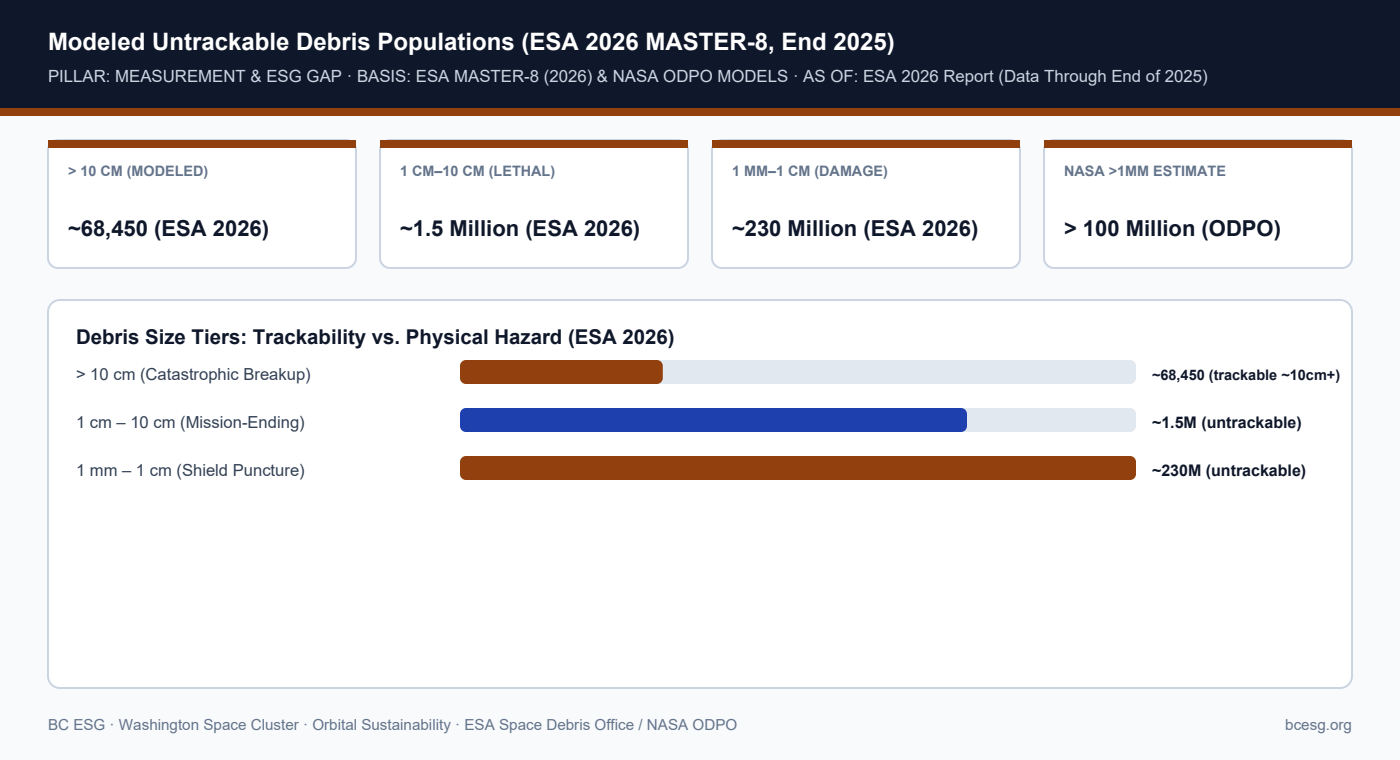
Modeled estimates (~68,450 >10 cm; ~1.5M 1–10 cm; ~230M 1 mm–1 cm) cited from ESA 2026 Space Environment Report (data through end of 2025); NASA >100M 1 mm–1 cm from ODPO (2025–2026).
ORBITAL SUSTAINABILITY · MEASUREMENT & ESG GAP · ESA MASTER-8 (2026) & NASA ODPO MODELS
Untrackable 1 mm–10 cm Debris Risk
Ground radar and optical networks cannot routinely track debris smaller than ~10 cm in LEO; ESA's 2026 Space Environment Report (MASTER-8, data through end of 2025) estimates ~1.5 million fragments (1–10 cm) capable of ending missions and ~230 million fragments (1 mm–1 cm).
Primary Authority / Source: ESA Space Debris Office / NASA ODPO | As-Of / Horizon: ESA 2026 Report (Data Through End of 2025)
Documented Instrument & Engineering Record
- The tracking blind spot: Standard SSN radar/optical tracking degrades below ~10 cm in LEO, meaning collision-avoidance maneuvers cannot protect spacecraft against the vast majority of hazardous fragments.
- ESA 2026 Space Environment Report (MASTER-8, data through end of 2025): Estimates ~68,450 objects >10 cm, ~1.5 million objects from 1 cm to 10 cm (capable of mission-ending damage), and ~230 million objects from 1 mm to 1 cm (capable of puncturing shields).
- NASA ODPO comparison (2025–2026): Estimates >100 million untrackable millimeter-sized (1 mm–1 cm) pieces in Earth orbit.
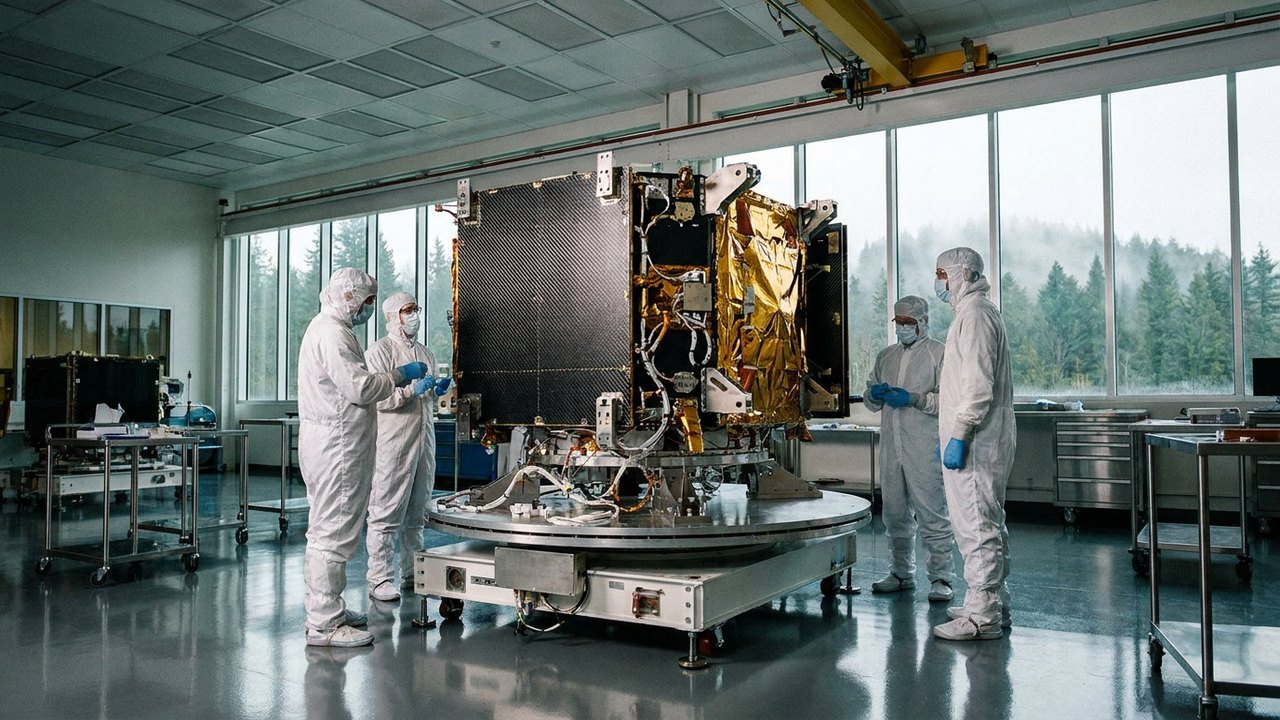
- Engineering defense: Because you cannot dodge what you cannot track, spacecraft rely on Whipple shields, multi-layer insulation (MLI), harness routing redundancy, and armored propellant/battery enclosures.
Debris Size Tiers & Mission Design Controls
| Size Class | ESA 2026 Estimate (End 2025) | Primary Mitigation |
|---|---|---|
| > 10 cm | ~68,450 objects | 18th SDS tracking + avoidance burns |
| 1 cm – 10 cm | ~1.5 million objects | Component placement + redundancy (cannot dodge) |
| 1 mm – 1 cm | ~230 million objects | Whipple bumpers + MLI + tank shielding |
Mission Designer, Compliance Lead & Founder Takeaways
- A 1–3 cm fragment strike on a propellant tank or battery can kill attitude control and strand a satellite above its passive 5-year decay altitude.
- NASA ODARs require micrometeoroid and orbital debris (MMOD) penetration probability assessments using BUMPER / DAS.
- Protecting passivation valves and battery disconnect relays against 1 mm–1 cm strikes preserves end-of-life deorbit capability.
Connected Census Profiles, Segments & Rules
- Tracked Objects vs. Modeled Debris (2026)
- NASA ODAR Contract Deliverable Guide
- Passivation & Stored-Energy Guide