
Breakup count (>660) and 2024 propulsion spike (>3,000 fragments) cited from ESA 2026 Space Environment Report (data through end of 2025).
ORBITAL SUSTAINABILITY · DISPOSAL REGIME · FCC / NASA-STD-8719.14C / ODMSP
Spacecraft & Upper-Stage Passivation
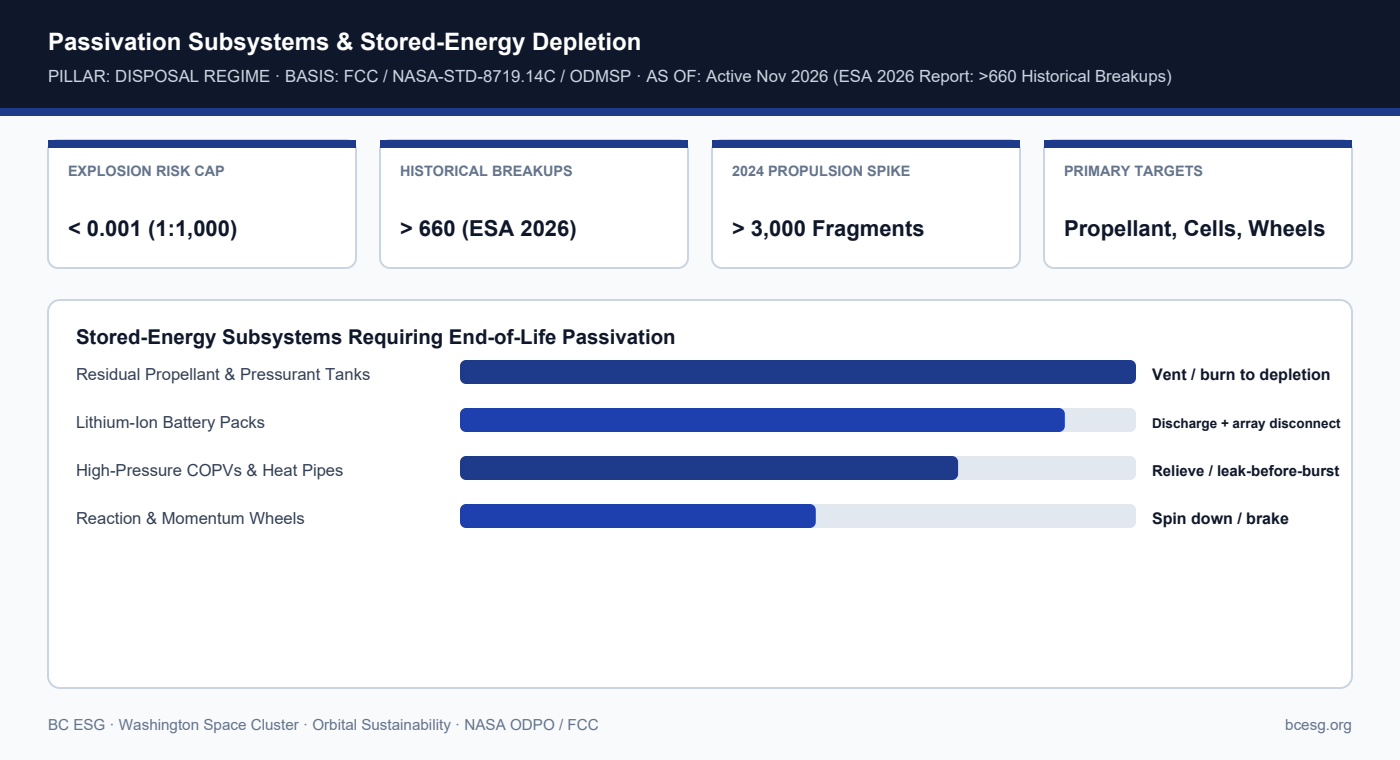
Passivation removes all stored internal energy—residual propellants, pressurants, batteries, and momentum wheels—at end of mission to keep accidental breakup probability below 0.001 (1 in 1,000) across more than 660 historical fragmentation events recorded through end of 2025.
Primary Authority / Source: NASA ODPO / FCC | As-Of / Horizon: Active Nov 2026 (ESA 2026 Report: >660 Historical Breakups)
Documented Instrument & Engineering Record
- Why passivation is enforced: ESA's 2026 Space Environment Report (data through end of 2025) documents more than 660 historical breakups, explosions, and fragmentation events—including a 2024 spike of >3,000 tracked fragments driven by propulsion-related breakups.
- Propulsion passivation: Operators must burn or vent residual fuel, oxidizer, and pressurant gases (e.g., helium, nitrogen, krypton) to prevent tank over-pressurization from solar heating.
- Electrical passivation: Batteries must be discharged and permanently isolated from solar arrays (disconnect relays or bleed resistors) so internal cell shorts cannot trigger thermal runaway.
- Kinetic & thermal stores: Reaction wheels must be spun down and pressurized heat pipes or cryocoolers accounted for in the ODAR.
Passivation Engineering Checklist by Subsystem
| Subsystem | Stored Energy Hazard | Required EOL Action |
|---|---|---|
| Liquid / Cold-Gas Propulsion | Hypergolic/pressurant tank rupture | Depletion burn + latch-open vent valves |
| Electric Propulsion (Hall/Ion) | High-pressure xenon/krypton tank | Bleed residual gas through thruster/valves |
| Power / Batteries | Thermal runaway & cell explosion | Full discharge + permanent charge-path open |
| ADCS Momentum Wheels | Rotor burst on structural fatigue | Active spin-down before bus shutdown |
Mission Designer, Compliance Lead & Founder Takeaways
- Designing latch-open pyro or solenoid vent valves adds minimal mass early in CDR but is nearly impossible to retrofit after integration.
- Upper-stage propulsion firms in WA (Blue Origin, Stoke Space, Aerojet Rocketdyne Redmond) must verify passivation sequences under both FAA Part 450 and NASA ODAR deliverables.
- Passivation sequencing matters: telemetry must confirm disposal burn completion *before* permanent battery disconnect cuts communications.