Grounded in WSDOT OSOW pass rules and ITAR physical-custody requirements.
FREIGHT, RAIL & VALLEY · CLOSURE PLAYBOOK · OPERATIONAL PLAYBOOK
Winter Pass & OSOW Staging Playbook
A practical staging playbook for hardware moving between Puget Sound and Moses Lake when WSDOT traction/chain laws automatically ban oversize loads on I-90 Snoqualmie Pass.
Primary Agency / Source: WSDOT Mountain Passes / CVO | As-Of / Horizon: 2026-11-16
Documented Corridor Facts & Continuity Record
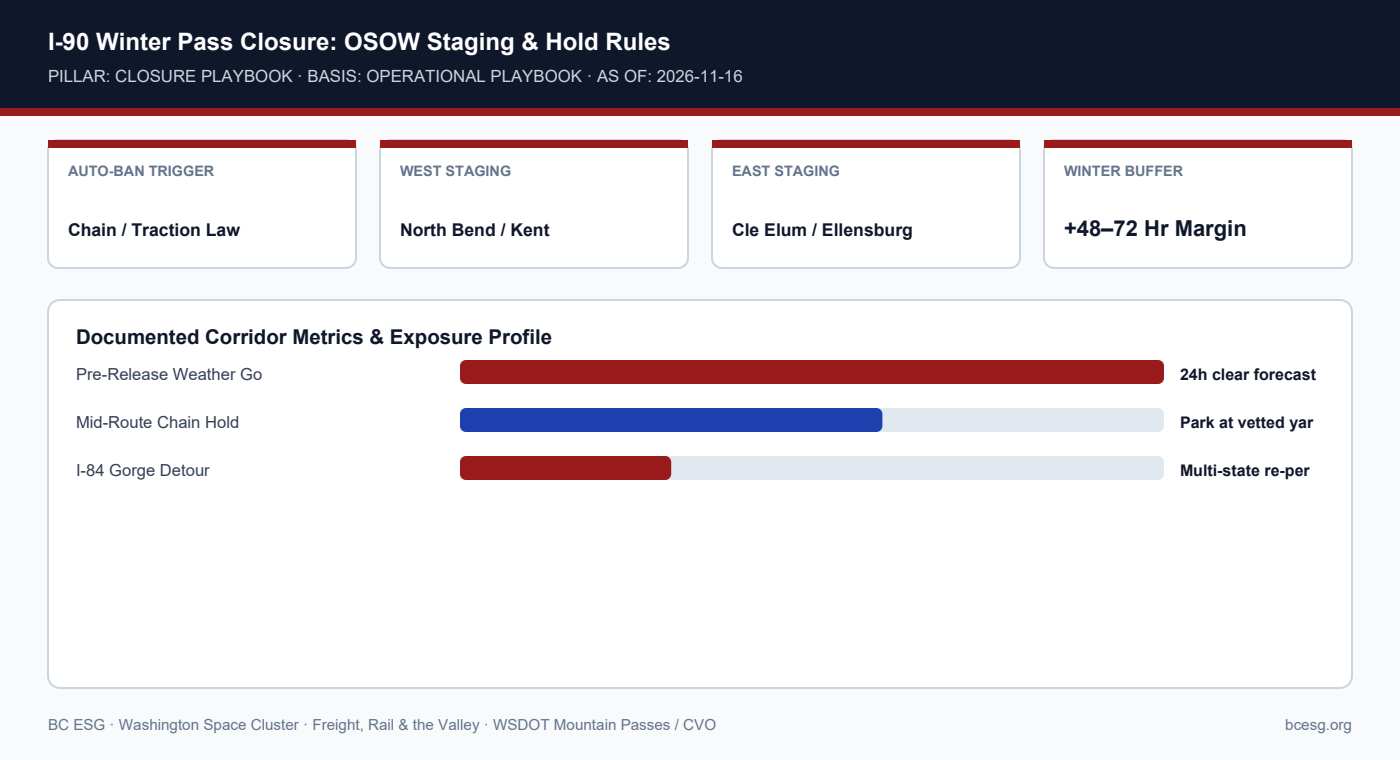
- Because WSDOT automatically voids OSOW travel during chain/traction restrictions on Snoqualmie Pass, every winter oversize move needs a pre-vetted staging yard.
- Do not release an oversize load from Kent if the 24-hour WSDOT pass forecast shows incoming snow levels below 3,000 feet.
- For ITAR/flight hardware, staging yards must provide gated, badged, or manned-security parking—never unguarded highway pullouts.
I-90 Winter OSOW Go / No-Go Protocol
| Condition | Decision | Action |
|---|---|---|
| Dry / Wet, No Restrictions | GO | Release at 9:00 AM to clear SR 18 curfew |
| Traction Tires / Chains Forecast | HOLD AT ORIGIN | Keep hardware inside Kent/Auburn bay |
| Unexpected Mid-Transit Chain Law | STAGE SECURE | Park at pre-vetted North Bend/Cle Elum yard |
Operational Exposure & Facility Playbook
- Add a 48–72 hour weather buffer to November–March Moses Lake test schedules.
- Keep Oregon OSOW contingency contacts on file only if a multi-day I-90 closure justifies re-permitting via I-5/I-84.
- Verify heated battery/nitrogen-purge support if sensitive payloads sit overnight in freezing temperatures.
Connected Valley Cities, Segments & Role Briefs
- WA Space Cluster Hub (#1382)
- Moses Lake WA Space Cluster Profile
- Kent WA Space Cluster Profile
- Program Manager Desk Brief
- Launch Segment Continuity Exposure