Why Propellant Chemistry Dictates the Entire Compliance Surface
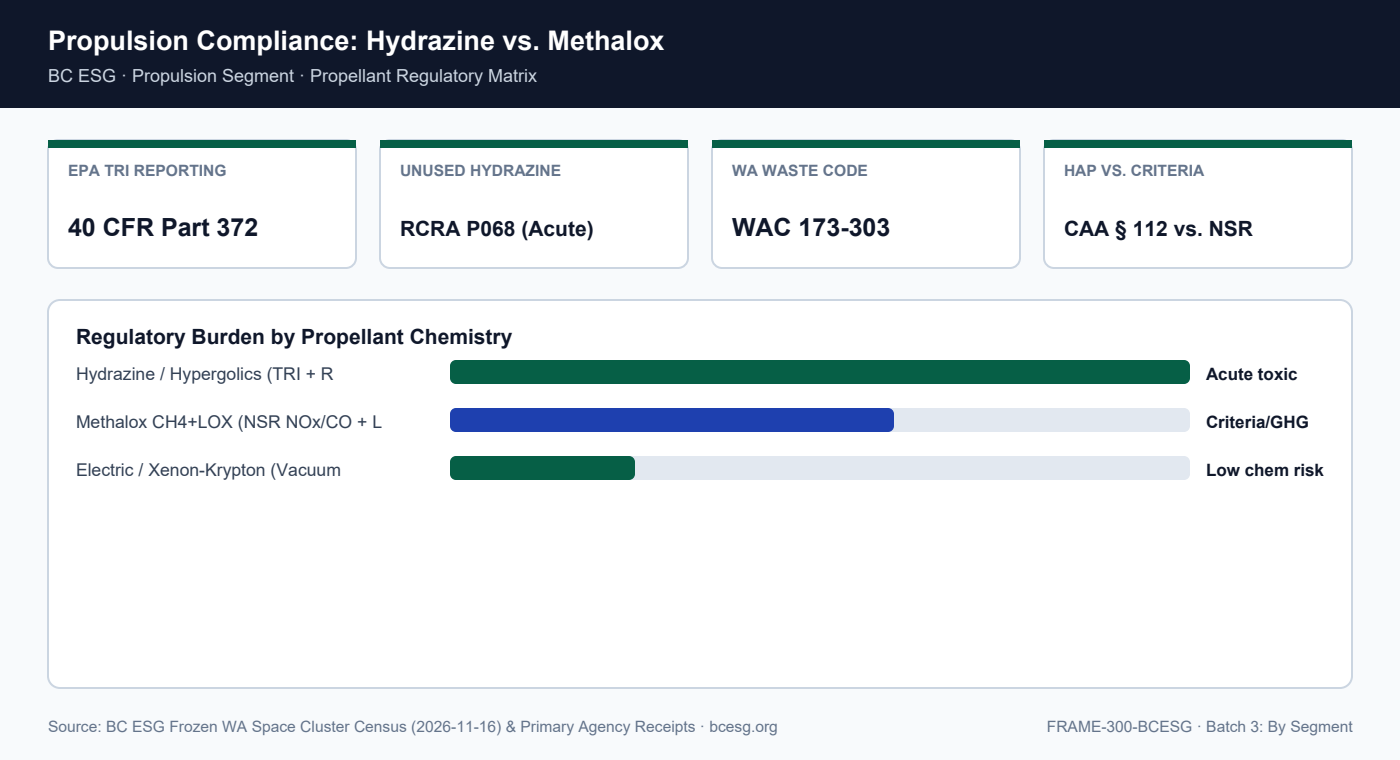
In propulsion, environmental compliance is strictly governed by propellant chemistry. Hydrazine and hypergolic propellants ($ ext{N}_2 ext{H}_4$, MMH, $ ext{N}_2 ext{O}_4$) are Clean Air Act Section 112 Hazardous Air Pollutants (HAPs) requiring closed-loop chemical vapor scrubbers, fence-line monitoring, EPA Toxics Release Inventory (TRI) reporting under 40 CFR Part 372, and acute hazardous waste management (RCRA P068 / WAC 173-303).
By contrast, methalox ($ ext{CH}_4$ + LOX) systems—used by launch-adjacent propulsion programs—produce predominantly $ ext{CO}_2$ and water vapor with trace CO and thermal $ ext{NO}_x$, shifting permitting to Clean Air Act New Source Review (NSR), methane Leak Detection and Repair (LDAR), and 40 CFR Part 98 GHG reporting.
| Rule / Statute | Propellant Trigger | Binding Requirement | Primary Source |
|---|---|---|---|
| EPCRA § 313 / EPA TRI (40 CFR 372) | Hydrazine, nitric/ammonia streams, solvents | Annual toxic release & off-site transfer reporting | EPA TRI Program |
| RCRA P068 / WAC 173-303 | Unused or spent hydrazine | Acute hazardous waste storage, manifest & disposal | WA Ecology Dangerous Waste |
| Clean Air Act § 112 (HAP) vs. NSR | Hypergolics vs. Methalox | Closed-loop vapor scrubbers vs. flares/LDAR | EPA Clean Air Act |
Related BC ESG Guides & Verified Primary Sources
- Washington Space Cluster Census Hub
- Aerojet Rocketdyne (Redmond) Profile
- Agile Space Industries (Bellevue) Profile
- Launch & Propulsion Core Group (GHKN, Juno, New Frontier, Reach, RPS)
- Launch Disclosure & FAA Part 450
- EPA Toxics Release Inventory (TRI)
- WA Ecology Dangerous Waste Guidance
- EPA Clean Air Act Overview
- WA Legislature WAC 173-303