Updated Nov 2, 2026 — refreshed 2027 board budgeting playbook, reserve study financing stack, Article 321 census protocols, and statutory relief pathways.
As of October 6, 2026, co-op and condo boards should confirm LL97 pathway and CY2025 filing status in BEAM; the June 30 and August 29, 2026 filing deadlines have passed — this guide does not state outcomes for any building.
November 2026 Board Action Checklist: 2027 Budget & Reserve Decisions
With 2027 annual budget and reserve study cycles commencing this month, co-op and condominium boards must execute this four-step statutory triage before levying capital assessments or approving debt packages:
- Verify LL33 Label Posting & ESPM Cleanliness: Confirm physical entrance posting of the building’s 2026 Energy Efficiency Rating label (statutory deadline: October 31). Verify that prior-year Local Law 84 benchmarking in Portfolio Manager is reconciled without missing meter records; under 1 RCNY § 103-14, clean benchmarking is a mandatory prerequisite before DOB will review any mediated penalty relief or Decarbonization Plan filing.
- Calculate 2024–2029 Statutory Penalty Exposure: Calculate your property’s net emissions penalty liability using gross floor area, fuel splits, and the statutory penalty coefficient of $268 per metric ton of CO2e ($268/tCO2e) over the Article 320 occupancy limit. Model baseline exposure using the Local Law 97 fines calculator ($268/ton).
- Execute the Article 321 Census Test: Audit the building’s certified rent roll. Under NYC Administrative Code § 28-321, if more than 35% of dwelling units are rent-regulated or rent-stabilized, the building is legally exempt from Article 320 annual carbon caps and $268/ton fines. The board pivots immediately to verifying completion of the 13 Prescriptive Energy Conservation Measures (ECMs) rather than levying electrification special assessments. Compare pathway requirements in the Article 320 vs 321 decision guide.
- Evaluate § 28-320.7 Financial Hardship Relief (2035 Cap Deferral): For Article 320 properties facing acute capital constraints, determine whether the building’s average unit assessed valuation is below $65,000 per unit or capital retrofit outlays exceed 10% of property assessed value. Under NYC Administrative Code § 28-320.7 and 1 RCNY § 103-12, qualifying properties may petition the DOB for statutory adjustment and delayed compliance through 2035.
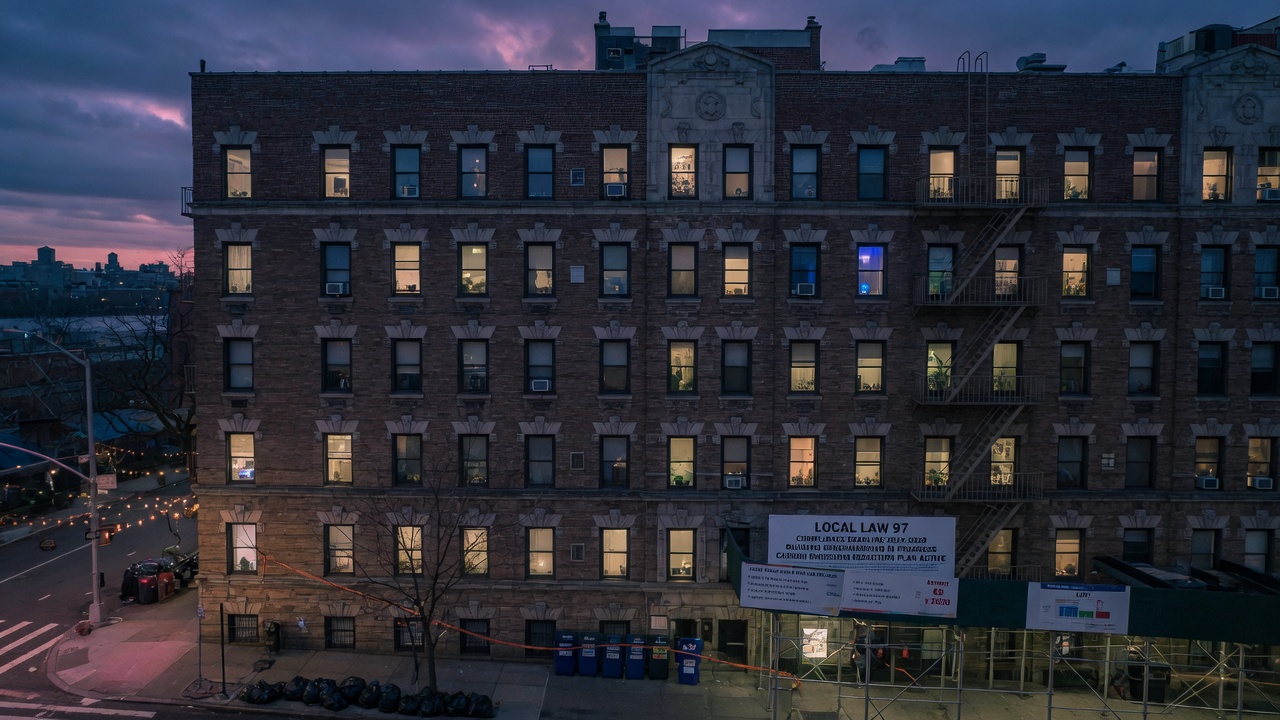
If your co-op or condo building is over 25,000 square feet, Local Law 97 applies to you — but which version applies, and what it costs, depends on your building’s rent-regulation mix, and 2026 is the year one of the gentler pathways gets real. The legal challenge is over (the Glen Oaks suit — brought by a Queens co-op — lost at New York’s highest court in May 2025, with no appeal possible), the Council bill to delay penalties for moderate-value condos and co-ops died at the end of session, and multifamily buildings filed their first-year reports at a 94% rate. The question for boards is no longer whether LL97 is happening. It is which pathway you are on, and what the next capital plan should assume.
First question: which pathway is your building on?
LL97 is not one rule for all residential buildings — coverage splits on rent regulation and affordability status (DOB LL97 page):
| Pathway |
Who is on it |
What applies |
| Article 320, standard (Pathway 0) |
Most market-rate co-ops and condos >25,000 sqft (or condo buildings sharing a board totaling >50,000 sqft) |
Emissions caps from 2024, annual RDP-certified reports, $268/tCO2e overage penalties |
| Article 320, 2026 start (Pathway 1) |
Buildings with at least one but no more than 35% rent-regulated units |
Cap compliance began January 1, 2026 — this year is their first capped year |
| Article 320, 2035 start (Pathway 2) |
Certain buildings under §28-320.3.9 |
Caps begin 2035 |
| Article 321, prescriptive (Pathway 3) |
>35% rent-regulated, HDFC co-ops, Mitchell-Lama, income-restricted, project-based federal housing |
One-time prescriptive energy measures (a defined checklist of upgrades) instead of caps; $10,000 penalties for non-compliance |
Your pathway is shown on the Covered Buildings List published each year on DOB’s LL97 page; disputes go through a BEAM portal ticket. If your building has a mix of rent-regulated units, checking the percentage against DOF records is the single highest-value hour a managing agent can spend this year — Pathway 1 buildings are in their first capped year right now, and many boards do not know it.
The math boards actually face
The multifamily emissions cap for 2024–2029 is 0.00675 tCO2e per square foot (1 RCNY 103-14). For a 120,000 sq ft co-op, that is an annual limit of 810 tCO2e. Exceed it by 100 tons and the penalty is $26,800 a year. Fail to file at all and the penalty is 120,000 × $0.50 = $60,000 per month — which is why “we’re under the cap so we don’t need to do anything” is the most expensive sentence in co-op governance. Filing is mandatory regardless of emissions; for most buildings under the cap it costs the $210 fee plus the engineer.
About 9% of covered properties exceed today’s caps — but roughly 57% exceed the 2030 caps (Urban Green Council). For residential boards the 2030 number is the one that belongs in the reserve study, because the realistic retrofit menu — heat pump conversions, window and envelope work, boiler replacement timed to end-of-life — takes more than one budget cycle to finance and execute. Habitat’s reporting captured the honest owner calculus: some owners are choosing fines over retrofits because, as one put it, eliminating the fine would cost “15 to 20 times the fine amount” (Habitat, March 2025). That math can be rational in 2026 — and flips as the caps tighten and the fines repeat annually, forever.
What boards hoping for a rescue should know
- The lawsuit is over. Glen Oaks Village Owners — a Queens garden co-op — argued the state climate law preempted LL97. The NY Court of Appeals rejected the challenge on May 22, 2025 (opinion); as a state-law ruling from the highest court, it cannot be appealed further.
- The relief bills stalled. Int 1197 (Lee/Ung), which would have delayed penalties for condos and co-ops with average unit assessed value under $65,000, was never moved by the Speaker; Int 1180’s REC cap also died at end of session. No amendment has touched the $268 rate, the caps, or the May 1 cycle.
- Enforcement has started. DOB’s April 22, 2026 release: 93% of covered properties filed, ~1,400 non-filers are receiving Notices of Deficiency, and OATH penalty cases are being prepared (DOB press release).
The board playbook for 2026
October 2026 status: The June 30, 2026 statutory deadline and the August 29, 2026 extended deadline (for buildings that secured a $60 extension by June 30) are both in the past. Use DOB BEAM and DOB NOW records to verify whether your building filed; this article does not state filing outcomes for any property.
- Confirm your pathway and filing status in BEAM today. As of October 6, 2026, the June 30, 2026 and August 29, 2026 CY2025 filing deadlines have passed; verify whether your building filed rather than assuming an outcome. See the LL97 2026 deadlines reference.
- Get the real number before the meeting. An energy audit that converts “we might be over” into “we are 110 tons over, which is $29,480 a year, and these three measures close 80% of it” changes the quality of every board conversation that follows.
- Time retrofits to equipment life, not to panic. The cheapest decarbonization is the boiler you were going to replace anyway, replaced with the electric option, with the beneficial-electrification credits that remain richest before December 2026.
- Know the mitigation menu before you need it: good-faith-efforts (requires filed reports + current LL84 + LL88 attestation plus a qualifying path like an RDP-certified decarbonization plan); RECs (electricity-attributable emissions only, NYC-deliverable); AHRF offsets (capped at 10% of your limit, $268/ton); and after a fire or flood, the disaster provision that can zero a penalty year with documentation (1 RCNY 103-14(i)(1)).
- Use the free help. NYC Accelerator provides no-cost LL97 compliance guidance, and the Building Energy Exchange published a co-op/condo-specific playbook, Cutting Carbon in Co-ops & Condos, in May 2026.
What this means for each seat at the table
| If you are the… |
LL97 in 2026 means… |
| Board (the owner) |
The penalty exposure and the capital plan are yours. Put the 2030 number in the reserve study now; annual fines are a recurring line item, not a one-time fee. |
| Managing agent (the coordinator) |
Pathway verification, the three-portal filing chain, the RDP booking, and the mitigation paperwork run through you — including the disaster documentation if the building ever floods or burns. |
| Shareholders / unit owners (the residents) |
LL97 costs reach you through maintenance and common charges either as planned retrofit financing or as unplanned fines — and the planned version is almost always cheaper. The A–F energy grade at the entrance is your building’s public report card. |
Frequently asked questions
Does Local Law 97 apply to co-ops and condos?
Yes — co-op and condo buildings over 25,000 square feet (or condo buildings under one board totaling over 50,000 square feet) are covered. The applicable pathway depends on rent-regulation and affordability status: most market-rate buildings face Article 320 caps; buildings over 35% rent-regulated, HDFC, and Mitchell-Lama follow Article 321’s one-time prescriptive measures instead.
What is the LL97 penalty for a co-op?
The same as any Article 320 building: (actual emissions minus the cap) × $268 per ton CO2e per year, and $0.50 per square foot per month for failing to file. Article 321 buildings face $10,000 penalties for late or missing compliance reports.
What changed for partially rent-regulated buildings in 2026?
Buildings with at least one but no more than 35% rent-regulated units (Pathway 1) began cap compliance on January 1, 2026 — 2026 is their first capped calendar year, reportable in 2027.
Did the co-op lawsuit against LL97 succeed?
No. Glen Oaks Village Owners v. City of New York was decided against the challengers by the NY Court of Appeals on May 22, 2025, and cannot be appealed further. LL97 is settled law.
Will LL97 raise my maintenance or common charges?
For buildings over their caps, yes — the only question is whether the increase funds planned retrofits (often with incentives, and timed to equipment replacement) or recurring annual fines. The retrofit usually wins over a ten-year horizon, especially with 2030’s stricter caps.
Where can a board get free LL97 help?
NYC Accelerator (accelerator.nyc/ll97) offers free compliance guidance, and the Building Energy Exchange’s May 2026 “Cutting Carbon in Co-ops & Condos” playbook is written specifically for residential boards.
Primary sources
More in Local Law 97 and About BC ESG.
Related reading: board resolution checklist, Article 320 vs 321, and LL97 2026 filing deadlines (reference). Sister hubs: Restoration Intel, Healthcare Facility Hub, Continuity Hub, Risk Coverage Hub, and Tygart Media.
Co-op and Condo Capital Financing Stack: Eliminating Lump-Sum Special Assessments
The primary political crisis facing co-op and condo boards is the shareholder assessment revolt. When boards present heating plant decarbonization or envelope retrofits as lump-sum capital calls ($20,000 to $50,000 per apartment), shareholders routinely threaten board recalls or litigation. Modern decarbonization governance structures CapEx through long-term, non-accelerating financing instruments layered with utility rebates.
| Financing Mechanism |
Term & Security |
Impact on Shareholder Lien / Resale |
Eligible Project Scope |
| C-PACE (Commercial PACE) |
20–30 year fixed-rate financing repaid as a senior voluntary tax assessment via municipal property tax bill. |
Transfers automatically with title upon unit sale; never accelerates upon sale; does not impair individual shareholder mortgageability. |
100% of hard and soft costs: engineering, electrical switchgear upgrades, heat pumps, building envelope, solar PV. |
| NYCEEC Clean Energy Debt |
5–15 year term loans; subordinated debt or co-op building loan structures. |
Secured by building underlying cash flow or assignment of maintenance dues; requires lender consent. |
Pre-development studies, design engineering, electrical service risers, heating plant electrification. |
| Con Edison Clean Heat Rebates |
Direct utility capital incentives paid upon verified installation and commissioning. |
Non-debt capital infusion directly reducing project net borrowing requirement. |
Full-load heat pump space heating (up to $5,000 per dwelling unit market-rate; $12,000–$14,000 affordable) plus DHW heat pumps ($1,000/unit), or custom performance ($200/MMBtu). |
| 10-Year Reserve Amortization |
Integrated reserve study allocation paired with annual operating budget escalation (1.5%–3.0%). |
Predictable maintenance charge trajectory; prevents sudden special assessment notices during unit resales. |
Phased prescriptive retrofits according to the Retrofit Priority Stack for Existing Buildings (air sealing, steam balancing, smart thermostats). |
Board Resolution & Shareholder Communication Package
To establish institutional protection against breach-of-fiduciary-duty claims, boards should adopt formal resolutions authorizing technical feasibility studies and establish transparent shareholder communications well in advance of vote milestones.
Sample Board Resolution: Engineering Decarbonization Audit & PE/RA Engagement
“WHEREAS, the Corporation is subject to the building energy performance standards and greenhouse gas emissions limitations of NYC Administrative Code § 28-320 (Local Law 97); and
WHEREAS, compliance requires professional engineering analysis of heating plant electrification, electrical service capacity, and capital amortization options;
NOW, THEREFORE, BE IT RESOLVED, that the Board of Directors hereby approves the retention of a New York State licensed Professional Engineer (PE) or Registered Architect (RA) to perform an ASHRAE Level II Energy Audit, electrical load letter evaluation, and statutory Article 320/321 compliance pathway analysis; and
BE IT FURTHER RESOLVED, that the Treasurer and Managing Agent are authorized to solicit non-accelerating financing proposals, including C-PACE financing structures and utility incentive pre-approvals, to present an integrated Decarbonization Capital Plan at the upcoming Shareholder Informational Meeting.”
Shareholder Town Hall Structure: Cost of Inaction vs. Decarbonization
When presenting compliance proposals to shareholders, boards must contrast the Cost of Inaction against the Cost of Financed Decarbonization:
- Cost of Inaction: Accumulating annual DOB penalties ($268/tCO2e) beginning in the 2024–2029 cycle and escalating steeply in 2030, compounded by fossil fuel commodity price volatility, deteriorating LL33 letter grades (D or F posted at building entrance), and lender scrutiny on unit buyer mortgages.
- Cost of Decarbonization: Net capital outlay after utility equipment rebates, amortized over 20–25 years via C-PACE or energy debt. Because C-PACE is repaid through property tax assessments and transfers with unit title, departing shareholders pay only for their tenure of ownership, while lower operating EUI permanently reduces building operating expenses.
Resale Questionnaire & Lien Search Disclosures
Managing agents must prepare for increasing disclosure requirements on co-op lien searches and institutional buyer questionnaires. Institutional mortgage lenders (including Fannie Mae, Freddie Mac, and private portfolio lenders) now routinely request evidence of LL97 pathway classification, outstanding DOB violations, and projected special assessment liabilities. Boards that fail to adopt an approved capital compliance plan risk having buyer financing rejected by lender underwriting departments. For step-by-step administrative submission protocols, review How to File Local Law 97 on DOB NOW, ESPM, and BEAM.
Notice on Co-op/Condo Governance: This guidance is prepared for condominium unit owners, cooperative shareholders, board directors, and managing agents for capital budgeting and compliance strategy. Regulatory standards reflect NYC Administrative Code § 28-320 and 1 RCNY § 103-14. This analysis does not constitute formal legal counsel, certified engineering filings, or licensed financial underwriting. Boards must consult their corporate legal counsel, managing agent, and a New York State licensed Professional Engineer (PE) or Registered Architect (RA) prior to executing capital assessments or filing compliance documents.