Category: ESG Regulation

  • Illinois Climate Corporate Accountability Act (HB 3673): Rule 19(a) Status & Live Compliance Check

    Illinois Climate Corporate Accountability Act (HB 3673): Rule 19(a) Status & Live Compliance Check

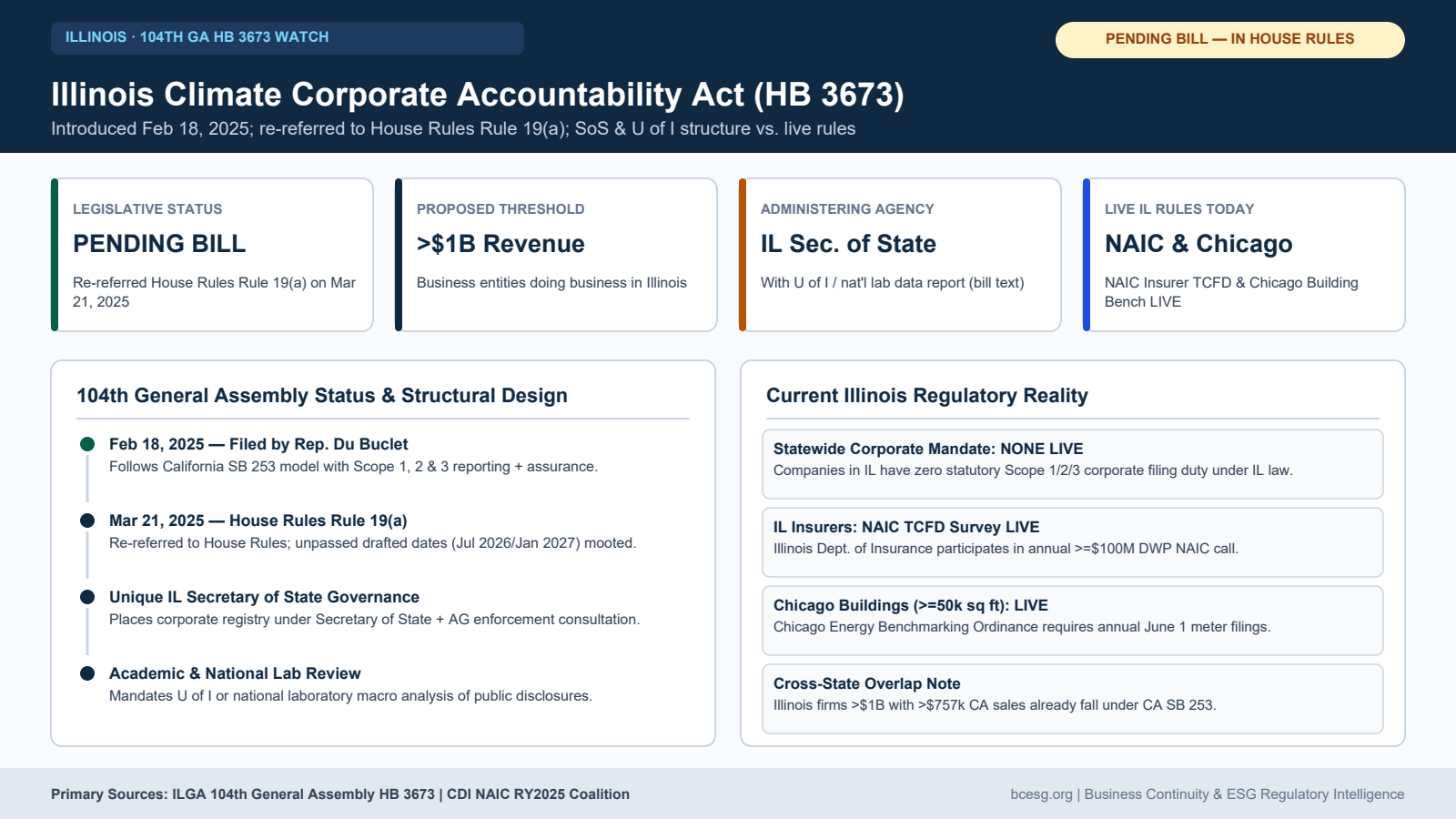
    Short answer — PENDING BILL, NOT LIVE LAW: Illinois House Bill HB 3673 (the Climate Corporate Accountability Act, 104th General Assembly) remains stalled in the House Rules Committee after its March 21, 2025 re-referral under Rule 19(a). Because HB 3673 was never enacted, the drafted July 1, 2026 rulemaking deadline and January 1, 2027 reporting date printed in the introduced text carry zero legal effect.

    Many national ESG compliance calendars still flag Illinois’ drafted January 1, 2027 date as active. This watch brief clears that confusion while identifying the two regimes that are enforceable in Illinois today: the NAIC TCFD Climate Risk Disclosure Survey for licensed insurers (>=$100M DWP) and municipal building benchmarking in Chicago (>=50,000 sq ft), alongside any Illinois-headquartered enterprise triggering California SB 253 through California revenue nexus.

    Statutory Status at a Glance
    • Enacted Status: NONE (Re-referred House Rules Rule 19(a) March 21, 2025).
    • Bill Design (>$1B Entities): Modeled on CA SB 253 with Scope 1, Scope 2, and Scope 3 emissions (+180 days post Scope 1/2) plus third-party verification.
    • Distinct Governance Design: Assigns corporate registry oversight to the Illinois Secretary of State (consulting the Attorney General) plus macro-analysis by the University of Illinois or a national laboratory.
    • Unpassed Dates Mooted: Drafted July 1, 2026 rulemaking & Jan 1, 2027 filing text are unpassed bill language — no filing is owed in Springfield.
    • Live Illinois Obligations Today: NAIC TCFD Survey (insurers >=$100M DWP) and Chicago Energy Benchmarking Ordinance (>=50,000 sq ft annual June 1).
    Print-First Compliance Brief

    Verify Illinois HB 3673 Legislative Status & Active Illinois Filings

    2-page Print-First regulatory watch clarifying why HB 3673’s unpassed 2026/2027 dates are not law while separating live Chicago Benchmarking and NAIC duties.

    Why Drafted January 1, 2027 Text in HB 3673 Keeps Tripping Automated Calendars

    When Rep. Kimberly Du Buclet introduced HB 3673 in February 2025, the bill text hard-coded statutory rollout dates — Secretary of State rules by July 1, 2026 and first-year Scope 1/2 disclosures starting January 1, 2027 (with Scope 3 180 days thereafter). Regulatory scrapers frequently index those printed dates without checking subsequent legislative posture.

    In the 104th Illinois General Assembly, however, HB 3673 hit Rule 19(a) re-referral on March 21, 2025 without clearing committee or chamber floor votes. Any future revival in Springfield would require amended statutory deadlines after passage.

    • Distinct Institutional Home: Rather than naming an environmental agency like CARB (CA) or NYSDEC (NY), HB 3673 places the public disclosure platform under the Secretary of State’s corporate division.
    • Research Partner Mandate: Directs an academic institution such as the University of Illinois or a national laboratory to publish aggregate trend analysis from corporate disclosures.
    Measure / MandateApplies ToLegal Status (Nov 14, 2026)Calendar Reality
    IL HB 3673 (104th GA)Entities >$1B doing business in ILPENDING (House Rules Rule 19(a) Mar 2025)Printed Jul 2026 / Jan 2027 dates NOT live law
    NAIC Climate Risk SurveyIL-licensed insurers >=$100M countrywide DWPLIVE Sectoral MandateAnnual TCFD disclosure via CDI / IL DOI portal
    Chicago BenchmarkingCovered Chicago buildings >=50,000 sq ftLIVE Municipal MandateAnnual June 1 Portfolio Manager + 3-yr data verif.
    Legislative status infographic for Illinois 104th General Assembly HB 3673 showing Rule 19(a) referral in House Rules, Secretary of State governance model, and live IL insurance/Chicago rules.
    Illinois 104th General Assembly HB 3673 (Pending Watch — House Rules Rule 19(a)) contrasted against live Illinois NAIC insurer disclosures and Chicago Benchmarking.

    What Companies Operating in Illinois Actually Owe Today

    While Illinois corporations owe zero state-level corporate GHG filings under HB 3673, major Illinois firms frequently sit inside live climate reporting requirements via two adjacent channels: out-of-state nexus (>$757,070 California sales for >$1B entities under California SB 253) or sectoral/city mandates inside Illinois.

    Illinois Department of Insurance partner carriers (>=$100M nationwide DWP) remain bound by the multi-state NAIC TCFD Climate Risk Disclosure Survey, and commercial/multifamily buildings >=50,000 sq ft in Chicago file annual energy disclosures every June 1.

    Compliance Execution Checklist

    StepOwner / TeamAuditable Deliverable
    1. Purge False DeadlineLegal / RiskCorrect any internal tracker showing 'IL Jan 1, 2027 Scope 1/2' — cite 104th GA Rule 19(a) status.
    2. Test CA NexusTax / SustainabilityVerify if IL enterprise >$1B revenue crosses $757k CA sales (triggering live CA SB 253 instead).
    3. Separate City/Insurer DutiesCRE / InsuranceConfirm Chicago >=50k sq ft building benchmarking & IL NAIC >=$100M insurer filings separately.
    4. 105th GA MonitorGov AffairsWatch post-election 2027 Illinois session introductions for successor Climate Corporate bills.
    Field & Print Package

    Keep This Illinois Compliance Checklist Handy

    Download the formatted 2-page PDF reference brief or pull the structured Markdown edition for internal compliance documentation.

    Frequently Asked Questions

    Do companies in Illinois have to report Scope 1 and Scope 2 emissions starting January 1, 2027 under HB 3673?

    No. Although the introduced text of Illinois HB 3673 listed a January 1, 2027 start date, the bill was re-referred to the House Rules Committee under Rule 19(a) on March 21, 2025 and never enacted into law.

    Who would administer Illinois HB 3673 if a future bill passes?

    HB 3673 designated the Illinois Secretary of State (in consultation with the Illinois Attorney General) to adopt rules and contract for a public corporate emissions registry, paired with research analysis by the University of Illinois or a national laboratory.

    Are there any live climate reporting laws in Illinois right now?

    Yes, within specific sectors and cities: Illinois participates in the annual NAIC Climate Risk Disclosure Survey for insurers writing >= $100M countrywide DWP, and the City of Chicago enforces annual June 1 benchmarking for covered buildings >= 50,000 sq ft.

    Primary Authorities & Official Resources

    Informational notice: This guide summarizes enacted statutes, regulations, or pending legislative records from the primary authorities linked above as of November 14, 2026. It is not legal, accounting, or licensed engineering advice.

  • New Jersey Climate Corporate Data Accountability Act (S679): Scope 1/2 Pivot & Pending Watch

    New Jersey Climate Corporate Data Accountability Act (S679): Scope 1/2 Pivot & Pending Watch

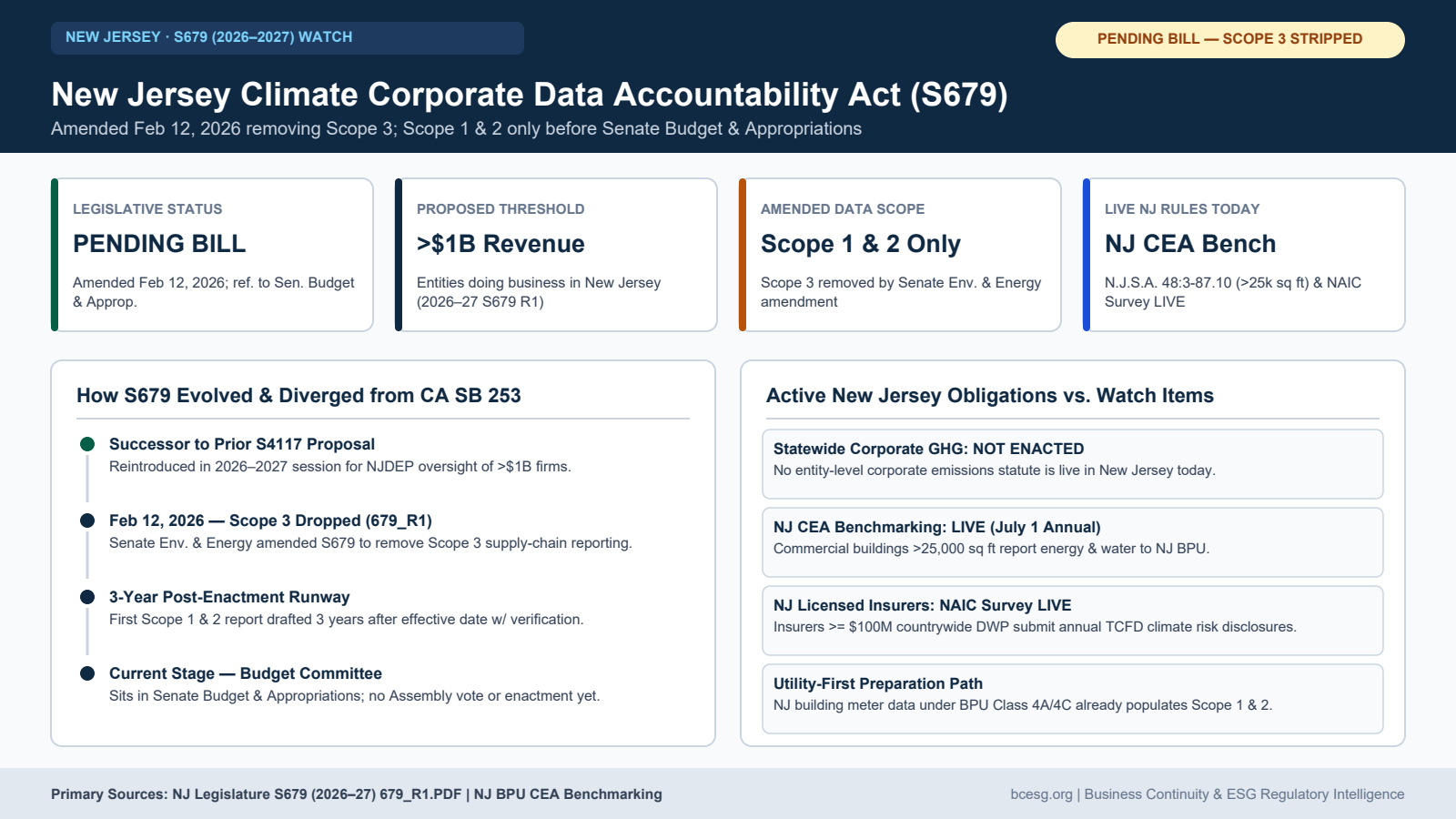
    Short answer — PENDING BILL, NOT LIVE LAW: New Jersey Senate Bill S679 (2026–2027 Legislative Session, successor to earlier S4117) remains pending in the Senate Budget & Appropriations Committee and imposes zero current corporate emissions filing obligations.

    Yet S679’s February 12, 2026 committee reprint (679_R1.PDF) marks an important national policy signal: unlike California SB 253 and New York S9072A, New Jersey’s Senate Environment & Energy Committee explicitly removed Scope 3 emissions reporting, narrowing the proposal to Scope 1 and Scope 2 GHG emissions verified by an independent consultant under NJDEP oversight. Meanwhile, New Jersey commercial buildings over 25,000 sq ft do owe active July 1 benchmarking filings under our live New Jersey Clean Energy Act Benchmarking Guide.

    Statutory Status at a Glance
    • Enacted Status: NONE (Pending in Senate Budget & Appropriations). Committee reprint 679_R1 adopted Feb 12, 2026.
    • Proposed Covered Entities: U.S. business entities with >$1 billion in total annual revenue doing business in New Jersey.
    • Proposed Scope (Amended R1): Scope 1 and Scope 2 emissions only (Scope 3 deleted in Feb 2026 amendment) plus independent third-party/consultant verification.
    • Proposed Runway: Drafted to require first reporting 3 years after enactment under New Jersey Department of Environmental Protection (NJDEP) rules.
    • Live NJ Obligations Today: NJ BPU CEA Benchmarking (Class 4A/4C buildings >25k sq ft due July 1) & NAIC TCFD Insurer Survey (>=$100M DWP).
    Print-First Compliance Brief

    Track New Jersey S679's Scope 3 Stripping Amendment & Live NJ Rules

    2-page Print-First watch explaining how Senate Env. & Energy amended S679 to Scope 1 & 2 only (679_R1.PDF) vs. active NJ BPU July 1 benchmarking.

    Why S679 Dropped Scope 3 — And Why That Matters to Corporate Data Teams

    When state climate disclosure bills spread east after California enacted SB 253, Scope 3 value-chain reporting became the single sharpest legislative sticking point for mid-sized industrial, logistics, and life-sciences firms headquartered in New Jersey. By removing Scope 3 in 679_R1, Senate drafters turned S679 into a utility-and-fleet Scope 1 & 2 transparency bill.

    Even if S679 clears Senate Budget & Appropriations and passes both houses in 2027, its 3-year post-enactment lead time plus Scope 1/2 restriction means New Jersey-only companies would rely overwhelmingly on utility electricity and natural gas billing records—the exact meter datasets already standardized by Portfolio Manager under NJ CEA.

    • Compare Against NY & CA: Multinationals with >$1B revenue touching California already fall under full Scope 3 planning for CARB’s 2027 schedule, regardless of whether New Jersey’s bill omits Scope 3.
    • Audit Verification Model: S679 maintains an independent verification requirement over Scope 1 & 2 data prior to public disclosure by NJDEP.
    InstrumentUniverseScope / RequirementLive Status (Nov 14, 2026)
    NJ S679 (679_R1 Reprint)Entities >$1B revenue doing business in NJScope 1 & 2 ONLY (Scope 3 removed) + verification; 3 yrs post-enactmentPENDING in Sen. Budget & Appropriations
    NJ Clean Energy Act (N.J.S.A. 48:3-87.10)Commercial Class 4A/4C buildings >25,000 sq ftAnnual ENERGY STAR Portfolio Manager energy & water (July 1)LIVE & Enforced by NJ BPU
    NAIC Climate Risk SurveyInsurers >=$100M nationwide DWP licensed in NJAnnual 4-pillar TCFD climate financial risk narrativeLIVE Sectoral Mandate
    Visual summary of New Jersey pending S679 Climate Corporate Data Accountability Act showing Feb 12 2026 Senate amendment removing Scope 3 and active NJ CEA building benchmarking.
    New Jersey S679 (2026–2027 Session, 679_R1.PDF) Pending Status: amended to Scope 1 & 2 only in Senate Budget & Appropriations vs. live NJ CEA benchmarking.

    Active New Jersey Compliance Today: CEA Benchmarking & NAIC Insurers

    Corporate real-estate and facility directors often mistake New Jersey’s July 1 benchmarking filings for S679 corporate reporting. Under N.J.S.A. 48:3-87.10, New Jersey Board of Public Utilities (NJBPU) enforces annual July 1 ENERGY STAR Portfolio Manager benchmarking across commercial Class 4A/4C buildings exceeding 25,000 sq ft.

    Similarly, New Jersey participates in the 29-jurisdiction NAIC Climate Risk Disclosure Survey, binding NJ-licensed insurers with >=$100M in countrywide direct written premiums.

    Compliance Execution Checklist

    StepOwner / TeamAuditable Deliverable
    1. Mark S679 PendingCompliance / LegalLog S679 (679_R1) as Watch-Only; exclude from live statutory penalty registers.
    2. Leverage NJ BPU MetersFacilities / EnergyUse active July 1 NJ CEA Portfolio Manager utility exports as clean building blocks for Scope 1 & 2.
    3. Separate CA NexusSustainabilityConfirm whether >$1B corporate parent already owes Scope 1/2/3 via CA SB 253.
    4. Budget Committee TrackGov AffairsTrack Senate Budget & Appropriations scheduling and any Assembly companion amendments.
    Field & Print Package

    Keep This New Jersey Compliance Checklist Handy

    Download the formatted 2-page PDF reference brief or pull the structured Markdown edition for internal compliance documentation.

    Frequently Asked Questions

    Did New Jersey pass its Climate Corporate Data Accountability Act (S679)?

    No. S679 (2026–2027 Session) was amended in the Senate Environment & Energy Committee on February 12, 2026 and referred to the Senate Budget & Appropriations Committee. No cross-sector corporate GHG disclosure law is enacted in New Jersey.

    Does New Jersey S679 still require Scope 3 supply-chain emissions reporting?

    No. Under the February 12, 2026 committee reprint (679_R1.PDF), Scope 3 was removed, narrowing the pending bill to Scope 1 and Scope 2 emissions with independent verification.

    What climate reporting IS mandatory in New Jersey right now?

    Commercial buildings over 25,000 sq ft (Tax Class 4A/4C) must file annual July 1 benchmarking under the NJ Clean Energy Act, and insurers >= $100M countrywide DWP file the annual NAIC TCFD Climate Risk Disclosure Survey.

    Primary Authorities & Official Resources

    Informational notice: This guide summarizes enacted statutes, regulations, or pending legislative records from the primary authorities linked above as of November 14, 2026. It is not legal, accounting, or licensed engineering advice.

  • New York Climate Corporate Data Accountability Act (S9072A / A4282A): Pending Status & Readiness

    New York Climate Corporate Data Accountability Act (S9072A / A4282A): Pending Status & Readiness

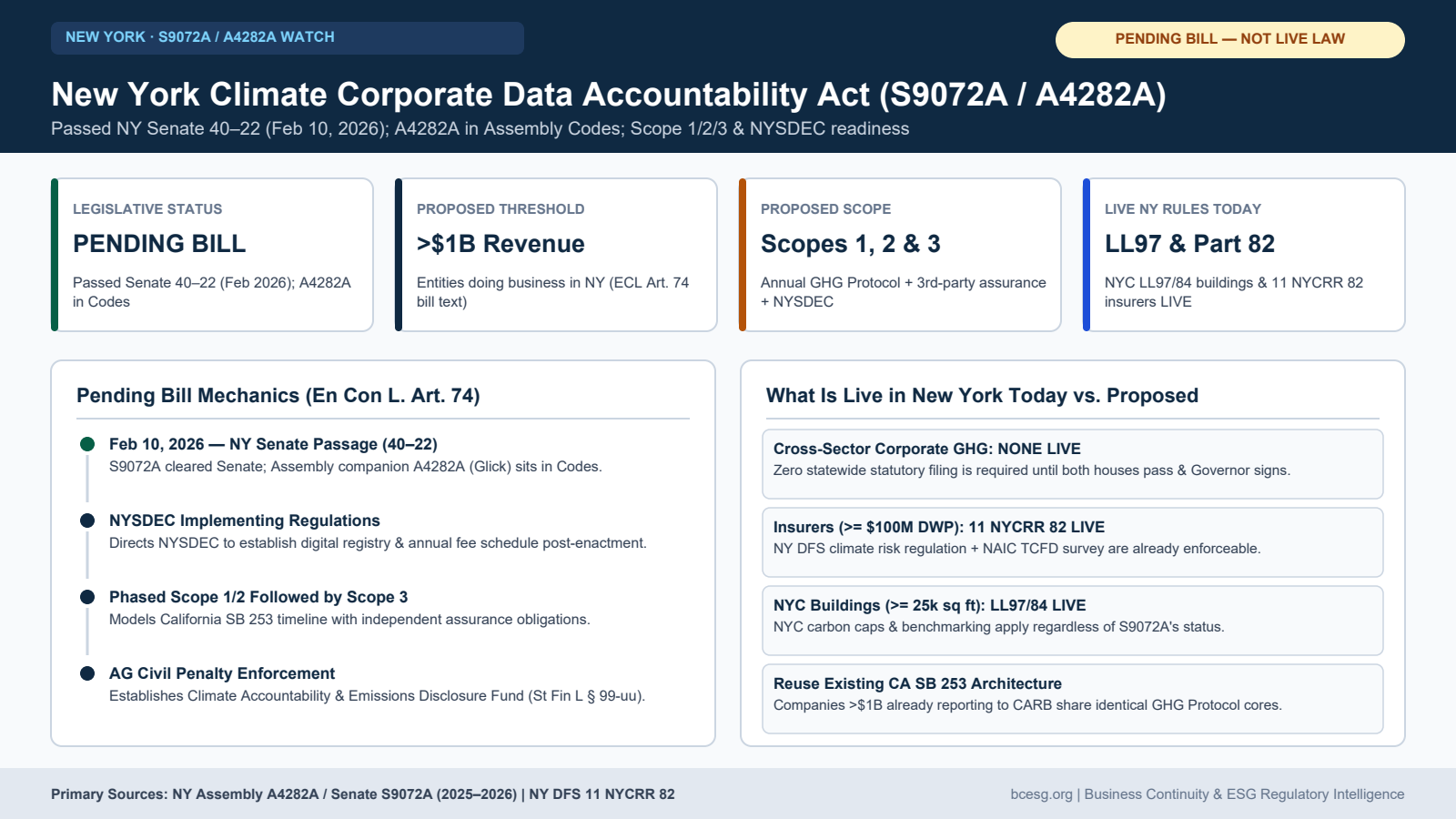
    Short answer — PENDING BILL, NOT LIVE LAW: New York does not have a live statewide cross-sector corporate greenhouse gas disclosure law in effect. Senate Bill S9072A cleared the New York State Senate by a 40–22 margin on February 10, 2026, but identical Assembly companion A4282A remains pending in the Assembly Codes Committee without final passage or gubernatorial signature.

    For general counsel and sustainability teams, the practical governance distinction in New York is sharp: zero filings are due today under ECL Article 74—yet two adjacent New York regimes are already live and actively enforced: 11 NYCRR 82 (NY Department of Financial Services climate-risk governance for insurers alongside the NAIC TCFD Survey) and New York City’s Local Law 97 / Local Law 84 building caps.

    Statutory Status at a Glance
    • Enacted Status: NONE (Pending Legislation). S9072A passed Senate (40–22, Feb 10, 2026); A4282A remains in Assembly Codes.
    • Proposed Covered Entities: U.S. partnerships, corporations, LLCs, or business entities doing business in New York with total annual revenues exceeding $1 billion.
    • Proposed Administering Agency: New York State Department of Environmental Conservation (NYSDEC), backed by Attorney General civil penalty enforcement into State Finance Law § 99-uu.
    • Proposed Emissions Scope: Annual Scope 1, Scope 2, and Scope 3 GHG emissions per GHG Protocol with independent third-party assurance phased across reporting years.
    • What Is Live Today in NY: NYC Local Law 97 & LL84 (buildings >=25k sq ft), NY State benchmarking workflows, and NY DFS climate guidance / 11 NYCRR 82 for insurers.
    Print-First Compliance Brief

    Track New York S9072A / A4282A Without Confusing Pending Bills for Live Law

    2-page Print-First regulatory watch separating pending >$1B cross-sector S9072A/A4282A proposals from live NY insurer (11 NYCRR 82) and NYC LL97/84 mandates.

    Inside S9072A / A4282A: How the Proposed ECL Article 74 Architecture Works

    Drafted as a direct east-coast counterpart to California SB 253, S9072A / A4282A proposes adding Article 74 (§§ 74-0101 and 74-0102) to the New York Environmental Conservation Law alongside a dedicated Climate Accountability and Emissions Disclosure Fund (State Finance Law § 99-uu).

    Unlike New Jersey’s amended S679—where Senate Environment & Energy stripped Scope 3 in February 2026—New York’s Senate-passed text retains full Scope 1, Scope 2, and Scope 3 disclosures plus third-party assurance phased after NYSDEC rulemaking.

    • Consolidated Reporting Alignment: Because both CA SB 253 and NY S9072A rely on the Greenhouse Gas Protocol Corporate Accounting and Reporting Standard and Corporate Value Chain (Scope 3) Standard, multi-state firms >$1B already assembling CARB inventories can reuse identical entity boundaries.
    • Rulemaking Lead Time Guarantee: Even if resurrected in post-election legislative sessions, statutory reporting duties do not begin immediately upon signature; NYSDEC must first adopt implementing regulations, digital registry contracts, and fee schedules.
    Framework / BillTarget UniverseCurrent Status (Nov 14, 2026)Immediate Action
    S9072A / A4282A (ECL Art. 74)U.S. entities >$1B doing business in NYPENDING (Passed Sen. 40–22; A4282A in Codes)Monitor only; map reuse of CA SB 253 Scope 1/2/3 controls
    NY DFS 11 NYCRR 82 & NAICLicensed insurers (>=$100M DWP / NY domestic)LIVE Sectoral MandateMaintain board climate governance & annual TCFD response
    NYC LL97 & LL84Covered NYC buildings >=25,000 sq ftLIVE Municipal Carbon CapFile annual May 1 LL84 & LL97 compliance / mitigation reports
    Legislative status diagram for New York S9072A / A4282A Climate Corporate Data Accountability Act showing Feb 10 2026 Senate passage (40-22), Assembly Codes stall, >$1B scope, and live NY LL97 / Part 82 rules.
    New York S9072A / A4282A (Pending Watch — not live cross-sector law) contrasted with live NY DFS 11 NYCRR 82 insurer rules and NYC Local Law 97/84.

    Separation Check: Live New York Mandates Already Requiring Filings

    Compliance calendars in New York routinely conflate S9072A news headlines with enforceable statutes that already carry financial penalties. Teams operating buildings or insurance carriers in the state must isolate three separate compliance streams.

    First, real-estate owners >=25,000 sq ft inside New York City remain governed by Local Law 84 benchmarking and Local Law 97 carbon-intensity caps regardless of Albany action. Second, NY domestic and licensed insurers >=$100M DWP answer annual TCFD climate risk surveys alongside NY DFS expectations under 11 NYCRR 82.

    • Private Non-Insurer Corporations Outside NYC Real Estate: Zero statutory statewide Scope 1/2/3 filing obligation today unless they also trigger California SB 253 via >$757k California sales.
    • Albany Trigger Watch: Monitor Assembly Codes and 2027 committee reintroduction schedules; post-2026 legislative sessions determine whether S9072A is carried over or refiled with Assembly revenue/assurance revisions.

    Compliance Execution Checklist

    StepOwner / TeamAuditable Deliverable
    1. Calendar HygieneLegal / ComplianceTag S9072A/A4282A strictly as Pending Watch — remove any implied 2026/2027 statutory fine assumptions.
    2. CA SB 253 MappingSustainability LeadDocument whether NY entity already falls under CA SB 253 (> $1B global rev + CA nexus).
    3. NY DFS / LL97 CheckRisk / Real EstateVerify live insurer obligations (11 NYCRR 82) and NYC property LL97/84 filings independently.
    4. Session Carryover WatchGov AffairsTrack Assembly Codes & 2027 committee calendar for amended text or Scope 3 adjustments.
    Field & Print Package

    Keep This New York State Compliance Checklist Handy

    Download the formatted 2-page PDF reference brief or pull the structured Markdown edition for internal compliance documentation.

    Frequently Asked Questions

    Do companies have to file corporate GHG emissions reports with New York State in 2026 or early 2027?

    No. New York's Climate Corporate Data Accountability Act (S9072A / A4282A) passed the Senate in February 2026 but remained pending in Assembly Codes as of November 14, 2026. No cross-sector statewide corporate GHG reporting statute is enacted or in force.

    What does New York S9072A / A4282A require if enacted?

    The bill as passed by the Senate covers entities with annual revenues over $1 billion doing business in New York, phasing in annual Scope 1, Scope 2, and Scope 3 emissions reports under the GHG Protocol with third-party assurance administered by NYSDEC.

    Which climate disclosure rules ARE live in New York today?

    Insurers face live obligations under NY DFS 11 NYCRR 82 and the NAIC TCFD Survey (>= $100M DWP), while covered New York City buildings >= 25,000 sq ft face live annual compliance under Local Law 84 benchmarking and Local Law 97 carbon limits.

    Primary Authorities & Official Resources

    Informational notice: This guide summarizes enacted statutes, regulations, or pending legislative records from the primary authorities linked above as of November 14, 2026. It is not legal, accounting, or licensed engineering advice.

  • California Climate Disclosure Playbook: SB 253, Enjoined SB 261 & AB 1305 Status

    California Climate Disclosure Playbook: SB 253, Enjoined SB 261 & AB 1305 Status

    Updated: November 14, 2026 — Refreshed to reflect current statutory cycles, verification rules, and post-election regulatory posture.

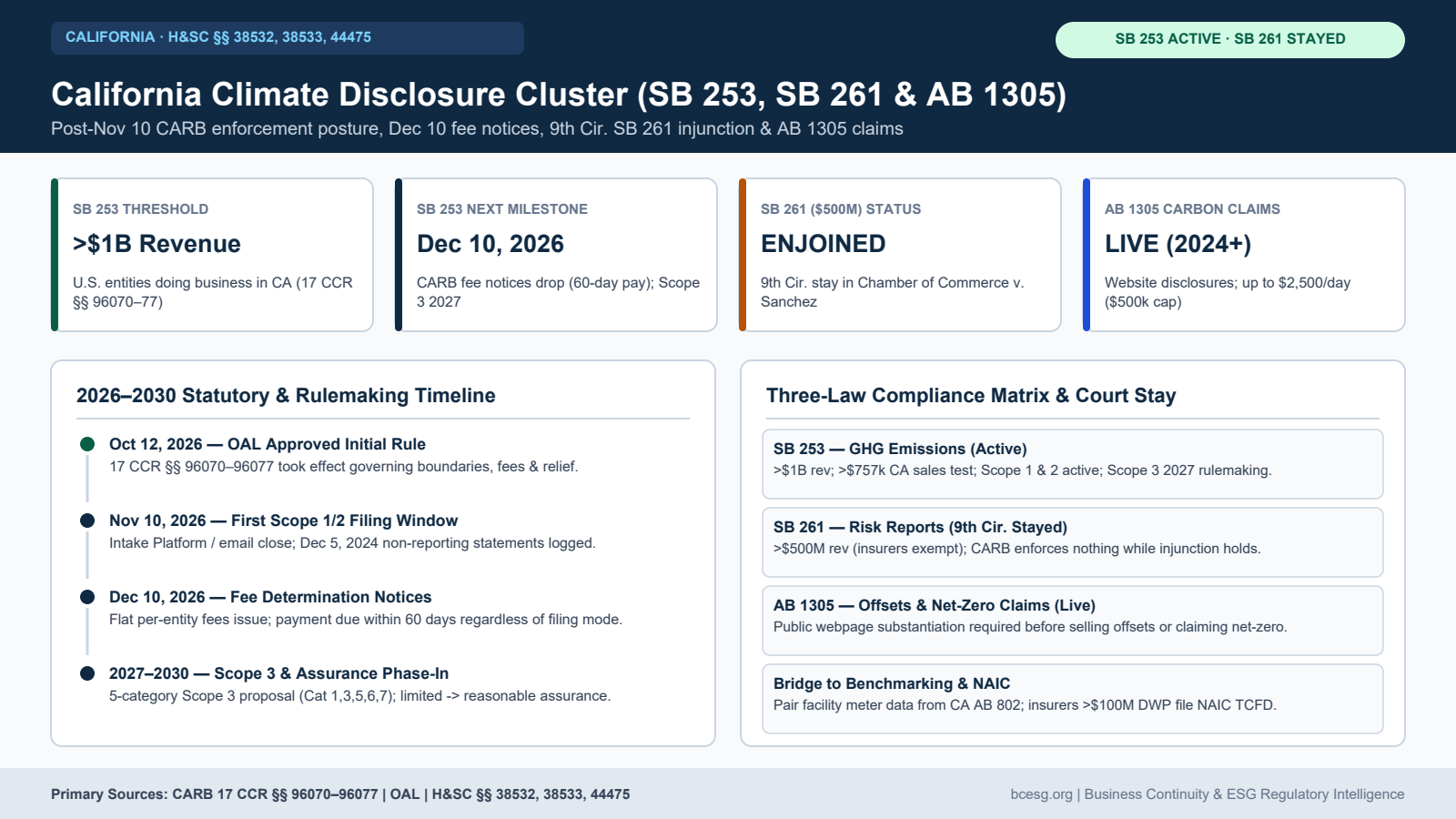
    Short answer: California operates the United States’ only enacted, live cross-sector corporate climate disclosure regime—yet its three flagship statutes sit in distinct operational postures. Following the California Office of Administrative Law (OAL) approval of CARB’s Initial Regulation (17 CCR §§ 96070–96077) on October 12, 2026, the inaugural November 10, 2026 Scope 1 and Scope 2 reporting deadline under SB 253 has just closed—shifting immediate corporate focus to December 10, 2026 CARB fee notices and the 2027 Scope 3 / assurance rulemaking.

    Meanwhile, SB 261 (biennial financial-risk reporting for >$500 million entities) remains paused under the Ninth Circuit’s preliminary injunction in Chamber of Commerce v. Sanchez (No. 25-5327), whereas AB 1305 (website carbon-offset and net-zero claims substantiation under Health & Safety Code §§ 44475–44475.3) has been actively enforceable since January 1, 2024. Together—alongside our detailed filing walkthrough in California SB 253, SB 261 & AB 1305 Filing Pack—this guide establishes the authoritative post-November 10 compliance baseline.

    Statutory Status at a Glance
    • SB 253 (Live — >$1B Revenue): H&SC § 38532 & 17 CCR §§ 96070–96077. Nov 10, 2026 initial Scope 1 & 2 filing window passed; Dec 10, 2026 CARB fee notices due in 60 days; 2027 Scope 3 (5 categories proposed) & limited assurance.
    • SB 261 (Enjoined — >$500M Revenue): H&SC § 38533. Preliminarily stayed by the Ninth Circuit (Nov 18, 2025 injunction, argued Jan 9, 2026); CARB maintains a voluntary docket only and expressly exempts insurance companies.
    • AB 1305 (Live — Claims & Offsets): H&SC §§ 44475–44475.3 (eff. Jan 1, 2024). Mandatory annual website disclosures for companies selling/marketing voluntary carbon offsets or making carbon-neutral/net-zero claims in California ($2,500/day, $500k cap).
    • California Nexus Test: Incorporates Rev. & Tax. Code § 23101 sales test alone (>$757,070 California sales for 2025 or 25% of total sales) — physical property or payroll in California is not required.
    • Property & Insurer Intersections: Pair building utility records via California AB 802 Benchmarking; licensed insurers >$1B owe SB 253 even though exempt from SB 261 (covered separately by the NAIC TCFD Insurer Survey).
    Print-First Compliance Brief

    Download the Updated California Three-Law Disclosure Reference

    2-page Print-First PDF aligning SB 253 Dec 10 CARB fee notices & 2027 Scope 3 prep, SB 261 Ninth Circuit injunction posture, and AB 1305 claim checks.

    Post-November 10 SB 253 Mechanics: Fee Notices, Non-Reporting Relief & 2027 Scope 3

    Under 17 CCR §§ 96070–96077 (adopted following OAL review at oal.ca.gov), applicability is evaluated at the individual legal-entity level using global gross receipts under Rev. & Tax. Code § 25120(f)(2) measured at the lesser of the previous two fiscal years. Parents may submit consolidated reports and pay one consolidated fee on behalf of qualifying subsidiaries.

    Because CARB’s December 5, 2024 enforcement notice allowed entities lacking Scope 1 and 2 data as of that historical cutoff to submit a signed Statement of Non-Reporting on corporate letterhead for the 2026 cycle (§ 96076(b)(1)), companies exiting November 10 via non-reporting relief carry two immediate post-deadline tasks: remitting CARB’s December 10, 2026 fee assessment within 60 days, and commissioning an auditable GHG Protocol inventory before 2027 rulemaking converts non-reporting relief into limited-assurance requirements.

    • December 10, 2026 Fee Determination Cycle: Flat annual cost-recovery fee assessed under §§ 96073–96075 applies to every covered entity whether it uploaded Scope 1/2 emissions data or a non-reporting statement.
    • 2027 Scope 3 Five-Category Proposal: CARB’s July 21, 2026 workshop proposed limiting Year-1 mandatory Scope 3 reporting to Categories 1 (purchased goods/services), 3 (fuel- & energy-related activities), 5 (waste), 6 (business travel), and 7 (employee commuting), leaving the remaining 10 GHG Protocol categories voluntary pending formal draft rulemaking.
    • Assurance Staircase & Civil Penalties: Unaudited Scope 1/2 for 2026 shifts to limited assurance in 2027–2029 and reasonable assurance in 2030, backed by statutory maximum civil penalties of $500,000 per reporting year.
    Statute & CitationCovered EntitiesCore Duty & 2026–2030 DeadlinesCurrent Enforceability
    SB 253 (H&SC § 38532; 17 CCR 96070–77)U.S. entities >$1B global revenue doing business in CA (>$757k sales)Scope 1/2 (Nov 10, 2026 passed); Dec 10 fee notice (60d); 2027 Scope 3 + lim. assuranceLIVE & Enforceable (up to $500k/yr civil penalty)
    SB 261 (H&SC § 38533)U.S. entities >$500M global rev in CA (insurers exempt)Biennial TCFD climate-related financial risk report on company websiteENJOINED (9th Cir. stay; voluntary CARB docket only)
    AB 1305 (H&SC §§ 44475–44475.3)Entities selling offsets or making net-zero/reduction claims in CA (no rev floor)Public website disclosure of offset registries, protocols & verificationLIVE since Jan 1, 2024 ($2,500/day, $500k cap)
    Compliance overview of California SB 253 Scope 1/2/3 deadlines and December 10 fee notices, SB 261 Ninth Circuit injunction status, and AB 1305 website carbon claim disclosures.
    California's three climate disclosure statutes as of November 14, 2026: active SB 253 fee/Scope 3 horizon under 17 CCR §§ 96070–96077, stayed SB 261 litigation, and live AB 1305 rules.

    SB 261 Ninth Circuit Stay vs. Enforceable AB 1305 Website Disclosures

    In Chamber of Commerce of the United States v. Sanchez (No. 25-5327), the Ninth Circuit enjoined enforcement of SB 261 on First Amendment grounds on November 18, 2025 while leaving SB 253 undisturbed. Following January 9, 2026 oral argument, CARB ceased enforcement of SB 261’s January 1, 2026 deadline pending final appellate resolution, maintaining a strictly voluntary submission docket in the interim.

    Compliance teams often misread SB 261’s injunction as a pause on AB 1305 — it is not. Under Health & Safety Code §§ 44475–44475.3, any entity making claims in California regarding achievement of net-zero emissions, carbon neutrality, or significant GHG reductions (or marketing/purchasing voluntary carbon offsets tied to those claims) must publish primary project, methodology, and independent-verification facts on its public website. AB 1305 carries no $500M revenue floor and exposes non-compliant marketers to Attorney General and local prosecutor civil suits of up to $2,500 per day (capped at $500,000).

    • Why Insurers Still Watch SB 253: H&SC § 38533 explicitly exempts insurance companies from SB 261 because they report climate risks to state commissioners under TCFD-aligned insurance calls; H&SC § 38532 (SB 253) contains no insurer exemption.
    • Multi-State Spillover Check: Companies configuring GHG Protocol controls for California now cover the exact core template proposed by New York S9072A/A4282A (pending), New Jersey S679 (pending), and Illinois HB 3673 (pending).

    Compliance Execution Checklist

    StepOwner / TeamAuditable Deliverable
    1. Fee Contact & RemittanceTax / ControllerVerify CARB Intake contact and pay Dec 10, 2026 fee notice within 60 days (§§ 96073–96075).
    2. 2027 Assurance BridgeSustainability / AuditConvert any 2026 Statement of Non-Reporting into metered Scope 1/2 + 5-cat Scope 3 pipeline.
    3. AB 1305 Website ScrubLegal / MarketingAudit all net-zero/carbon-neutral webpages & offset serials against H&SC § 44475 disclosures.
    4. SB 261 TCFD Shelf PackFinance / RiskMaintain internal 4-pillar TCFD draft without public filing while 9th Cir. stay holds.
    Field & Print Package

    Keep This California Compliance Checklist Handy

    Download the formatted 2-page PDF reference brief or pull the structured Markdown edition for internal compliance documentation.

    Frequently Asked Questions

    Do we still owe CARB's December 10, 2026 fee if we filed a Statement of Non-Reporting on November 10?

    Yes. Under 17 CCR §§ 96073–96076, every covered entity over $1 billion doing business in California is assessed the flat annual program cost-recovery fee payable within 60 days of CARB's notice, regardless of whether it submitted emissions data or a non-reporting statement.

    Is California SB 261 back in force in November 2026?

    No. Enforcement of SB 261 remains stayed under the Ninth Circuit's November 18, 2025 preliminary injunction in Chamber of Commerce v. Sanchez (No. 25-5327). CARB has confirmed it will not enforce SB 261 while the injunction remains active, though voluntary filings remain open.

    Does AB 1305 have a $500 million or $1 billion revenue threshold?

    No. California's Voluntary Carbon Market Disclosures Act (AB 1305) applies with no revenue minimum to entities operating in California that market or sell voluntary carbon offsets or make carbon-neutral, net-zero, or significant GHG reduction claims.

    Primary Authorities & Official Resources

    Informational notice: This guide summarizes enacted statutes, regulations, or pending legislative records from the primary authorities linked above as of November 14, 2026. It is not legal, accounting, or licensed engineering advice.

  • The European Green Deal: Europe’s Climate-Neutral Growth Strategy, Mapped

    The European Green Deal: Europe’s Climate-Neutral Growth Strategy, Mapped

    The European Green Deal is not a law. It is the European Union’s growth strategy — a 2019 commitment to make Europe the first climate-neutral continent by 2050, executed through dozens of laws that followed it. That distinction explains most of the confusion around it: people look for “the Green Deal” in the statute book and find instead the Climate Law, the emissions trading reforms, the carbon border tax, and the reporting directives — which is the point. The Deal is the architecture; the instruments below are its machinery. This page maps both: what the Deal commits Europe to, the laws that carry it, and what it means for companies — including the ones outside Europe that the machinery reaches anyway.

    The commitments

    Three numbers organize everything. Climate neutrality by 2050 — made legally binding by the European Climate Law (Regulation (EU) 2021/1119), not merely aspired to. A net reduction of at least 55 percent in greenhouse gas emissions by 2030 against 1990, the target the “Fit for 55” legislative package of 2021 was built to deliver, and likewise written into the Climate Law. And a 2040 waypoint — the Commission has proposed a 90 percent net reduction — which has been the subject of the Deal’s most contested recent negotiation. Around the climate core sits the wider agenda the 2019 communication announced: a circular economy, a farm-to-fork food system, biodiversity restoration, zero pollution, and the financing to match, framed from the start as an economic modernization program rather than an environmental one.

    The machinery: the laws that carry the Deal

    Carbon pricing first. The EU Emissions Trading System — the cap-and-trade market covering power, industry, and aviation — was tightened under Fit for 55 and extended toward maritime emissions, with a second system (ETS2) created for buildings and road transport fuels. The Carbon Border Adjustment Mechanism (CBAM) prices the carbon in imports of cement, steel, aluminium, fertilizers, electricity, and hydrogen — transitional reporting from October 2023, with the financial regime phasing in from 2026 — so that the carbon price cannot be escaped by moving production abroad. Then the disclosure and diligence layer: the EU Taxonomy (Regulation (EU) 2020/852) defining which economic activities count as sustainable; the Corporate Sustainability Reporting Directive (CSRD) and its standards, requiring audited sustainability disclosure; and sector instruments like the Deforestation Regulation, treated in depth on this site, which condition market access on commodity-level diligence. And the energy build-out: renewable-energy and efficiency directives with binding national trajectories, accelerated after 2022 by REPowerEU, the plan to end dependence on Russian fossil fuels that fused the Deal’s climate logic with energy security.

    Where it stands: delivery, friction, and the simplification turn

    The architecture is law; the argument now is about pace and burden. The 2024–2029 Commission kept the destination and reframed the route: the Clean Industrial Deal of 2025 recasts decarbonization as a competitiveness program — cheaper clean energy, lead markets for green steel and cement, state-aid room for industrial transition — while the “omnibus” simplification packages moved to cut the reporting load the first wave created, proposing narrower scopes and delayed timelines for parts of the CSRD and due-diligence regimes. Both impulses are genuinely the Deal’s children: the original strategy always claimed growth and climate were the same project, and the friction of the 2020s — energy prices, industrial competition from the US and China, farmer and voter pushback — is the stress test of that claim. Companies planning against the Green Deal should plan on the destination holding and the instruments being recalibrated: timelines flex, the direction has not reversed through any of the pushback so far.

    What it means beyond Europe

    The Deal’s reach is extraterritorial by design. CBAM prices non-EU producers at the border. The Deforestation Regulation conditions non-EU commodities on geolocated diligence. CSRD reporting reaches the value chains of covered companies worldwide, which is how a regulation Brussels wrote becomes a questionnaire in a supplier’s inbox in Ohio or Penang. For non-EU companies, the practical translation is short: if your products enter the EU, or your customers report under its rules, parts of the Green Deal are your compliance landscape too — and the gap between the EU’s measurement expectations and a supplier’s data is now a commercial fact, priced in procurement long before it is priced in law.

    Frequently asked questions

    What is the European Green Deal?

    The European Union’s growth strategy, launched in December 2019, committing the EU to climate neutrality by 2050 and a net 55 percent emissions cut by 2030 against 1990. It is an architecture rather than a single law: the targets are made binding by the European Climate Law, and delivered through instruments including the ETS, CBAM, the EU Taxonomy, and the CSRD.

    Is the European Green Deal legally binding?

    The Deal itself is a strategy; its core targets are law. The European Climate Law (2021) makes climate neutrality by 2050 and the 2030 reduction of at least 55 percent legally binding obligations, and the individual instruments — emissions trading, the carbon border mechanism, reporting directives — bind the companies they cover directly.

    What is Fit for 55?

    The 2021 legislative package designed to deliver the 2030 target of a net 55 percent emissions reduction. It revised the emissions trading system, created the carbon border adjustment, set effort-sharing among member states, and tightened the energy, transport, and land-use rules that make the number reachable.

    Does the European Green Deal affect companies outside Europe?

    Yes — by design. CBAM prices carbon in covered imports, the Deforestation Regulation conditions commodity market access on diligence, and CSRD reporting pulls value-chain data from suppliers worldwide. Any company selling into the EU, or supplying a company that reports under EU rules, meets part of the Deal in practice.

  • EU Deforestation Regulation (EUDR): What It Requires, Who It Catches, Where the Dates Stand

    EU Deforestation Regulation (EUDR): What It Requires, Who It Catches, Where the Dates Stand

    The EU Deforestation Regulation — Regulation (EU) 2023/1115, the EUDR — makes market access conditional on a forest claim. Seven commodity families — cattle, cocoa, coffee, oil palm, rubber, soya, and wood, plus listed products derived from them — may be placed on the EU market or exported from it only if they are deforestation-free, produced in accordance with the relevant laws of the country of production, and covered by a due diligence statement backed by geolocation data. It is the supply-chain due-diligence idea, which this site treats across its compliance work, written into hard law with coordinates attached. This page covers what the regulation requires, whom it catches, and where its timeline honestly stands.

    The three conditions

    Deforestation-free means the commodities were produced on land that was not subject to deforestation after December 31, 2020 — the regulation’s fixed cut-off date — and, for wood, that harvesting did not induce forest degradation after the same date. Legality means production complied with the producing country’s own relevant laws: land use, environmental protection, forest management, labor and human rights, tax and trade rules. And the due diligence statement is the operator’s formal submission — made through the EU’s information system before the goods are placed on the market — declaring that diligence was exercised and no more than negligible risk was found. All three conditions, evidenced, or the goods do not move. There is no de minimis and no self-certification shortcut; the statement is a legal attestation, with the liability that implies.

    What due diligence actually involves

    Information, assessment, mitigation — the standard sequence, with one extraordinary input: coordinates. Operators must collect the geolocation of every plot of land where the commodities were produced, alongside supplier, species, quantity, and legality documentation. Then assess risk against the country benchmarking the Commission publishes (countries are classed low, standard, or high risk; the first benchmarking exercise placed the large majority of countries at standard risk, with simplified diligence available for low-risk origins and enhanced scrutiny for high), the complexity of the supply chain, and the credibility of the information. Then mitigate any non-negligible risk — additional information, independent audits, supplier engagement — or do not place the goods. Records are kept for five years, and competent authorities in member states conduct checks, with penalties that include fines calibrated to EU turnover and confiscation of the goods and revenues. The practical transformation: a commodity trader’s core asset used to be relationships; under the EUDR it is plot-level data, flowing from farm and concession through every intermediary intact.

    Who is caught — including outside Europe

    Operators and traders placing the listed products on the EU market carry the duty directly, with obligations scaled by company size, and non-EU producers feel it contractually: a coffee exporter in a producing country, a cattle operation, a rubber processor — none files the EU statement themselves, and all of them must supply geolocation and legality evidence into their buyers’ diligence or lose the market. That transmission mechanism is the regulation’s real reach, and it pairs with the broader supply-chain diligence movement in the compliance frameworks map: Europe increasingly buys only what can be evidenced. Small and micro operators received lighter obligations and later dates in the regulation’s design — but “lighter” still ends at the same geolocation data, arriving through the buyer’s requirements if not the law’s.

    The timeline, stated honestly

    This regulation’s dates have moved, and any source that gives one date without context is behind. As adopted in 2023, application was set for December 30, 2024 for large operators. A postponement law adopted in late 2024 moved application to December 30, 2025 for large and medium operators and June 30, 2026 for micro and small enterprises. Through 2025, further simplification and delay proposals were debated in Brussels — including changes aimed at reducing the burden on smaller actors and downstream traders — and the legislative position continued to evolve. The durable advice for any operator: the dates in force for your size class, in the amended regulation as it stands when you read this, are the only dates that count, and the diligence machinery (geolocation, legality evidence, plot-level records) is worth building regardless of which month the starting gun fires — because your buyers’ questionnaires will not wait for it.

    Frequently asked questions

    What is the EUDR?

    The EU Deforestation Regulation, Regulation (EU) 2023/1115. It conditions EU market access for cattle, cocoa, coffee, oil palm, rubber, soya, and wood (and listed derivatives) on three proofs: deforestation-free after a December 31, 2020 cut-off, production legal under the origin country’s laws, and a due diligence statement supported by geolocation data.

    What does deforestation-free mean under the EUDR?

    The commodities were produced on land not subject to deforestation after December 31, 2020; for wood, harvesting must also not have induced forest degradation after that date. The cut-off is fixed in the regulation — later clearing cannot be offset or averaged away.

    Who must comply with the EUDR?

    Operators and traders placing the listed products on the EU market, or exporting them from it, with obligations scaled by size. Non-EU producers are not the filing party but are caught in practice: they must supply geolocation and legality evidence into their EU buyers’ due diligence or lose access.

    When does the EUDR apply?

    The dates have been postponed once and debated since: the 2024 postponement set December 30, 2025 for large and medium operators and June 30, 2026 for micro and small enterprises, and simplification measures continued through the legislative process. Check the amended regulation for the dates in force for your size class — and build the diligence data now, because buyer requirements move faster than the law.

  • No California Office? You May Still Owe CARB a Report on November 10

    No California Office? You May Still Owe CARB a Report on November 10

    On October 12, 2026, California’s Office of Administrative Law approved the Air Resources Board’s initial regulation for SB 253, and it took effect the same day. The first Scope 1 and Scope 2 emissions reports are due November 10, 2026.

    The sentence most likely to get a board in trouble this month is “we don’t operate in California.” SB 253 coverage does not turn on where a company sits. It turns on global revenue and California sales — and a company with no California office, no California employees, and no California property can still owe CARB a report in 18 days.

    This is the coverage test, the exemptions, and the part of the filing almost nobody plans for: whatever you submit becomes public.

    The three-part coverage test

    SB 253 — the Climate Corporate Data Accountability Act, Health and Safety Code section 38532 — applies to a “reporting entity” that meets all three tests:

    • Formed under U.S. law. Organized in California, another state, D.C., or by an act of Congress. A U.S.-formed subsidiary of a foreign-headquartered group can be covered in its own right.
    • More than $1 billion in total annual revenue. Revenue is measured globally, not by California sales, using the lesser of the entity’s two most recent fiscal years — one exceptional year does not pull you in, and one soft year does not let you out.
    • Doing business in California. CARB borrows the tax code’s definition (Revenue and Taxation Code section 23101) but adopted the sales-based test: an entity organized or commercially domiciled in California, or with California sales above the threshold — $735,019 for 2024 and $757,070 for 2025, adjusted over time. CARB did not adopt the property and payroll thresholds that also appear in the tax statute.

    Read that third test again. Roughly three-quarters of a million dollars of California sales — a rounding error for a billion-dollar company — is enough. Physical presence is not required, and CARB has been explicit that the applicability determination is the entity’s own job: you run the test, and you keep the records behind your answer.

    Who is out

    The regulation excludes several categories outright:

    • Tax-exempt nonprofit organizations.
    • Entities regulated by the California Department of Insurance, or engaged in the insurance business in another state.
    • Government entities, and companies more than 50% government-owned.
    • Entities whose only California activity is wholesale electricity transactions.
    • Entities whose only California business is employee compensation or payroll — including paying people who telework from California.

    If none of those describe you and the three tests are met, the question is no longer whether you file. It is what you file — and that is where the three doors into the first filing come in: report the data you had, or file the statement explaining why you are not reporting.

    Whatever you file becomes public

    Reports go to CARB through its Report Intake Platform (CARB’s preferred route) or by email to [email protected]. Companies that were not collecting emissions data as of CARB’s December 5, 2024 enforcement notice may instead submit a statement of non-reporting on company letterhead.

    Both kinds of submission become public. That makes the November 10 filing a different exercise from most compliance paperwork: it is a document your competitors, your customers, ESG raters, and plaintiffs’ counsel will be able to read.

    Two practical consequences follow. First, the non-reporting statement deserves the same care as the report itself — short, factual, and confined to the reason CARB’s rule allows: the data was not being collected as of December 5, 2024. It is not the place for commentary about the law. Second, the numbers in a full report should be numbers the company is prepared to defend in public, because public is where they will live.

    CARB has said it will exercise enforcement discretion in the first year and expects entities to submit the information available to them. That posture is real, but it is not the law: the statute’s penalty ceiling — up to $500,000 per reporting year — stands behind the deadline either way.

    The fee arrives either way

    Covered entities owe CARB an annual program fee whether they submit emissions data or a non-reporting statement. CARB has not published a final per-entity figure; law-firm estimates put it in the $2,000 to $7,000 range per entity.

    Fee notices are scheduled for December 10, 2026, with payment due within 60 days of the invoice. A parent company may consolidate fee payments for subsidiaries that report on a consolidated basis. Budget holders should treat the fee as a cost of the determination itself: deciding you are covered creates the obligation, filing or not.

    If you are covered, the filing mechanics are already mapped

    Scope 3 is not required in 2026. Assurance is not required this year — CARB accepts 2026 submissions with or without limited assurance. The report covers the prior fiscal year’s Scope 1 and Scope 2 emissions, built from information the company possessed or was already collecting as of December 5, 2024.

    For the working checklist — which fiscal year goes in the first report, the exact filing routes, and the preparation steps that still fit in the remaining time — see our companion piece: California’s First SB 253 Filing: The November 10 Compliance Checklist.

    What comes next

    This year’s filing is the narrow one. CARB expects Scope 3 reporting to begin in 2027, covering 2026 emissions — which means the supplier data requests start now, not next year. Limited assurance applies to Scope 1 and 2 first, transitioning to reasonable assurance by 2030.

    And one litigation note, because boards ask: the Ninth Circuit has enjoined enforcement of SB 261, the companion climate-risk law. SB 253 has not been enjoined. The November 10 deadline is in force.

    This article is general information about a public regulation, not legal advice. Applicability determinations under SB 253 are fact-specific; companies should confirm their position with counsel. Sources: Greenberg Traurig, “California SB 253: CARB Sets Nov. 10, 2026, Deadline for Scope 1 and Scope 2 Emissions Reports” (October 2026); CARB SB 253 Initial Regulation, 17 CCR sections 96070–96077 (effective October 12, 2026).

  • California’s First SB 253 Filing: The November 10 Compliance Checklist

    California’s First SB 253 Filing: The November 10 Compliance Checklist

    Updated Nov 2, 2026 — added the free SB 253 first-filing quick card, Nov 10 first-filing print pack, and SB 253 first-filing bot book downloads to this checklist.

    On October 12, 2026, the California Office of Administrative Law approved the California Air Resources Board’s Initial Regulation for SB 253, and the regulation took effect the same day. That approval locked the date every covered company now has to work to: the first Scope 1 and Scope 2 emissions reports under the Climate Corporate Data Accountability Act are due to CARB on or before November 10, 2026.

    This is not a proposed rule and it is not a distant phase-in. It is a live filing, roughly three weeks out, for U.S. companies with more than $1 billion in annual revenue that do business in California. What follows is the practitioner version: exactly who is covered, which fiscal year goes into the first report, the ways CARB will accept the filing, what assurance does and does not require this year, and the preparation steps that still fit in the time left.

    Instant First-Filing Downloads

    Equip Your Compliance Team or Feed Your AI Assistant

    Grounded in California’s approved Initial Regulation (17 CCR §96075–§96078) and HSC §38532. Zero legal advice—practical working tools for the November 10, 2026 deadline.

    Field Reference
    FREE

    SB 253 First-Filing Quick Card

    2-page field card: filing-in-one-table, coverage rules, data year February 1 test, submission routes, fee & penalty schedule, and 5-year records.

    Download Free PDF

    Direct download • No email gate

    Working Pack
    $7

    Nov 10 SB 253 First-Filing Print Pack

    6-page fillable working pack: Applicability Worksheet (RTC §25120 & §23101), Fiscal Year Picker, Scope 1 & 2 Data Checklist, Submission Checklist, and Five-Year File Log.

    Get Print Pack ($7) →

    Instant checkout • Square verified

    AI Intensive
    Book for Bots
    $17

    SB 253 First-Filing Bot Book

    Feed to Claude, ChatGPT, or Gemini: 4 AI-run routines (/applicability, /fiscalyear, /datainventory, /submission) with embedded output router.

    Get Bot Book ($17) →

    Software made of words • Instant delivery

    The filing in one table

    Item What the approved rule requires
    Who files U.S.-organized business entities with revenue over $1 billion that do business in California
    First deadline November 10, 2026
    Scopes in the 2026 report Scope 1 and Scope 2 only — Scope 3 is not required this cycle
    Data year Prior fiscal year, selected under the February 1 rule below
    How to file CARB’s voluntary 2026 Report Intake Platform, or email to [email protected]
    Assurance Limited assurance is the statutory standard from 2026, but CARB accepts 2026 filings with or without it
    Fee Annual, formula-based; CARB issues fee determination notices by December 10, payment due within 60 days
    Penalty ceiling Up to $500,000 per reporting year for nonfiling, late filing, or other failure to comply
    Records Keep the California tax records behind your applicability determination for five years

    Who must file — and who is out

    The regulation defines a “reporting entity” as a partnership, corporation, limited liability company, or other business entity formed under the laws of California, another U.S. state, the District of Columbia, or an act of Congress, with total annual revenues in excess of $1 billion, that does business in California.

    Three details of that definition decide most borderline cases. First, revenue means gross receipts, as defined in California Revenue and Taxation Code section 25120(f)(2). Second, the revenue test uses the lesser of the entity’s two previous fiscal years — one exceptional year does not pull an entity in, and one soft year does not let it out. Third, the test is applied entity by entity, at the individual business entity level; revenue from intercompany transactions inside the same combined reporting group does not count toward the threshold.

    “Doing business in California” is also a defined term, not a vibe. It means doing business under Revenue and Taxation Code section 23101(a) and meeting either the section 23101(b)(1) or the section 23101(b)(2) test. Wholesale electricity sales in interstate commerce do not count toward the (b)(2) sales test. CARB’s guidance is explicit that entities are responsible for determining their own applicability — there is no approval step where CARB confirms your status for you.

    Five categories are outside the article entirely:

    • Tax-exempt nonprofit or charitable organizations
    • Business entities regulated by the California Department of Insurance, or in the business of insurance in any other state
    • Federal, state, and local government entities, and companies majority-owned (over 50 percent) by government entities
    • Entities whose only California activity is wholesale electricity transactions in interstate commerce
    • Entities whose only California business is employee compensation or payroll expenses, including teleworking employees

    One structural relief valve matters for groups: reports may be consolidated at the parent-company level. A covered subsidiary does not have to file separately if its parent files a consolidated report that includes it.

    Which fiscal year goes in the first filing

    The first report covers a prior fiscal year, and section 96076(c) of the regulation picks which one by a February 1 line:

    • Fiscal year ends on or before February 1 in a calendar year → report the fiscal year ending in the current calendar year.
    • Fiscal year ends after February 1 → report the fiscal year ending in the previous calendar year. The entity may instead choose its most recent preceding fiscal year, if that data is available.

    Worked through the common cases: a calendar-year filer reports its 2025 fiscal year. A company whose fiscal year ends June 30 reports the year that ended June 30, 2025 — but may elect the year ended June 30, 2026 if the data is ready. A company whose fiscal year ends January 31 reports the year ended January 31, 2026, because that year ends in the current calendar year under the first branch of the rule.

    Scope for this cycle is deliberately narrow. Scope 1 is direct greenhouse gas emissions from sources the entity owns or directly controls, regardless of location, including fuel combustion. Scope 2 is indirect emissions from purchased or acquired electricity, steam, heating, or cooling, regardless of location. Scope 3 — the value-chain inventory — is not part of the 2026 report; under the statute it begins in 2027. Emissions are measured and reported in conformance with the Greenhouse Gas Protocol’s standards and guidance.

    The no-data door, stated precisely

    For the November 10, 2026 report only, the regulation carries forward CARB’s December 5, 2024 Enforcement Notice. A covered entity has two options:

    • (A) Submit Scope 1 and Scope 2 emissions from its prior fiscal year that can be determined from information it already possessed or was already collecting on or before December 5, 2024; or
    • (B) Submit a statement of non-reporting on company letterhead stating that it is not submitting a report because it did not possess Scope 1 or Scope 2 information and was not collecting it on or before December 5, 2024.

    CARB asks that the statement be submitted through the intake platform or by email before November 10, 2026. Read this door for exactly what it is: a one-cycle enforcement-discretion posture for the first report, not an exemption from SB 253. An entity that uses it is still a reporting entity, still owes the fee, and still needs a real inventory for the next cycle. Our earlier briefing walks through the three doors into the filing in more depth.

    How to file in 2026

    CARB built a 2026 Report Intake Platform, and its status surprises people: use of the platform is voluntary, not mandatory. Ahead of the deadline it can carry your contact information, your Scope 1 and 2 report through its submission fields, and the billing information CARB needs for fee invoicing. The alternative route is plain email — send the emissions report and contact information to [email protected].

    The first-year formats are equally pragmatic. CARB’s September 1, 2026 reporting guidance accepts an existing annual report that includes Scope 1 and 2 emissions, existing Scope 1 and 2 data already reported to other programs or voluntary initiatives, or CARB’s Draft Scope 1 and 2 GHG Reporting Template — which is itself voluntary for 2026. For Scope 2, no single factor dataset is mandated this year: EPA eGRID 2023, the Cornerstone Sustainability Data Initiative’s eGRID 2024, or other credible sources may be used, provided the filing identifies the factors and sources behind the numbers.

    CARB also encourages filers to include the context around the numbers — methodologies, data sources, global warming potential values, emission factors, organizational boundaries, disaggregation by category and gas, and assumptions. That context is encouraged rather than mandated in the first-year guidance, but it is the cheapest defensibility a filer can buy: it is the record that shows how each number was produced.

    November 10, 2026 Deadline

    Operationalize Your First SB 253 Filing

    With California’s first filing deadline days away, covered entities cannot afford ambiguous gross receipts calculations, misapplied February 1 fiscal year rules, or unorganized submission records. Build an auditable five-year compliance file and evaluate your data options under CARB’s first-year enforcement rules.

    📋

    What’s In The Toolkit:

    • Applicability Worksheet: RTC §25120 & §23101 tests.
    • Fiscal Year Picker: 17 CCR §96076(c) worked form.
    • Scope 1 & 2 Checklist: Dec 5, 2024 baseline inventory.
    • Submission Checklist: Intake platform vs email route.
    • AI Bot Routines: 4 automated workflows ($17).
    Secure 1-Click Square Checkout

    Assurance: the requirement versus the first-year enforcement

    The statute sets a real assurance ladder. Health and Safety Code section 38532 requires independent third-party assurance of the disclosure: limited assurance for Scope 1 and 2 beginning in 2026, rising to reasonable assurance beginning in 2030.

    The first-year enforcement posture is different from the requirement, and conflating the two is the most common error in coverage of this filing. CARB’s FAQ and its September 2026 guidance state that CARB will accept 2026 submissions whether or not assurance has been obtained. The obligation did not move; the enforcement did. Assurance requirements for 2027 and beyond are part of CARB’s second rulemaking and are not settled by the Initial Regulation — so the correct 2026 posture is to file on time, and to build the inventory so that it can survive limited assurance when the second rulemaking lands.

    Fees, penalties, and the five-year file

    The fee is an annual implementation fee assessed per reporting entity, calculated by formula: CARB’s program costs are recovered across the number of covered entities, with contingency and debt components in the calculation. The approved regulation sets the mechanics, not a fixed dollar figure — anyone quoting you an exact per-company fee for 2026 is quoting an estimate, not the rule. CARB issues fee determination notices by December 10, and payment is due within 60 calendar days of the notice. A parent may pay on a consolidated basis, but the fee is still assessed per covered entity.

    The penalty exposure sits in the statute. CARB’s penalty regulations may reach nonfiling, late filing, or other failure to meet the law’s requirements, and penalties imposed on a reporting entity shall not exceed $500,000 in a reporting year. In setting a penalty, CARB considers all relevant circumstances, including the entity’s past and present compliance and whether it took good-faith measures to comply, and when. Keep that separate from fee enforcement: under the fee subarticle, each calendar day of a violation is a separate offense, violations may be enjoined, and an unpaid fee is a separate violation for each day it remains unpaid. The $500,000 cap and the daily fee offenses are two different mechanisms, and a compliance calendar should track both.

    Finally, the recordkeeping rule that outlives the deadline: entities must keep the California tax records that prove the revenue and doing-business thresholds for five years, and produce them on request. Your applicability memo is not a one-time work product; it is a five-year file.

    What changed on the way to November 10

    Companies that planned against the original calendar have already been whipsawed once, and the history explains the current date. SB 219 (2024) amended SB 253 and its companion law — among other changes it moved CARB’s deadline to adopt the implementing regulation and formalized parent-level consolidation. The Initial Regulation CARB approved on February 26, 2026 set the first filing deadline at August 10, 2026. CARB withdrew that package from the Office of Administrative Law on June 24, released modified text for a 15-day comment period on July 27 deferring the deadline to November 10, 2026, resubmitted the final package on September 21, and OAL approved it effective October 12, 2026.

    The lesson is not that dates move. It is that this date has finished moving: the regulation is approved and in effect, and November 10 is the deadline in the operative text.

    Preparation checklist: the next three weeks

    1. Close the applicability question in writing. Entity-by-entity revenue test on the lesser of the last two fiscal years, doing-business analysis, exemption check — signed off and filed for the five-year record.
    2. Pick the fiscal year deliberately. Apply the February 1 rule, and where the election exists, decide whether the most recent preceding fiscal year is genuinely ready or merely newer.
    3. Inventory what existed on December 5, 2024. That date decides whether you file numbers, file numbers built from what you had, or file the letterhead statement. Do not reconstruct this answer from memory in November.
    4. Choose the route and format. Intake platform or email; existing report, other-program data, or CARB’s draft template. Any of them beats a late bespoke build.
    5. Assemble the methodology context now. Boundaries, factors and their sources, GWP values, assumptions — while the people who produced the numbers still remember how.
    6. Set the assurance posture explicitly. Filing without assurance is accepted in 2026; arriving at the second rulemaking with an unassurable inventory is the real risk. Build to the limited-assurance standard even if no provider signs this cycle.
    7. Calendar December 10. The fee determination notice starts a 60-day payment clock, and it lands in the middle of year-end close.
    8. Read the filing the way your insurer will. A CARB submission is a dated, signed representation about your operations. Our sister desk at Risk Coverage Hub reads the same filing as a liability document — what a missed or inconsistent filing does to penalties, D&O applications, and renewals.

    One tooling note for teams starting from zero: BC ESG’s Corporate Carbon Footprint Calculator can size a Scope 1, 2, and 3 footprint quickly enough to sanity-check an inventory in progress. Use it for exactly what it is — a planning estimate built on published U.S. EPA factors, in the page’s own words not an audit, not a GHG Protocol inventory, and not a certification. It is a reasonableness check on the filing, never a substitute for it.

    Choose Your SB 253 Compliance Toolkit

    Grounded directly in California’s approved Initial Regulation (17 CCR §96075–§96078) and HSC §38532.

    Quick Reference

    SB 253 First-Filing Quick Card

    FREE

    2-page printable card: filing-in-one-table, coverage rules, February 1 test, submission routes, and 5-year records.

    Download Free PDF

    Working Pack

    Nov 10 SB 253 First-Filing Print Pack

    $7

    6-page fillable working pack: Applicability Worksheet, Fiscal Year Picker, Scope 1 & 2 Checklist, Submission Checklist, and Five-Year File Log.

    Buy Now ($7) →

    AI Intensive

    SB 253 First-Filing Bot Book

    $17

    8-page feed-to-AI operating system: 4 AI-run routines (/applicability, /fiscalyear, /datainventory, /submission) with embedded output router.

    Buy Now ($17) →

    Frequently asked questions

    Is the November 10, 2026 deadline real, or is the regulation still proposed?

    It is real. The Office of Administrative Law approved CARB’s Initial Regulation on October 12, 2026 and it took effect that day. The operative regulation sets the first Scope 1 and Scope 2 reports due on or before November 10, 2026. Older CARB web pages still carry some “proposed” language; the October approval and CARB’s September 1, 2026 reporting guidance control.

    Our revenue crossed $1 billion once, two years ago. Are we covered?

    Probably not on that fact alone — and the reverse is also true. Applicability uses the lesser of your two previous fiscal years’ gross receipts, measured entity by entity. One spike year above $1 billion with the other year below it leaves the lesser year under the line. Two years above it puts you in, even if the current year is softer.

    We have no emissions data at all. What do we file?

    For the 2026 report only, if you did not possess Scope 1 or Scope 2 information and were not collecting it on or before December 5, 2024, you may submit a statement of non-reporting on company letterhead, through the intake platform or by email, before November 10, 2026. That is a first-cycle enforcement posture, not an exemption — and the statement must be true. If you were collecting data for any purpose by that date, the honest route is to report what that data supports.

    Do we have to use CARB’s intake platform?

    No. The 2026 Report Intake Platform is voluntary. You may file through it — it also collects contact and billing information for fee invoicing — or email your emissions report and contact information to [email protected]. CARB’s own draft reporting template is likewise voluntary for 2026; an existing annual report or data already reported to another program can serve as the filing.

    Is third-party assurance required for the 2026 filing?

    The statute requires limited assurance of Scope 1 and 2 disclosures beginning in 2026, with reasonable assurance from 2030. For this first cycle, however, CARB has stated it will accept 2026 submissions whether or not assurance has been obtained. Treat that as enforcement discretion for one year, not a repeal: assurance requirements from 2027 sit in CARB’s second rulemaking.

    What does the filing cost, and what does a miss cost?

    The annual fee is formula-based — CARB’s program costs divided across covered entities — with determination notices issued by December 10 and payment due within 60 days; the regulation does not set a fixed dollar amount. A miss costs more: administrative penalties for nonfiling, late filing, or other failure to comply can reach $500,000 in a reporting year, with good-faith compliance efforts counted in the entity’s favor, and fee violations accrue as separate daily offenses on top of that.

    Is SB 261 the same deadline?

    No. SB 261 is the companion climate-risk reporting law for companies over $500 million, on a biennial cycle — and its enforcement is currently enjoined by the Ninth Circuit. November 10, 2026 is an SB 253 date, for Scope 1 and Scope 2 emissions, for companies over $1 billion. The two laws share a regulation but not a deadline, a threshold, or a current enforcement posture.

  • Three Doors Into November 10: How the First SB 253 Filing Actually Works

    Three Doors Into November 10: How the First SB 253 Filing Actually Works

    California’s first corporate emissions filing is due November 10, 2026, and the regulation behind it is no longer a proposal. The Office of Administrative Law has approved CARB’s Initial Regulation — Title 17, California Code of Regulations, Article 6, sections 96070 through 96077 — and it took effect October 12. What gets filed by the deadline, though, is narrower and stranger than the headline version. For the first cycle, what you owe California depends less on what your emissions are than on what you were already doing about them on December 5, 2024.

    This is the operator’s briefing: who is in the room, the three doors into the filing, the mechanics nobody reads until the week before, and the line between what is now in force and what CARB is still proposing.

    First, decide whether you are in the room

    SB 253 — the Climate Corporate Data Accountability Act, Health and Safety Code section 38532 — covers U.S. companies with total annual revenues over $1 billion that do business in California. “Revenue” is tested on gross receipts as California’s tax code defines them (Revenue and Taxation Code section 25120(f)(2)), using the lower of the two most recently completed fiscal years. “Doing business” borrows the tax code’s test as well: actively transacting in the state, or crossing its economic-presence thresholds on California sales, property, or payroll.

    CARB’s guidance is blunt about whose job the determination is: yours. Entities are responsible for deciding whether they meet the definition of a reporting entity, including assessing their own revenue and California footprint. CARB has published a frequently-asked-questions document and sent reminder letters to organizations that may be subject to the program — if a letter arrived, treat it as a prompt to run the test, not as the test itself.

    The statute behind the deadline carries penalties of up to $500,000 per reporting year for late filing, nonfiling, or other violations. The first cycle comes with a safety net, described below — but the net is CARB’s enforcement posture, not an amendment to the law.

    Door one: you were already counting

    CARB’s December 2024 Enforcement Notice set the line that still governs this cycle. For the 2026 report, CARB exercises enforcement discretion: you report the Scope 1 and Scope 2 emissions for your preceding fiscal year based on the information you already had, or were already collecting, when that notice was issued — whether or not the data received limited assurance.

    The acceptable vehicles are deliberately unglamorous. CARB will take an existing annual report that includes your Scope 1 and Scope 2 data. It will take the data as reported to another program or voluntary initiative — the inventory already sitting in a CDP response or another filing does not need to be rebuilt in a California shape. Or you can use CARB’s Draft Scope 1 and 2 Reporting Template, posted in October 2025; its use is voluntary for this cycle.

    Two details separate a filing from a number. Emissions are measured under the Greenhouse Gas Protocol, as the statute requires. And CARB encourages filers to include the context that qualifies the figures — methodologies, data sources, global warming potential values, organizational boundaries, disaggregation by category and gas, and the assumptions used. For Scope 2, no single emission-factor dataset is mandated: eGRID 2023 is acceptable, as are other credible sources, provided the report identifies the factors and where they came from.

    Door two: you were not counting yet

    If your company was not collecting Scope 1 and 2 data — and was not planning to — when the December 2024 notice issued, CARB does not expect an inventory for this first cycle. What it requests instead is a statement of non-reporting on company letterhead, saying exactly that, submitted before November 10 through the intake platform or by email.

    Read that door carefully, because it is the one most often misdescribed. It is not an exemption from SB 253 and it is not a filing holiday. It is a one-cycle posture tied to a specific date: the discretion applies to the 2026 report only, and the facts it rests on — what you were collecting on December 5, 2024 — are either true of your company or they are not. Companies that were collecting data do not get to use the letter, and companies that use the letter should expect the posture to end with this cycle.

    Assurance follows the same pattern of a hard statute and a soft first year. The law requires limited assurance on Scope 1 and 2 beginning in 2026, phasing to reasonable assurance by 2030. CARB will nonetheless accept 2026 submissions whether or not assurance has been obtained. The requirement did not move; the enforcement did.

    The mechanics: platform, email, and a fee

    CARB built a voluntary 2026 Report Intake Platform, released with its September 1, 2026 guidance document. Use is not mandatory. The platform collects contact information ahead of the deadline, offers fields to submit the Scope 1 and 2 report itself, and gathers billing information for fee invoicing. Anything the platform accepts can also be emailed to CARB’s climate disclosure inbox instead — the channel is your choice; the deadline is not.

    The Initial Regulation also stands up the fee that funds the program: a flat annual charge per covered entity, set to cover CARB’s cost of administering it. Staff estimates during the rulemaking put the SB 253 fee in the low thousands of dollars per entity per year — roughly $3,100 — which is also why the intake platform asks for billing contacts. The fee is a rounding error next to the cost of building the inventory; the reason to register your contact information accurately is that this platform is how the program will reach you from here.

    The road to this date is worth knowing, because it explains the compressed calendar. The regulation was proposed with an August 10, 2026 deadline. CARB withdrew the package in June, released modified text in July, and OAL approved the revised version in October — moving the first deadline to November 10 in the process. Companies that built their plan around August got three extra months; companies that waited for certainty got about four weeks.

    What is in force, and what is still only proposed

    In force today: the November 10, 2026 deadline for first-year Scope 1 and 2 reports; the definitions of revenue and doing business; the fee structure; and the enforcement-discretion posture for 2026 described above. Scope 3 reporting begins in 2027 under the statute — the emissions themselves are owed from next year, not from this filing.

    Still to come: a second CARB rulemaking that will set the 2027-and-beyond machinery — accounting methodologies, deadlines, assurance requirements, and reporting formats. Anything you read about how 2027 reporting will work in detail is, at this point, a proposal moving through that process, not a rule you can file against. Build the 2026 filing to the documents that exist; design the underlying data system so it can absorb the machinery when it lands.

    Do not conflate the companion law. SB 261, the climate-related financial risk act, covers a wider population (over $500 million in revenue), runs on a biennial cycle, and is currently not being enforced: the Ninth Circuit enjoined its enforcement in November 2025, and CARB has said it will not enforce the statute while the injunction stands. CARB opened a public docket in December 2025 where companies may post risk reports voluntarily. SB 261’s pause changes nothing about the November 10 SB 253 deadline.

    If you also report in Europe

    Dual reporters face two different instruments built on the same underlying inventory. California asks for an emissions number, measured under the GHG Protocol, from any company over the revenue line that does business in the state — regardless of where it is headquartered or listed. The EU’s CSRD, as narrowed by the Omnibus package, asks a wider question — double materiality across environmental and social topics, in ESRS format — of a differently drawn population. Our CSRD roadmap after the 2026 Omnibus walks the European side, and our regulatory convergence map tracks how the regimes line up.

    The operational answer is boring and correct: one inventory, documented once, with the methodology trail kept at a standard that satisfies the strictest reader, then rendered into each regime’s format. Groups can report to California at the parent level, which keeps a multi-subsidiary structure from fragmenting into dozens of inconsistent filings. What does not transfer is the assurance clock and the legal posture — California’s good-faith first year is California’s alone.

    For a facilities-level view of what the November 10 numbers set in motion inside buildings and portfolios, see our companion piece, November 10 Is Locked. The filing itself, though, is a three-week problem now: run the applicability test, establish which side of December 5, 2024 your company was on, and put the report — or the letter — through one of the doors before November 10.

    Risk Coverage Hub, our sister desk, reads the same filing as an insurance document — what a signed emissions statement does inside a D&O application, a greenwashing defense, and a renewal.

  • November 10 Is Locked: California’s OAL Approval Puts Scope 1 and 2 on the Calendar for Facilities

    November 10 Is Locked: California’s OAL Approval Puts Scope 1 and 2 on the Calendar for Facilities

    On October 12, 2026 the California Office of Administrative Law approved the California Air Resources Board’s Initial Regulation implementing SB 253 and SB 261. The rule became effective the same day. It sets November 10, 2026 as the first deadline for Scope 1 and Scope 2 greenhouse gas emissions reports under the Climate Corporate Data Accountability Act for U.S.-organized companies with more than $1 billion in annual revenue that do business in California.

    CARB had earlier withdrawn the package to push the date from August 10 to November 10 and to clarify certain mechanics. The OAL approval ends that uncertainty for the 2026 cycle. More than 4,000 U.S. companies were identified in CARB’s preliminary list as likely in scope. For the first year, companies may use emissions data they already had or were collecting as of December 5, 2024, or they may file a statement of non-reporting if they were not collecting the data. Third-party assurance is not required for 2026 submissions. Scope 3 value-chain reporting begins in 2027.

    SB 261, the companion Climate-Related Financial Risk Act covering companies above $500 million, remains subject to a Ninth Circuit injunction. Enforcement is stayed pending appeal. The Scope 1 and 2 obligation under SB 253 is not.

    What the number actually changes for facility teams

    The hard date is November 10, 2026. That is less than four weeks from the approval. Facility managers, property managers, and real-estate operators who sit inside or sell to companies above the $1 billion threshold now face a concrete data demand, not a future rulemaking.

    Scope 1 covers direct emissions from company-controlled sources—on-site boilers, generators, fleet vehicles. Scope 2 covers purchased electricity, steam, heating, and cooling. Most commercial buildings generate both. The data already lives in utility bills, fuel invoices, and building-management systems. The work is assembling it into a report that matches the GHG Protocol or an equivalent standard CARB accepts.

    For property managers the immediate so-what is ownership of the inventory. If the building owner or the corporate occupier is a reporting entity, someone must produce the numbers. Green-lease clauses that already allocate energy data sharing become operational this month. Facilities teams that have treated ESG language as boilerplate now have a filing date attached to it.

    Contract clauses that move from aspiration to requirement

    IFMA’s earlier Facility Management Pulse showed 45 percent of facilities managers already writing ESG or sustainability provisions into project contracts. The October 12 approval gives those clauses a concrete use. Price-escalation, cybersecurity, and data-security language were already rising; emissions data access is the next line item that can be justified with a calendar date.

    Practical language that now has a deadline behind it includes:

    • Utility and fuel data delivery within a fixed number of days after month-end.
    • Access to building-management-system exports for Scope 2 calculations.
    • Contractor notification of on-site fuel use or temporary equipment that creates Scope 1 emissions during a project.
    • Record retention aligned with the five-year California tax-record obligation in the Initial Regulation.

    None of this requires inventing new Scope 3 methodologies today. Scope 3 is still 2027. The 2026 filing is Scope 1 and 2 only. Teams that already collect vendor carbon for GRESB or internal targets can keep doing so, but the regulatory clock for purchased goods and services has not started.

    Green leases and the owner-occupier split

    The same building can generate reporting obligations on both sides of the lease. The owner may need Scope 2 for base-building energy. The tenant may need Scope 1 and 2 for its own operations and, later, Scope 3 Category 1 for the services it purchases. Restoration, janitorial, and capital projects sit in that Category 1 line when the tenant engages the work.

    Property managers sit at the only point where every trade is authorized. Making energy and fuel data a condition of engagement is cheaper in October 2026 than reconstructing it from invoices in November. The Initial Regulation also sets an annual fee framework; earlier staff estimates put the SB 253 fee near $3,106 per entity. The fee is small relative to the cost of a late or incomplete filing, but it is real and due after the December 10 determination notice.

    What to do before November 10

    Confirm whether the entity is in scope: U.S.-organized, more than $1 billion revenue, doing business in California. CARB sent reminder letters to organizations on its preliminary list. If the company was not collecting Scope 1 and 2 data as of December 5, 2024, a statement of non-reporting is available for this cycle.

    For everyone else, pull the utility and fuel files, map them to the GHG Protocol, and decide the submission path—CARB’s voluntary online intake platform or email to [email protected]. Document the methodology. The 2026 reports do not require limited assurance, but the data will be the baseline for later years when assurance and Scope 3 arrive.

    Facility teams that treat the November 10 date as a data-collection drill rather than a compliance crisis will be positioned when Scope 3 categories that touch capital goods, purchased services, and waste begin in 2027. The OAL approval did not invent the obligation. It removed the last procedural excuse for treating it as optional.

    How the 2026 numbers feed 2027 Scope 3 work

    The 2026 Scope 1 and 2 inventory becomes the organizational boundary for later Scope 3 calculations. When Category 1 purchased goods and services and Category 2 capital goods enter the reporting window in 2027, the same facility data systems that produced this year’s numbers will be asked to tag contractor activity. Restoration jobs, roof replacements, HVAC retrofits, and janitorial contracts all sit in those categories when the reporting entity engages the work.

    GRESB scores already reward supplier ESG monitoring. Green-lease riders that require energy and water data sharing can be extended, without new legal invention, to require the same data formats that will satisfy CARB’s 2027 templates. The Initial Regulation’s five-year record-retention rule for threshold determinations also creates a paper trail that auditors and later assurance providers will expect to see.

    The practical sequence is short. First, lock the Scope 1 and 2 file by November 10 using data already in hand. Second, inventory the vendors and capital projects that will fall into Scope 3 Categories 1 and 2 next year. Third, write the data-delivery clause into the next round of service agreements so the reconstruction cost never appears. The October 12 OAL approval simply made the first step non-optional for covered entities.

    Facilities operators who treat the deadline as a one-time filing exercise will spend 2027 reconstructing invoices. Those who treat it as the start of a recurring data system will have the files when the Scope 3 wave arrives. The regulation did not create new physics; it created a calendar.

BC ESG

ESG Strategy, Sustainability Intelligence, and Business Continuity for Forward-Thinking Organizations

© 2026 BC ESG — Business Continuity, ESG & Sustainability Intelligence