Corpus standard: BC ESG does not declare a 'winner' of the state fight; it documents instruments, decisions, and structural facts.
THE STATE FIGHT · STRUCTURAL FACTORS · NON-ADVOCACY COMPARATIVE SYNTHESIS
Site-Selector Matrix: WA vs. TX, FL, AL & CO
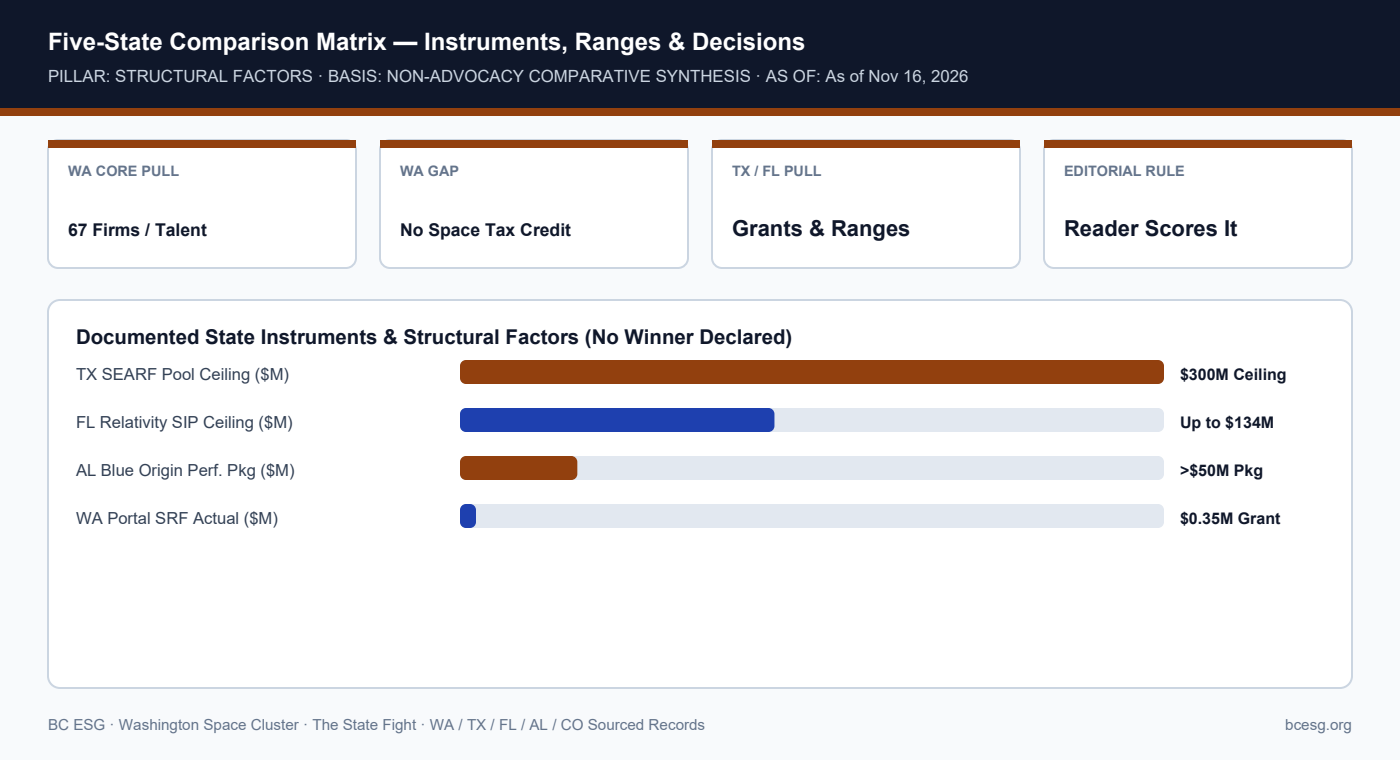
This non-advocacy decision matrix places Washington's documented instruments ($350K SRF example, no space-specific tax credit, EO 26-04 Council, >68% preliminary satellite ecosystem) side-by-side against Texas, Florida, Alabama, and Colorado so founders, staffers, and site selectors can weight the tradeoffs themselves.
Primary Authority / Source: WA / TX / FL / AL / CO Sourced Records | As-Of / Horizon: As of Nov 16, 2026
Documented Policy & Site-Selection Record
- No Declared Winner: Consistent with BC ESG's reader-first standard, this matrix presents verified instruments, ceilings, and company decisions without advocating for or against any state or tax proposal.
- When Washington Wins: High-density satellite engineering, flight software, RF/antennas, in-space servicing, and orbital compute R&D (K2 Space, Agile Space, Cowboy Space, Portal, Starcloud).
- When Coastal States Win Launch: Orbital pad infrastructure and range-coupled vehicle integration (Florida SIP, Texas ranges), because Washington has zero orbital launch pads.
- When Inland/Southern States Win Factories: Large-capex engine or second-plant manufacturing where >$50M–$300M state/local incentive ceilings offset greenfield setup (Alabama BE-4, Texas SEARF, Colorado JGITC).
Five-State Site-Selection Comparison (Verified Record Only)
| State | Documented Space Instrument | Orbital Range? | Recent WA-Relevant Signal |
|---|---|---|---|
| Washington | SRF ($350K Portal); EO 26-04 Council; no space tax credit | No (Moses Lake test only) | 67 core firms; Cowboy/K2/Agile in; Lapsa Sept 2026 warning |
| Texas | TX Space Comm / SEARF ($150M + $300M ceilings) | Yes (Boca Chica / private) | Proactive outreach to Stoke Space (Sept 2026) |
| Florida | Space Florida / FDOT SIP (Relativity up to $134M ceiling) | Yes (Cape Canaveral / KSC) | Hosts WA firms’ launch ops (Blue Origin, Stoke) |
| Alabama | Performance abatements (Blue Origin >$50M Huntsville) | No (Marshall Test Stand) | Anchored Blue Origin BE-4 plant (2017–2020) |
| Colorado | OEDIT JGITC (8-yr), Opportunity Now, AIA ($150K–$250K) | No (Inland) | Inland workforce-credit benchmark cited in policy debate |
Founder, Staffer & Site-Selector Takeaways
- Founder Action: Score your next facility across four weights—(1) senior engineering hiring speed, (2) orbital range coupling, (3) gross-receipts vs. income tax exposure, and (4) cash value of milestone-gated incentives.
- Staffer Action: Use this matrix alongside the 25 companion briefs to separate enacted statutory tools from advisory bodies and headline ceilings.
Connected Census Profiles, Segments & Valley Corridors
- WA Space Cluster Hub (#1382)
- The 90-vs-67 Gap Analysis (#1385)
- Stoke Space WA Profile
- Cowboy Space WA Profile
- Portal Space Systems WA Profile
- Green River Valley Floodplain Overview