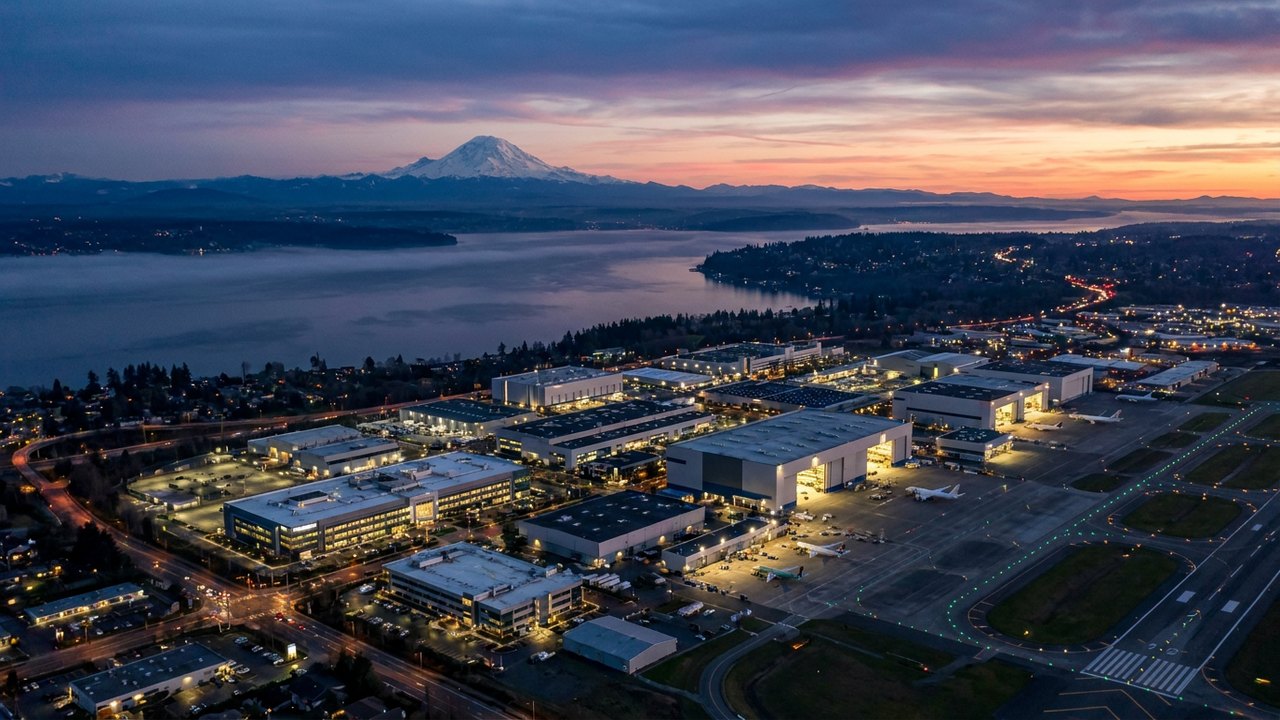
2025 TEU count (3,156,598) and -5.5% YoY change attributed to NWSA 2025 full-year cargo report.
FREIGHT, RAIL & VALLEY · THE CORRIDORS · AGENCY FIGURE (2025 FULL-YEAR)
NWSA 2025 Volume (3.16M TEUs)
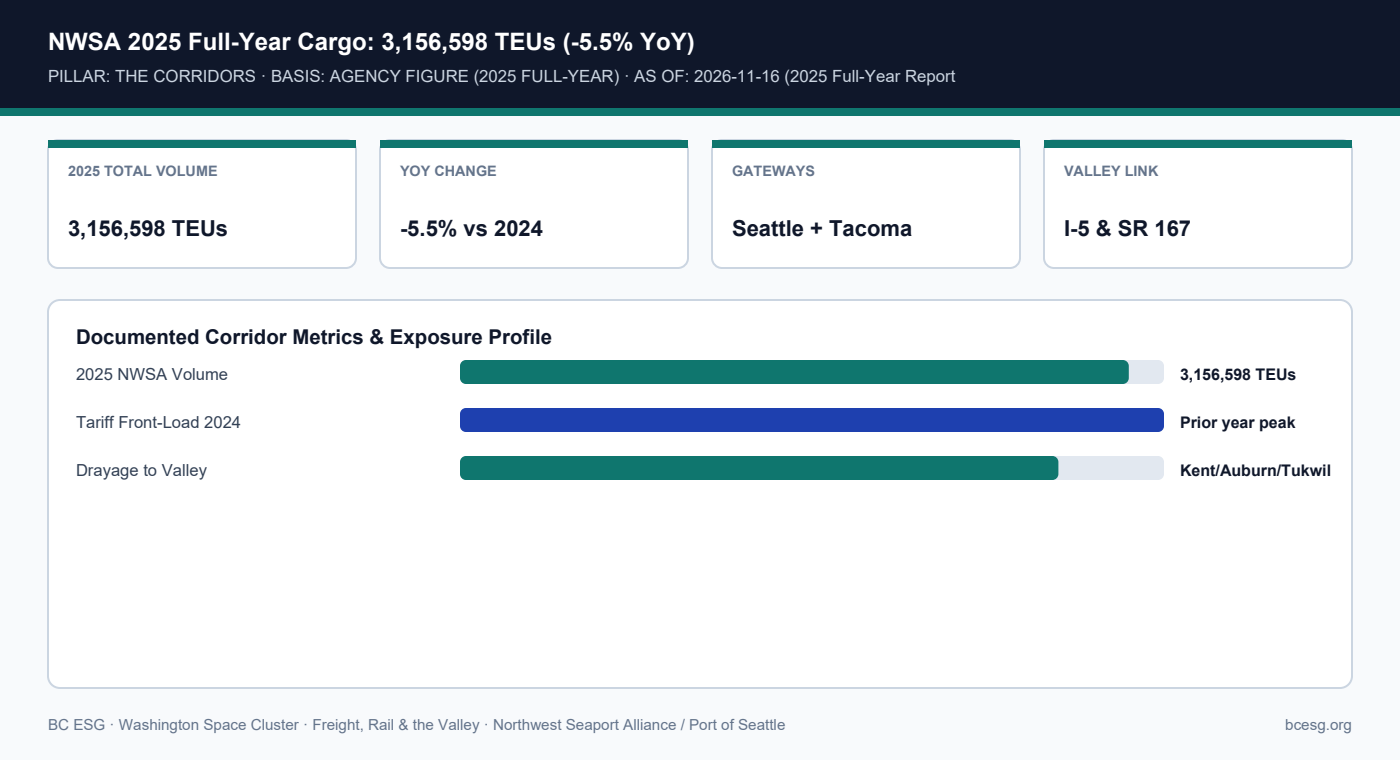
The Northwest Seaport Alliance handled 3,156,598 TEUs in 2025 (down 5.5% from 2024's tariff front-loading surge)—anchoring import/export container drayage into Kent, Auburn, and Tukwila warehouses.
Primary Agency / Source: Northwest Seaport Alliance / Port of Seattle | As-Of / Horizon: 2026-11-16 (2025 Full-Year Report)
Documented Corridor Facts & Continuity Record
- Per NWSA's 2025 full-year cargo report, the Seattle-Tacoma gateway handled 3,156,598 TEUs—a 5.5% decrease from 2024's front-loaded tariff surge.
- Containerized raw materials, ground-station electronics, solar-array hardware, and industrial tooling enter through Seattle and Tacoma marine terminals before draying into the Green River Valley.
- Drayage turns from Seattle (via SR 99/I-5/SR 599) and Tacoma (via I-5/SR 167) depend on unimpeded valley highway and rail-ramp access.
NWSA Container Gateway Metrics (2025)
| Metric | Figure | Source | Operational Relevance |
|---|---|---|---|
| 2025 Total Container Volume | 3,156,598 TEUs | NWSA 2025 Report | Baseline gateway throughput |
| Year-over-Year Change | -5.5% vs. 2024 | NWSA 2025 Report | Post-tariff front-loading normalization |
| Primary Inland Drayage | Kent / Auburn / Tukwila | King County / WSDOT | Dependent on I-5 & SR 167 |
Operational Exposure & Facility Playbook
- Time-sensitive satellite or ground-system components arriving in ocean containers face demurrage if SR 167 flood closures block drayage appointments.
- Use both Seattle and Tacoma terminal options where carrier schedules permit, while noting both feed the same I-5/SR 167 inland funnel.
- Coordinate customs clearance and ITAR/EAR import-control checks before container discharge to avoid terminal holds.
Connected Valley Cities, Segments & Role Briefs
- WA Space Cluster Hub (#1382)
- Seattle WA Space Cluster Profile
- Kent WA Space Cluster Profile
- Auburn WA Space Cluster Profile
- Supply-Chain & Procurement Desk Brief
- Ground Systems Continuity Exposure