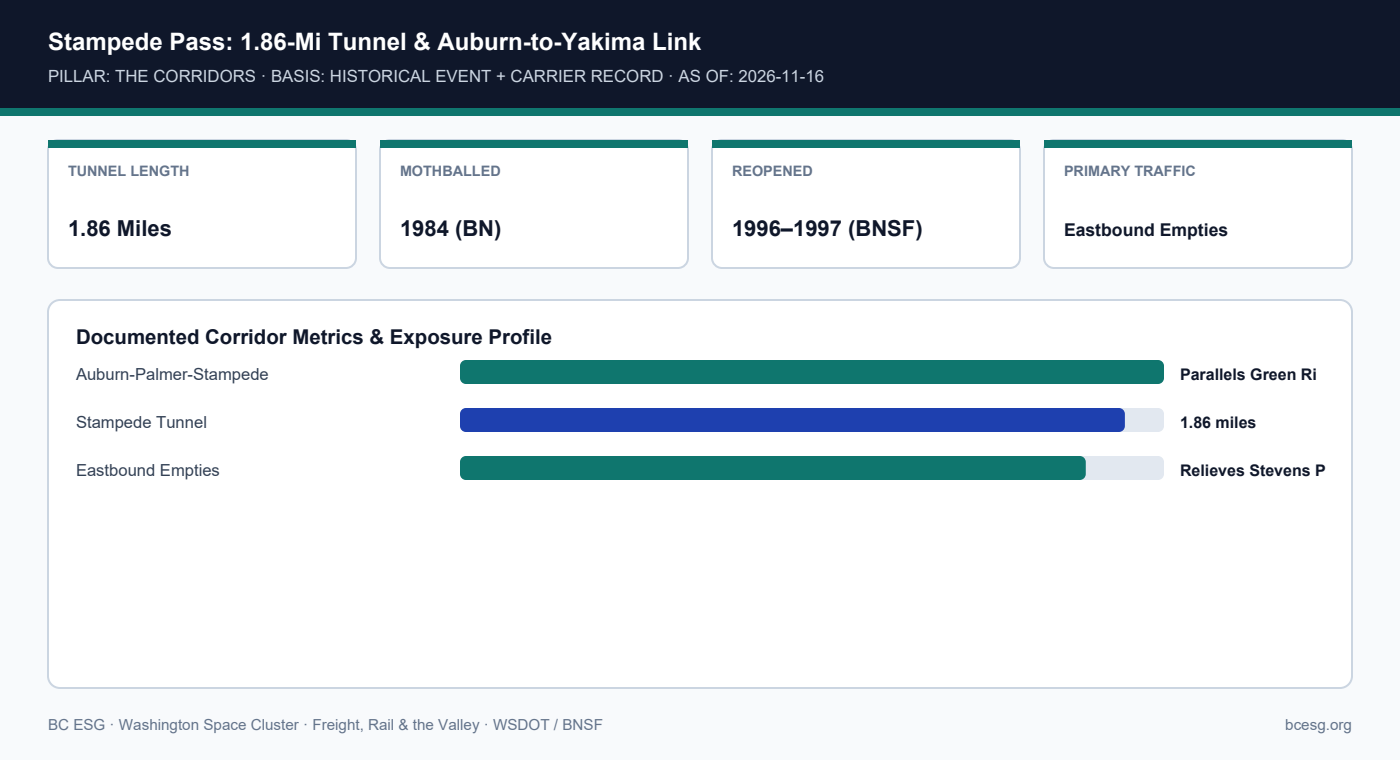
Historical reopening dates (1984 mothball, 1996–1997 reopening) and tunnel length (1.86 mi) per WSDOT/rail records.
FREIGHT, RAIL & VALLEY · THE CORRIDORS · HISTORICAL EVENT + CARRIER RECORD
Stampede Pass Rail Corridor
Originating out of Auburn Yard and climbing parallel to the Green River through the 1.86-mile Stampede Tunnel, BNSF's Stampede Subdivision was reopened in 1996–1997 to relieve Stevens Pass congestion.
Primary Agency / Source: WSDOT / BNSF | As-Of / Horizon: 2026-11-16
Documented Corridor Facts & Continuity Record
- Built by the Northern Pacific in the 1880s and mothballed in 1984, Stampede Pass was rehabilitated and reopened by BNSF in 1996–1997 due to congestion on Stevens Pass.
- The line exits Auburn Yard/Palmer Junction, runs parallel to the upper Green River, crosses the 1.86-mile Stampede Tunnel, and continues to Yakima and the Tri-Cities.
- Because of steep Cascade grades, Stampede Pass primarily carries eastbound empty unit trains and manifest freight, freeing Stevens Pass for priority westbound traffic.
Washington Trans-Cascade Rail Corridors (BNSF)
| Corridor | Valley Connection | Primary Role | Constraint |
|---|---|---|---|
| Stampede Pass (Subdivision) | Auburn Yard / Green River | Eastbound empties & manifest | Steep grades; 1.86-mi tunnel |
| Stevens Pass (Scenic) | Everett / North Sound | Priority westbound & intermodal | Single-track Cascade Tunnel |
| Columbia River Gorge | Vancouver, WA (South) | Heavy/high-volume flat grade | Requires north-south valley transit |
Operational Exposure & Facility Playbook
- Understanding BNSF's three-pass directional flow explains why Auburn Yard is vital even for shipments ultimately routed via Stevens Pass or the Gorge.
- Heavy-haul rail moves originating in the Midwest (like 737 fuselages) typically approach Puget Sound via northern/Gorge routes, while Stampede absorbs return capacity.
- Upper Green River mudslides or washouts near Palmer/Stampede directly affect Auburn Yard train staging.
Connected Valley Cities, Segments & Role Briefs
- WA Space Cluster Hub (#1382)
- Auburn WA Space Cluster Profile
- Kent WA Space Cluster Profile
- Components & Materials Continuity Exposure
- Supply-Chain & Procurement Desk Brief