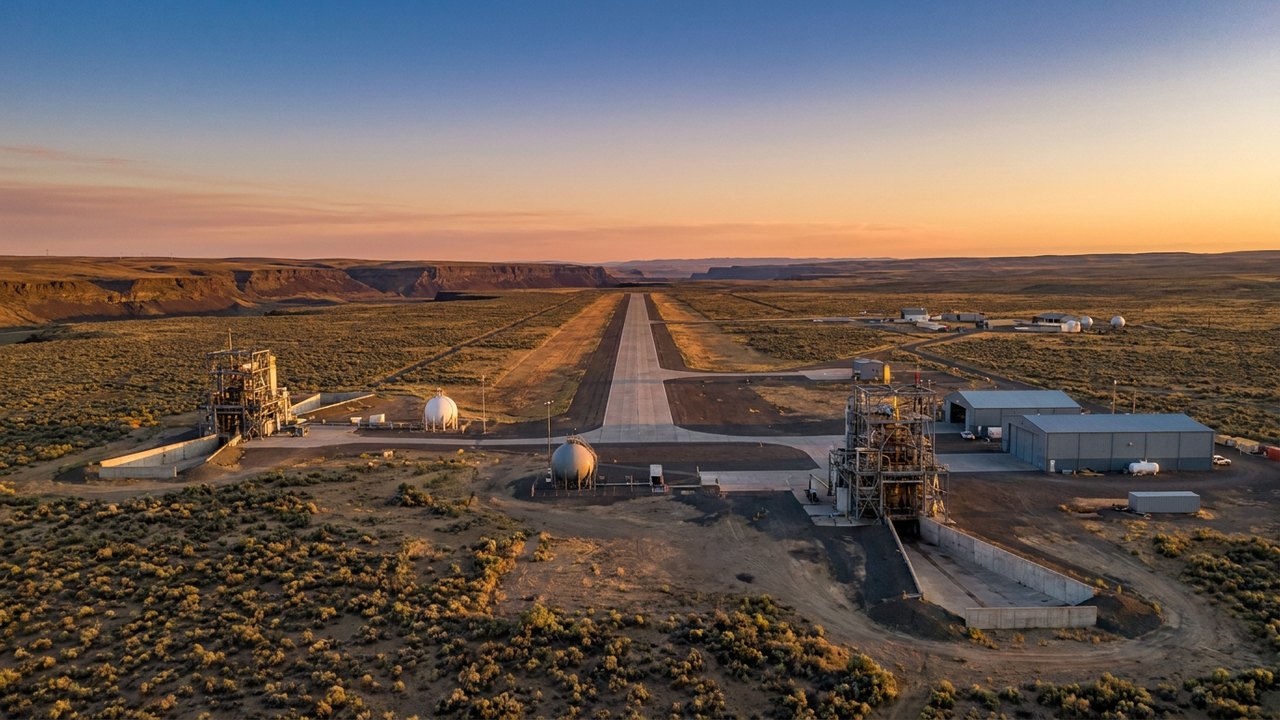
BC ESG · Washington Space Cluster Segments (November 16, 2026)
Sourced Baseline: THIN-RECORD TREATMENT: Starcloud demonstrated an H100 payload on Starcloud-1; Cowboy Space pursues Big Iron upper-stage compute; Sophia Space public specs remain sparse.
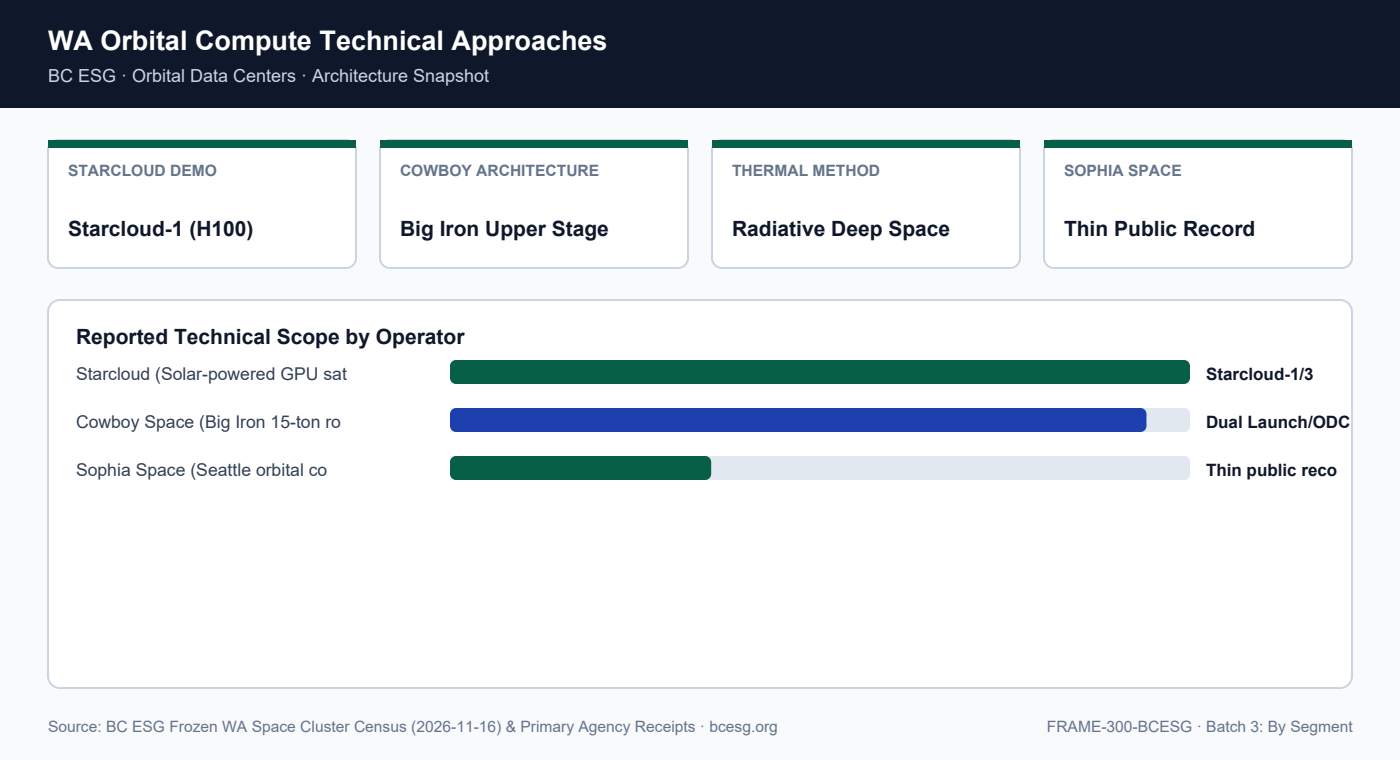
Two Divergent Hardware Paths (Plus One Thin-Record Startup)
Starcloud focuses on dedicated solar-powered orbital AI compute clusters using radiative thermal dissipation into deep space, following its late-2025 Starcloud-1 demonstration carrying an NVIDIA H100 GPU and scaling assembly in Woodinville.
Cowboy Space (formerly Aetherflux) pairs orbital compute with vertical launch integration—developing its Big Iron vehicle whose upper stage is designed to remain on orbit as a compute node with deployable radiators rather than being discarded. Sophia Space (Seattle, $10M reported Feb 2026) has minimal public hardware specifications and is kept concise here.
| Operator | Compute Concept | Power / Thermal | Public Maturity |
|---|---|---|---|
| Starcloud | Dedicated orbital GPU clusters | Solar PV + deep-space radiators | Starcloud-1 demo; Woodinville line |
| Cowboy Space | Big Iron rocket upper-stage compute | Solar / laser beaming R&D + radiators | Kent facility build-out; FCC filings |
| Sophia Space | Orbital compute architecture | Undisclosed in public filings | Early-stage ($10M reported) |