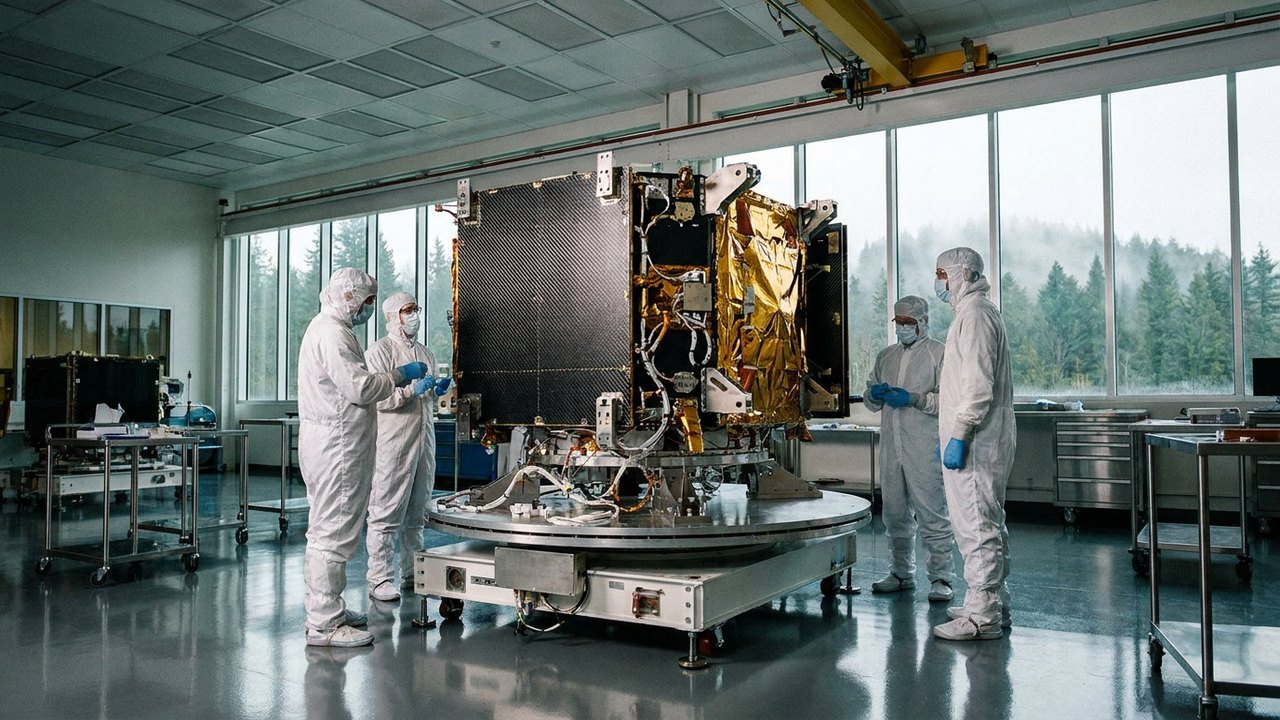
Structural geography and orbital-mechanics constraint underlying the WA-engineering / FL-launch split.
THE STATE FIGHT · STRUCTURAL FACTORS · GEOGRAPHY & RANGE PHYSICS
No Orbital Launch Range in Washington
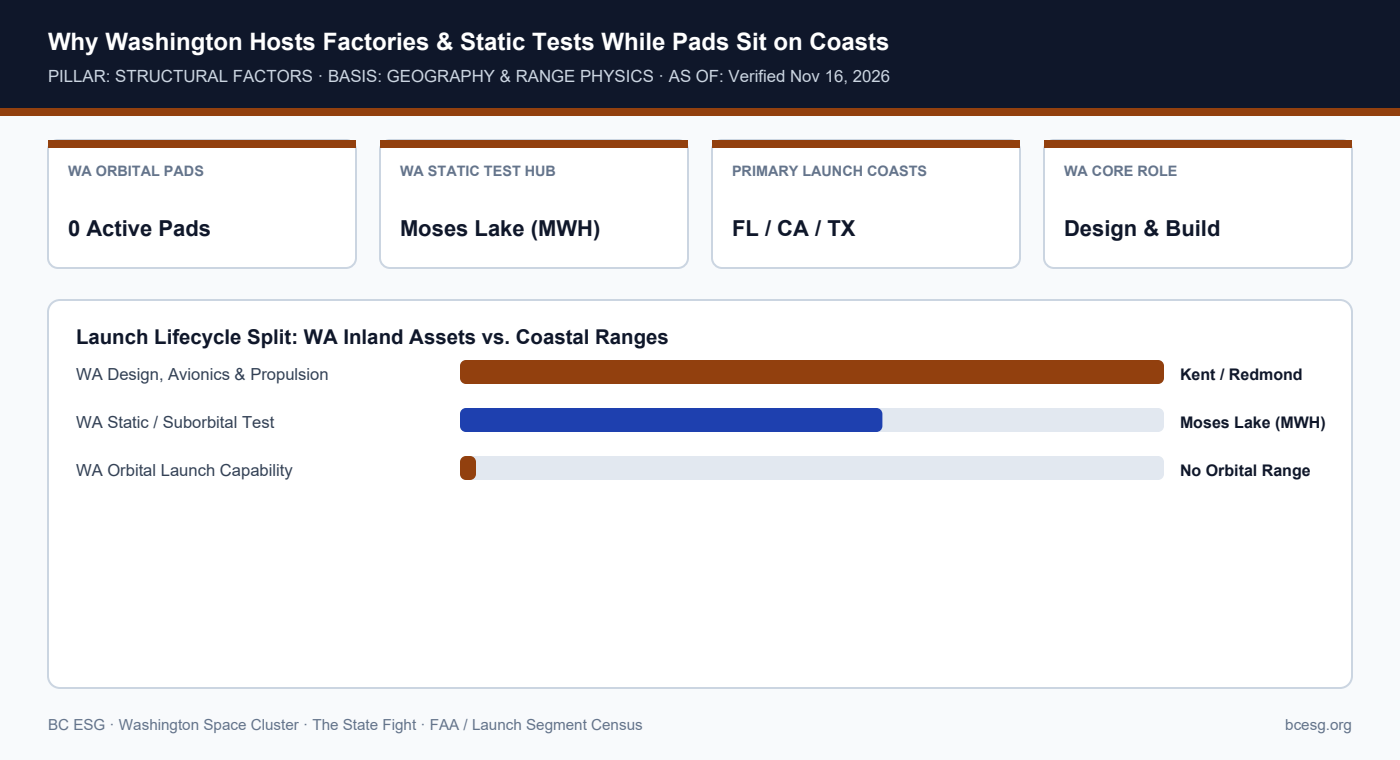
Washington has zero orbital launch pads because eastward equatorial launches and clear downrange ocean corridors require open Atlantic/Gulf coasts (Florida/Texas) or unobstructed Pacific south/west corridors (Vandenberg, CA); Washington therefore hosts vehicle manufacturing and Moses Lake static testing while orbital launches depart out of state.
Primary Authority / Source: FAA / Launch Segment Census | As-Of / Horizon: Verified Nov 16, 2026
Documented Policy & Site-Selection Record
- Eastward Rotational Advantage & Overflight: Standard prograde orbital launches fly east to capture Earth's rotational velocity, requiring unpopulated ocean downrange corridors—which Washington's inland geography and Puget Sound population centers lack.
- Polar/Sun-Synchronous Constraint: Even southward polar trajectories from Washington face coastal/maritime and Canadian/US West Coast overflight constraints already served by Vandenberg Space Force Base in California.
- Moses Lake Role: Grant County International Airport (MWH) in Moses Lake supports static engine/stage hot-fire testing (e.g., Stoke Space) and flight-test infrastructure, not orbital pad launches.
- Policy Clarity: Because no tax incentive can create an eastern coastal range in Washington, losing launch-pad operations to Florida is a geographic certainty—whereas losing *factories* to Texas or Alabama is a policy contest.
Launch Value Chain: Geographic Constraint vs. Contestable Policy
| Stage | Where It Happens | Driven By |
|---|---|---|
| Vehicle Design & Propulsion R&D | Kent, Redmond, Bellevue, Tukwila | Talent density (Contestable by WA policy) |
| Factory & Tankage Manufacturing | Kent (Blue Origin, Stoke, Cowboy), Bothell | Industrial space & incentives (Contestable) |
| Static Hot-Fire Testing | Moses Lake (MWH), Grant County | Inland buffer & I-90 corridor (#2185) |
| Orbital Pad Launch | Cape Canaveral FL / Vandenberg CA / TX | Orbital range geography (Non-contestable) |
Founder, Staffer & Site-Selector Takeaways
- Staffer Takeaway: Do not score Florida's pad wins as Washington policy failures; focus policy on retaining R&D, satellite assembly, and rocket factories.
- Founder Takeaway: Plan East-West hardware logistics early (see Batch 7 OSOW & Moses Lake corridor briefs).
Connected Census Profiles, Segments & Valley Corridors
- WA Space Cluster Hub (#1382)
- WA Space Launch Segment Overview
- Launch Segment Production & Moses Lake Test
- Moses Lake Test Corridor (MWH)
- Moses Lake WA Space Cluster Profile