
Who Owes What by When: 5-Year LEO Disposal & Application Disclosures
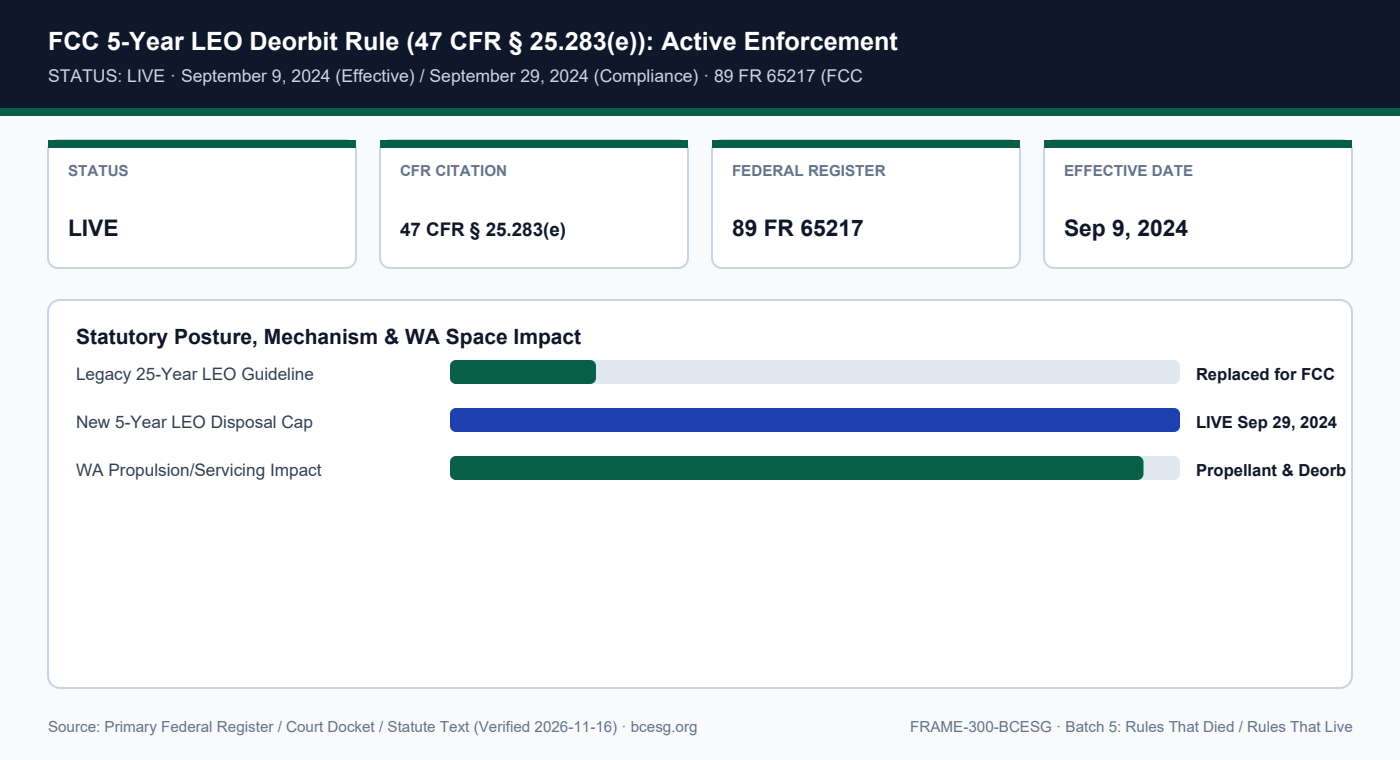
Under 47 CFR § 25.283(e) (89 FR 65217, Aug 9, 2024; implementing FCC 22-74), operators of non-geostationary satellites passing through or operating in LEO (<2,000 km) must dispose of spacecraft via atmospheric reentry as soon as practicable and no later than 5 years after end of mission.
The rule took effect September 9, 2024, with operational compliance beginning September 29, 2024 (subject to limited grandfathering for pre-existing licensed constellations). Satellite builders in Washington (Amazon Leo, BlackSky, Starfish Space, Gravitics, Portal Space Systems) must embed 5-year deorbit propellant budgets, drag devices, or servicing interfaces into FCC Part 25 / Part 5 / Part 97 applications.
- Codified at 47 CFR § 25.283(e) (plus §§ 5.64, 25.114, 97.207).
- 5-year maximum post-mission disposal window in LEO.
- Directly drives Washington propulsion, thruster, and on-orbit servicing demand.
| Parameter | Legacy Guideline | Current FCC Rule (47 CFR § 25.283(e)) |
|---|---|---|
| Max LEO Post-Mission Lifetime | 25 years | 5 years (as soon as practicable) |
| Effective / Compliance Date | Pre-2024 guidance | Sep 9, 2024 / Sep 29, 2024 (89 FR 65217) |
| Covered Licenses | Part 25 / 5 / 97 | All new FCC-licensed LEO space stations |
Batch 4 vs. Batch 5 Scope
While Batch 4 covered how satellite primes flow 5-year deorbit requirements down to component and propulsion suppliers, this Batch 5 brief establishes the underlying FCC statutory mandate and effective dates.