Who Issues This Ask, Authority, and Binding Status
CDP Supply Chain invitations are sent by large corporate buyers (often cloud/tech primes like Microsoft Azure Space or AWS Aerospace & Satellite, or major public defense primes) through the CDP (formerly Carbon Disclosure Project) portal.
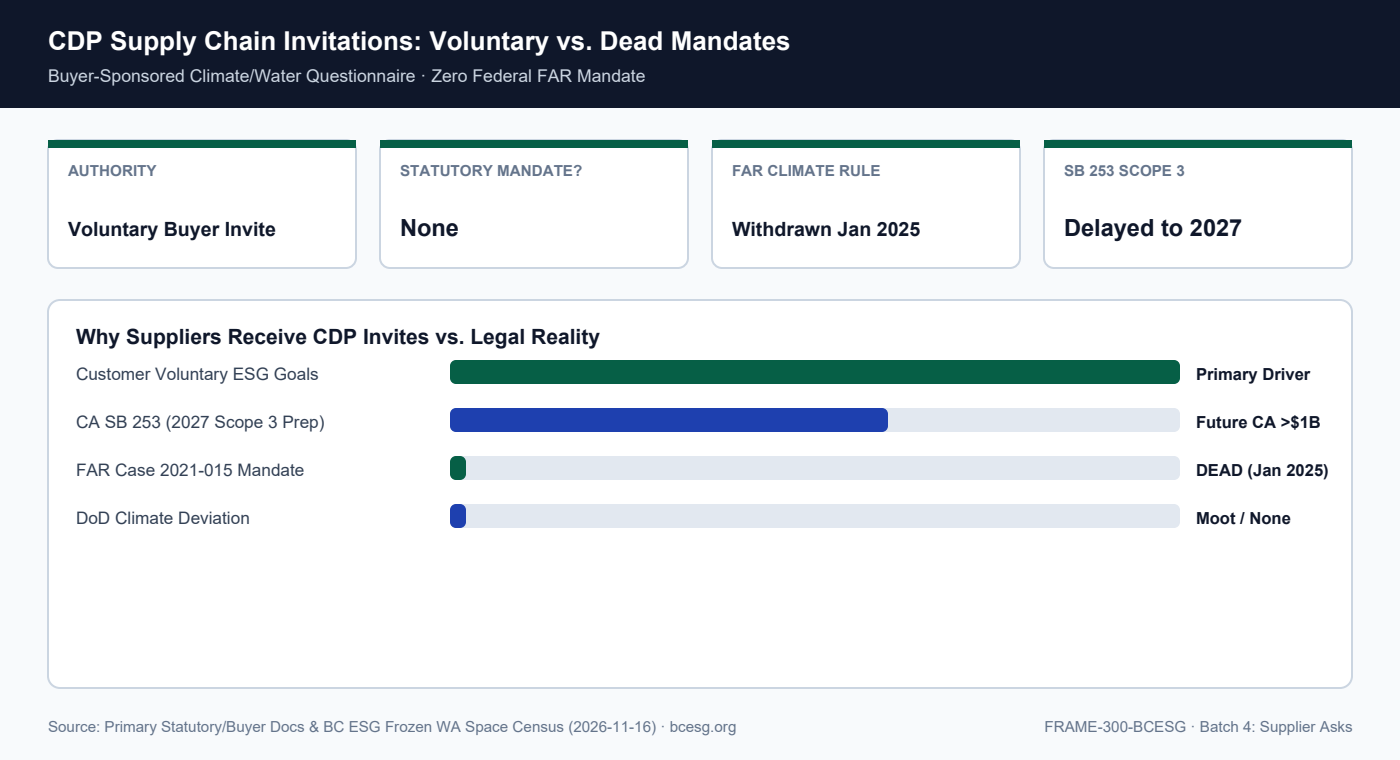
A CDP invitation is strictly voluntary—it carries zero statutory force. Dead-rule boundary: many suppliers assume CDP disclosure is legally required for federal contractors, but FAR Case 2021-015 was formally withdrawn on January 13, 2025 (90 FR 2663), and California SB 253 Scope 3 reporting is not required in 2026 (slated for 2027 only for >$1B CA-doing-business entities).
| Question | Verified Current State (Nov 2026) | Primary Basis |
|---|---|---|
| Is CDP Supply Chain legally binding? | No — voluntary buyer request unless in a binding PO | CDP Supply Chain Program |
| Does FAR require CDP / SBTi? | No — FAR Case 2021-015 withdrawn Jan 13, 2025 | 90 FR 2663 |
| Does CA SB 253 require Scope 3 in 2026? | No — Scope 1+2 only (Nov 10, 2026); Scope 3 starts 2027 | CARB SB 253 |
Evidence Required & Small-Supplier Effort Cost
Responding to a CDP Supply Chain invitation requires completing CDP's SME or full corporate climate/water questionnaire (Scope 1 and 2 emissions, energy use, and governance).
Exact CDP administrative fees for invited SMEs vary by sponsorship tier and are not in our data in full; many buyers sponsor first-time SME access, while internal GHG-inventory labor scales with facility utility-bill complexity.
WA Space Cluster Segments & Companies Affected
CDP invitations land most often on suppliers serving public tech/cloud primes in Ground Systems & SATCOM and Software & Mission Services, as well as Tier-1 suppliers to The Boeing Company. See also our Scope 3 Supplier Data Field Guide.