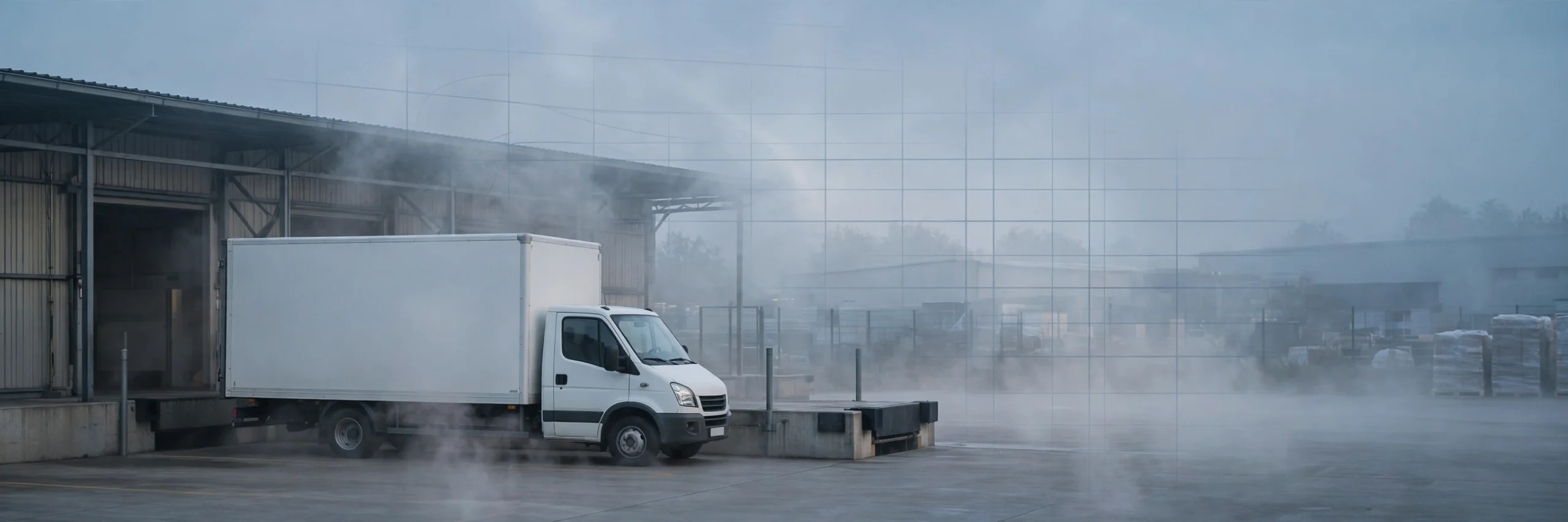
The same diesel truck can be Scope 1 for one company and Scope 3 for another, and neither company is wrong. Nothing about the truck changed. What changed is the relationship between the reporting company and the source of the emissions.
That is the one rule underneath the GHG Protocol’s three scopes, and it is the rule most summaries leave out. The GHG Protocol classifies emissions according to the reporting organisation’s boundaries and its relationship to the source. It does not classify them simply by whether an activity happens inside or outside the organisation’s premises. A source can sit in your yard and still not be yours to report as Scope 1; a source inside a supplier’s factory on another continent can still belong in your inventory, as Scope 3.
Sort by postcode instead of by relationship, and the inventory will misfile sources and miss whole categories.
What the GHG Protocol is
The GHG Protocol is the widely used international framework for measuring and reporting greenhouse gas emissions, developed by the World Resources Institute (WRI) and the World Business Council for Sustainable Development (WBCSD). Its Corporate Accounting and Reporting Standard — the Corporate Standard — defines the three scopes for a company-level inventory; a separate Corporate Value Chain (Scope 3) Standard sets out the Scope 3 categories in full, and separate Scope 2 guidance covers purchased energy.
The framework’s job is attribution, and the GHG Protocol’s own summary is compact: Scope 1 emissions are direct emissions from owned or controlled sources; Scope 2 emissions are indirect emissions from the generation of purchased energy; Scope 3 emissions are all indirect emissions not included in Scope 2 that occur in the value chain of the reporting company, upstream and downstream.
The same truck, walked through all three scopes
Take one delivery truck making one delivery to your facility, in three arrangements.
Your truck, your diesel. Your company owns and operates the truck, and it burns diesel your company bought. The combustion happens in a source you own or control, so those emissions are your Scope 1 — direct emissions.
Their truck, your delivery. Now a third-party logistics provider makes the same delivery in its own truck, burning its own diesel, and you pay for the transportation service. For the provider, that diesel is its Scope 1, for exactly the reason above. For you, the same physical emissions are Scope 3 — specifically upstream transportation and distribution, Category 4 of the Scope 3 Standard, because you purchased the transport service. Same truck, same fuel, same road. The scope moved because your relationship to the source moved: owner-operator in the first case, customer in the second.
Your truck, bought electricity. Finally, replace the diesel truck with an electric one your company owns and charges at your depot on purchased grid electricity. The truck produces no exhaust, but the electricity was generated somewhere by someone else, and you bought and consumed it. The emissions from generating that purchased electricity are your Scope 2. The charging did not become Scope 1 because the depot is your premises, and it did not become Scope 3 merely because the power station is off-site. Purchased energy consumed by the reporting company has its own scope.
Three arrangements, three scopes, one vehicle — and the premises determined none of them.
The three scopes, defined cleanly
Scope 1: direct emissions from sources you own or control
Scope 1 covers direct greenhouse gas emissions from sources within your organisational boundary — sources the reporting company owns or controls. In practice these come from stationary combustion (boilers, furnaces, generators), mobile combustion (company vehicles), process emissions from reactions in your own operations, and fugitive emissions such as refrigerant leaking from equipment you operate. The test is the boundary, not the building: if the source is yours under your chosen consolidation approach, its direct emissions are Scope 1 wherever it happens to be.
Scope 2: indirect emissions from energy you buy and consume
Scope 2 covers the emissions from generating the electricity, steam, heating and cooling your organisation purchases or acquires and consumes. The emissions physically occur at the generator’s facility; they are attributed to you because the energy was produced for your consumption. Scope 2 is reported two ways where the guidance applies: location-based, using the average emissions intensity of the grid where consumption occurs, and market-based, reflecting the contractual instruments — supplier contracts, power purchase agreements, energy attribute certificates — the company has actually bought. Our corporate carbon footprint calculator works through a location-based estimate so readers can see the mechanics on their own numbers.
Scope 3: all other indirect emissions in your value chain
Scope 3 covers every other indirect emission in the reporting company’s value chain, upstream and downstream, that is not already in Scope 2. You do not need to own the supplier’s factory, operate the carrier’s trucks, or control how a customer uses your product for the associated emissions to fall in your Scope 3 inventory. The Scope 3 Standard organises them into 15 categories: eight upstream, from purchased goods and services through employee commuting and upstream leased assets, and seven downstream, from downstream transportation through use and end-of-life treatment of sold products to investments. Not every category is material to every company; the work is deciding which are relevant and saying why the rest are not. For the hardest part — getting real data out of suppliers rather than spend-based proxies — see our field guide to Scope 3 supplier data.
Why the premises mistake happens, and what it breaks
The premises version is seductive because it is easy to draw: everything inside the fence is “ours,” everything outside it is “theirs.” For a single-site company with no leased assets or outsourced logistics, it can even produce a roughly right answer by accident. Then reality arrives — a leased warehouse, an outsourced delivery contract, a tenant in a building you own — and each separates location from control. Three kinds of damage follow:
- Misclassification. Sources the company controls off-site get missed or pushed into Scope 3, and on-site sources belonging to tenants or contractors get pulled into Scope 1. The totals can look plausible while the attribution underneath is wrong.
- Missed Scope 3 categories. If “not our premises” means “not our inventory,” the value chain disappears. Purchased goods, third-party freight, business travel, commuting, and the use of sold products are exactly what a premises test discards — and they are categories disclosure regimes increasingly ask about, as our guide to CSRD double materiality works through for real estate portfolios.
- Double counting inside the inventory. A source filed twice — once by location and once by contract, when landlord and tenant both report the same boiler as Scope 1 — inflates one company’s inventory. That differs from the overlap the Protocol expects between companies: the provider’s Scope 1 and its customer’s Scope 3 legitimately describe the same physical emissions from two positions in one chain, which is why inventories should not be added together as if every reported tonne were separate. Overlap across inventories is by design; duplication within one is an error.
The facility-level consequences — base building against tenant, landlord against occupier — are worked through in our carbon accounting guide for commercial facilities.
Organisational boundaries: the choice that sits underneath
Before any source can be sorted, the company has to say where the organisation ends. Under the equity share approach, a company accounts for emissions from an operation according to its share of economic interest in it. Under the control approaches, it accounts for all emissions from operations it controls — control defined in financial or operational terms — and none from operations it does not control, whatever its stake.
Two consequences matter. First, the same joint venture can legitimately land in different places in two companies’ inventories, because each drew its boundary by its own stated approach. Second, leased assets are the standing edge case: whether a leased building’s or vehicle’s emissions fall in Scope 1 and 2 or in Scope 3 depends on the approach chosen and the lease structure — which is why the boundary decision must be documented and applied consistently, not improvised source by source.
A three-question sorting checklist
For any source in front of you, ask in this order:
- Do we own or control the source itself? If yes, its direct emissions are Scope 1 — the boiler’s gas, the truck’s diesel, the refrigerant that leaked from your chiller. If no, move on; do not stop here just because the source is on your site.
- Did we buy the energy it produced? If the emission came from generating electricity, steam, heating or cooling your organisation purchased and consumed, it is Scope 2 — however far away the generator sits.
- Is it in our value chain because of something we bought, sold, leased, invested in, travelled for, or disposed of? If yes, it is Scope 3. Find the category — purchased goods, upstream transport, waste, use of sold products — and file it there, not in a residual “other” line.
If a source fails all three, it is not in your inventory, and you should be able to say why in one sentence. If it passes more than one, the order is the tiebreak: control first, purchased energy second, value chain last.
Sorting is the start, not the finish
The scopes are a filing system, not a result. A correctly sorted inventory still has to be measured, evidenced, and turned into targets a board can govern — where indicator design earns its keep, as our framework for KPI design for ESG performance sets out, and where the count itself should not be confused with the instruments traded against it, a distinction our explainer on carbon credits and the GHG Protocol keeps in view.
None of that later work survives a wrong sort at the start. Draw the boundary, state the approach, and ask whose source it is before you ask where it sits. The truck will tell you the rest.