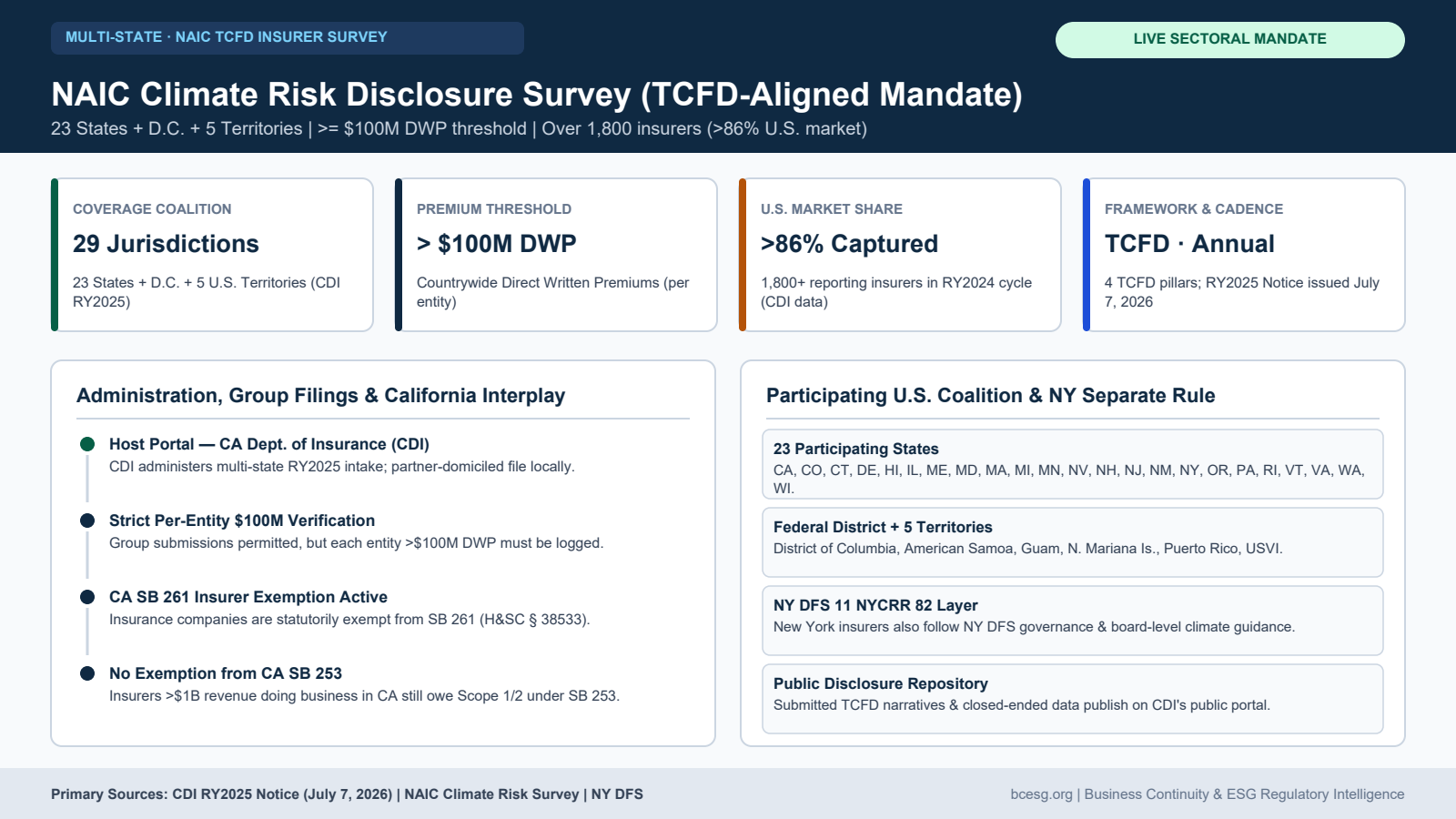
Short answer: While cross-sector state climate laws remain limited outside California, the U.S. insurance industry already operates under a nationwide mandatory climate-risk reporting regime. Administered jointly by the California Department of Insurance (CDI RY2025 Notice, July 7, 2026) and partner regulators across 23 states, Washington, D.C., and 5 U.S. territories, the Task Force on Climate-Related Financial Disclosures (TCFD)-aligned NAIC Survey captured more than 1,800 companies representing over 86% of the U.S. insurance market.
Unlike California SB 261—from which insurers are expressly exempt—the NAIC Survey has remained continuously active and un-enjoined. Crucially for compliance teams at multi-line carriers (>$1B revenue), neither the NAIC Survey nor SB 261’s insurer exemption waives California SB 253 GHG Scope 1 and 2 emissions obligations for major carriers doing business in California.
Statutory Status at a Glance
Governing Coalition (29 Jurisdictions): CA (host) + CO, CT, DE, DC, HI, IL, ME, MD, MA, MI, MN, NV, NH, NJ, NM, NY, OR, PA, RI, VT, VA, WA, WI + AS, GU, MP, PR, VI.
Mandatory Premium Floor:>$100 million in countrywide Direct Written Premiums (DWP) if licensed in any participating jurisdiction.
Required Content Architecture: TCFD 4-pillar narrative (Governance, Strategy, Risk Management, Metrics & Targets) submitted via CDI’s portal or partner commissioner portal, plus voluntary closed-ended NAIC questions.
Per-Entity Group Rule: Uniform group policy narratives are allowed across affiliates, but CDI strictly requires an individual submission document per licensed legal entity >$100M DWP.
New York & California Intersections: NY carriers also adhere to NY DFS 11 NYCRR 82 climate governance; CA SB 261 exempts insurers, whereas CA SB 253 (>$1B) does NOT.
2-page Print-First reference covering the 23-state + DC + 5-territory CDI coalition, per-entity $100M DWP verification, NY 11 NYCRR 82, and CA SB 253/261 boundary.
Who Must File, Reciprocal Portal Routing, and Per-Entity Group Rules
Under CDI’s Reporting Year 2025 notice (covering calendar 2025 direct written premiums for the August 2026 call), jurisdiction attaches through state licensure combined with countrywide premium volume >$100 million — not in-state premium volume alone. A mid-sized carrier with $120M nationwide DWP and just $5M of business in Oregon or Pennsylvania is fully in scope.
To prevent duplicate reporting across the 29 participating regulators, CDI allows carriers required to file in another participating partner state or jurisdiction to submit there rather than filing twice. However, CDI specifically audits multi-entity insurance holding companies: even when group-wide policies match identically across subsidiaries, each legal entity individually exceeding $100M DWP must have a corresponding filing tied to its NAIC company code.
Public Record Publication: All participating survey narratives and prior-year responses publish openly on CDI’s Climate Risk Disclosure database, creating public comparability across underwriting, investment portfolio carbon risk, and physical catastrophe pricing.
Closed-Ended Supplemental Questions: Alongside the narrative TCFD document, CDI requests responses to aligned closed-ended Y/N SurveyMonkey benchmarking items supporting NAIC industry aggregation.
Coalition / Dimension
Scope & Participating Jurisdictions
Key Rule / Threshold
Partner States (23)
CA, CO, CT, DE, HI, IL, ME, MD, MA, MI, MN, NV, NH, NJ, NM, NY, OR, PA, RI, VT, VA, WA, WI
NAIC Climate Risk Disclosure Survey (CDI RY2025 July 7, 2026 Call): 23 partner states + D.C. + 5 territories, >$100M DWP threshold, and interplay with CA SB 253 / SB 261.
Why State Insurance Regulation Intersects with Cross-Sector Disclosure Laws
Even in states listed as ‘None Found’ for cross-sector corporate disclosure statutes—such as New York, New Jersey, and Illinois—the NAIC TCFD Survey binds major carriers every single year.
At the same time, California Health & Safety Code § 38533 expressly carved insurers out of SB 261 precisely to defer to the NAIC/CDI framework—making the NAIC TCFD submission the de facto national insurer financial-risk standard while SB 261 sits in Ninth Circuit litigation.
Compliance Execution Checklist
Step
Owner / Team
Auditable Deliverable
1. Legal-Entity DWP Screen
Regulatory / Actuarial
Flag every licensed insurance affiliate exceeding $100M countrywide DWP for the reporting year.
2. Home-State Reciprocity Check
Compliance Lead
Confirm whether domiciliary partner state (e.g., NY, PA, IL) collects directly vs. California CDI portal.
How many states enforce the NAIC TCFD Climate Risk Disclosure Survey?
As of the July 7, 2026 Reporting Year 2025 Notice, California plus 22 partner states (23 states total), the District of Columbia, and 5 U.S. territories (29 U.S. jurisdictions) enforce the TCFD-aligned NAIC Survey.
Can an insurance holding company file one group PDF for all subsidiaries?
Uniform group narratives are allowed when affiliate policies and practices match, but CDI requires an individual filing document submitted for each licensed legal entity exceeding $100 million in countrywide DWP.
Are insurers exempt from California SB 253 as well as SB 261?
No. Health & Safety Code § 38533 exempts insurance companies from SB 261 (financial risk reporting), but H&SC § 38532 (SB 253 Scope 1/2/3 GHG emissions for >$1B entities) contains no insurer exemption.
Informational notice: This guide summarizes enacted statutes, regulations, or pending legislative records from the primary authorities linked above as of November 14, 2026. It is not legal, accounting, or licensed engineering advice.
If you own climate disclosure scope across ISSB, TNFD, California, or EU CSRD, this is the 2026 cross-framework map for physical and transition risk.
The climate disclosure landscape shifted fundamentally in October 2023. The Task Force on Climate-related Financial Disclosures (TCFD) formally wound down, and its governance structure integrated into the International Sustainability Standards Board (ISSB). The TNFD recommendations became live. California SB 253 and SB 261 are in force, with SB 253 emissions reporting phasing in from 2026 for applicable companies. The European Union formalized the Corporate Sustainability Reporting Directive (CSRD) Omnibus amendment. In 2026, there is no longer a choice about whether to disclose climate risk—only which framework to use and how thoroughly to build the underlying risk infrastructure.
This shift from voluntary disclosure to mandatory, standardized, auditable climate risk reporting has transformed how enterprises think about physical climate hazards and their financial implications. Organizations that treated climate risk as a communications problem now face a governance and operational problem. The stakes are higher, the definitions are tighter, and the cross-sector convergence is undeniable.
Instant Climate Risk & Convergence Downloads
Audit Physical & Financial Climate Risk Across Four Operational Lenses
Field-ready cross-framework quick card, printable 4-sector audit worksheets, and AI scenario-audit routines built to extend this disclosure framework.
Quick ReferenceFREE
Climate Risk 2026 Quick Card
2-page field reference: ISSB S1/S2, TNFD LEAP, CA SB 253/261 & EU CSRD crosswalk plus the 4-step physical risk valuation workflow.
The ISSB standards (IFRS Sustainability Disclosure Standards S1 and S2) form the structural foundation for climate risk disclosure in 2026. Unlike TCFD’s 11-page recommendations, which were flexible and company-interpretable, ISSB standards are prescriptive, internationally aligned, and integrated into financial reporting.
ISSB S2 (Climate-related Disclosures) requires organizations to identify and disclose both physical and transition climate risks and opportunities that could materially affect financial position. Physical climate risk is defined with precision: the risk of financial loss arising from exposure to climate-related hazards (heat stress, flooding, drought, wildfire, hurricane, etc.) that can impair assets, disrupt operations, and devalue collateral. Financial impact must be quantified or at least bounded with sensitivity analysis.
S2 also mandates climate scenario analysis—companies must model outcomes under multiple scenarios (typically aligned with ICP (Intergovernmental Panel on Climate Change) RCP 2.6, 4.5, and 8.5 pathways) out to 2050. This isn’t speculative foresight; it’s required risk quantification. Organizations must identify which assets, supply chains, or operations are materially exposed to physical climate hazards in those scenarios and describe the financial effect.
ISSB S1 (General Requirements) situates climate risk within a broader governance, strategy, and risk management framework. The “Governance” pillar requires disclosure of how the board and management oversee climate risk. The “Strategy” pillar demands description of the organization’s climate strategy and how it creates resilience. The “Risk Management” pillar covers how organizations identify, assess, manage, and monitor climate risk—and this is where operational reality meets disclosure requirement.
Physical Climate Risk: The risk of financial loss from exposure to climate-related hazards such as flooding, drought, wildfire, hurricane, and heat stress that can damage assets, disrupt operations, impair collateral, and increase insurance costs.
TNFD: Beyond Disclosure to Ecosystem Dependency
While ISSB S2 focuses on climate hazards, the Taskforce on Nature-related Financial Disclosures (TNFD) recommendations, which became live in June 2024 and are fully operational in 2026, extend the disclosure logic to nature-related dependencies and impacts. For organizations in agriculture, food production, water-intensive industries, healthcare, and real estate, TNFD recommendations are not optional.
TNFD is structured around the same four pillars as ISSB: Governance, Strategy, Risk Management, and Metrics & Targets. Organizations must disclose how nature dependency and impact affect business resilience. An agricultural company must disclose water scarcity risk in key growing regions. A pharmaceutical manufacturer must disclose supply chain dependency on rare plants or bioregions facing deforestation or climate stress. A healthcare system must disclose air quality and water quality dependencies. A real estate developer must disclose flood risk, wildfire risk, and regulatory exposure in key markets.
In 2026, the alignment between TNFD and ISSB is becoming operational reality. Both frameworks share the same governance logic: identify material risks and opportunities, build them into strategy, manage them through risk controls, and measure outcomes. Organizations that treat TNFD as separate from ISSB are creating duplicate work. Leading organizations are integrating physical climate risk and nature-related risk into a single, unified risk assessment and disclosure infrastructure.
California’s SB 261 and SB 253: The Regulatory Cliff
California SB 261 required companies with over $500 million in California revenue to disclose climate financial risks aligned with TCFD recommendations beginning January 1, 2026. Compliance was mandatory for fiscal years ending on or after that date. This law created a proxy requirement: California-sourced revenue triggers California climate risk disclosure, even for out-of-state companies.
California SB 253, the Climate Corporate Data Accountability Act, requires companies with over $1 billion in annual California revenue to report Scope 1, 2, and 3 greenhouse gas emissions. The reporting threshold includes not just companies headquartered in California but any enterprise with significant California operations. Scope 3 reporting—value chain emissions—is the most operationally complex requirement because it demands quantification of emissions from suppliers, logistics partners, customer use of products, and end-of-life disposal.
For organizations subject to both laws, the compliance burden is substantial. SB 261 requires physical and transition risk mapping, scenario analysis, and governance narrative. SB 253 requires emissions quantification across the full value chain, third-party assurance, and annual updates. Both laws carry regulatory enforcement risk if disclosures are materially incomplete or misleading.
Scope 3 Emissions: Indirect greenhouse gas emissions from all upstream suppliers, product transportation, customer use, and end-of-life disposal—representing the largest component of most organizations’ carbon footprint but requiring deep supply chain visibility to quantify.
The CSRD Omnibus Amendment: Simplified ESRS and Expanded Scope
The European Union finalized the CSRD Omnibus amendment in December 2022, bringing significant changes to reporting scope and timeline. Beginning with fiscal year 2027, non-financial undertakings with more than 1,000 employees and more than €450 million in turnover must report under the European Sustainability Reporting Standards (ESRS).
The CSRD Omnibus introduced the “simplified ESRS,” which applies to listed micro and small-and-medium enterprises (MSMEs). The simplified standards reduce disclosure burden for smaller organizations while maintaining alignment with ISSB. Physical climate risk remains a material disclosure topic—environmental remediation obligations, asset impairment from climate hazards, supply chain resilience, and market access constraints driven by climate regulation are all in scope.
Organizations with European operations, European suppliers, or European customers must now assume that their disclosure practices will eventually be benchmarked against CSRD standards, even if they are not legally subject to the directive. The regulatory gravity of Europe’s climate disclosure framework is pulling global organizations toward alignment.
The Cross-Sector Impact: Where Disclosure Meets Operations
The convergence of ISSB, TNFD, California law, and CSRD has created a unified disclosure mandate that transcends sector and geography. However, the operational consequences of these disclosures are deeply sector-specific.
Property restoration contractors face escalating climate-driven demand cycles—flooding, wildfire, hail, and hurricane activity are increasing the frequency and intensity of catastrophic loss events, directly translating to higher volumes of claims and restoration projects. The disclosure framework forces these organizations to quantify how climate hazards affect their supply chains, labor availability, equipment capacity, and margin profiles. For more on how restoration businesses are adapting to climate risk, see How Physical Climate Risk Is Rewriting Restoration Business Strategy in 2026.
Insurance companies and risk transfer markets are fundamentally repricing coverage. Traditional catastrophe models built on 30–50 years of historical loss data no longer capture forward-looking climate risk. Underwriters are adopting climate-adjusted loss projections, narrowing coverage in high-hazard zones, and substantially raising premiums for physical climate risk exposure. For detailed analysis, read Climate Risk and Insurance Pricing in 2026: How Physical Hazards Are Repricing Every Line of Coverage.
Business continuity and operational resilience programs are integrating climate scenario planning into risk assessment and incident response. ISO 22301’s 2024 amendment explicitly requires organizations to consider climate-related disruptions in their business continuity planning. See Integrating Physical Climate Risk Into Your Business Continuity Program: The 2026 ISO 22301 Approach for implementation guidance.
Healthcare systems face dual exposure: mandatory emissions reporting under Scope 1, 2, and 3 requirements, and escalating physical climate hazards that stress facility resilience, surge capacity, and supply chain continuity. Hospital networks in flood-prone, heat-stressed, or wildfire-adjacent regions must disclose climate risk exposure and build adaptation measures into capital planning. More in Healthcare Facility Climate Risk in 2026: Decarbonization Compliance, Physical Hazard Preparedness, and ESG Alignment.
Building the Infrastructure: Risk Assessment, Data, and Governance
Compliance with these frameworks demands more than writing a disclosure narrative. Organizations must build infrastructure to support ongoing climate risk assessment, data capture, and governance governance integration.
Physical climate risk assessment typically begins with asset-level or facility-level hazard mapping. Which locations face flood risk? Which face wildfire smoke, heat stress, or drought? This requires using climate projection data (downscaled GCM models, or procurement of climate hazard maps from specialized vendors like Moody’s Analytics, Jupiter Intelligence, or equivalent). Once hazards are mapped to assets, organizations must quantify financial exposure—asset value at risk, operational disruption cost, supply chain dependency, regulatory constraint.
Data integration is non-trivial. Organizations need to connect physical asset inventory (property, equipment, facilities), supply chain mapping, operational revenue attribution, and climate hazard data. Most enterprises lack unified systems to answer questions like “What is our total asset value in 100-year flood zones?” or “Which suppliers are exposed to severe drought risk?” Building this capability requires cross-functional effort from IT, real estate, procurement, operations, finance, and risk.
Governance must evolve. The board’s Risk Committee or Audit Committee typically gains oversight responsibility for climate risk. This means C-suite reporting, audit trail documentation, and periodic reassessment. Management must designate clear ownership for climate risk identification, assessment, and monitoring. Many organizations designate a Chief Sustainability Officer or integrate climate responsibility into the Chief Risk Officer’s mandate.
Downscaled GCM Models: Climate projection data from global circulation models (GCMs) that have been refined to regional or facility-level granularity, enabling location-specific forecasts of temperature, precipitation, and extreme weather frequency under different emissions scenarios.
Timeline and Implementation Priorities for 2026
For organizations currently assessing their compliance status, the 2026 priorities are:
Assess Jurisdictional Scope. Are you subject to California SB 261? SB 253? CSRD? Do you have EU operations triggering CSRD filing? Are you an SEC registrant monitoring the SEC climate disclosure rule (adopted March 2024, stayed pending litigation)? Being clear on regulatory jurisdiction shapes the disclosure standard and timeline.
Conduct Materiality Assessment. ISSB, TNFD, and California law all require materiality analysis—which climate risks could materially affect financial position or the organization’s ability to create value? This requires finance and sustainability collaboration to determine threshold, time horizon, and analysis depth.
Map Physical Climate Hazards to Assets and Operations. Use climate projection data to identify which facilities, supply chain nodes, or revenue streams face material physical climate risk. Quantify financial exposure where possible.
Build Scenario Analysis. Develop climate scenario models showing how physical climate risk could evolve under different warming pathways (1.5°C, 2°C, 3°C+). This informs strategy and helps stakeholders understand where risk becomes material.
Integrate into Governance. Assign board oversight, establish executive accountability, and document decision-making processes. This is auditable and must be traceable.
Establish Baseline Disclosures. Write the first draft of climate risk disclosure aligned with the applicable standard. Many organizations find this iterative—disclosure quality improves as underlying risk assessment matures.
Physical and financial climate risk disclosure is no longer discretionary. ISSB S1 and S2, TNFD recommendations, California law, and CSRD create a mutually reinforcing regulatory environment that demands rigorous, quantified, auditable climate risk assessment and disclosure. Organizations that treat climate risk disclosure as a communications exercise rather than an operational priority are exposed to both regulatory risk and stakeholder skepticism. The leading organizations in 2026 are building climate risk assessment into their core risk infrastructure, connecting disclosure requirements to actual asset protection and resilience strategy, and treating climate risk management as a business imperative, not a compliance checkbox.